Kirjailija
Christopher Whitehead
Kirjat ja teokset yhdessä paikassa: 11 kirjaa, julkaisuja vuosilta 2005-2024, suosituimpien joukossa Plural Heritages and Community Co-production. Vertaile teosten hintoja ja tarkista saatavuus suomalaisista kirjakaupoista.
11 kirjaa
Kirjojen julkaisuhaarukka 2005-2024.
Analysing Museum Display is the first comprehensive book to bring together approaches to studying museum displays. Drawing on global examples, it reviews different theoretical frameworks and methods, charting major contributions to the field and exploring their potentials and limitations.How and why should we study museum display, and what is its nature as a complex form of representation? The book argues that display is at once material, experiential, and political in producing knowledge and that analysis requires rigorous conceptualisation and careful methodologies. It provides a critical guide to existing concepts and methods, exploring how museum display can be understood using semiotic, narrative, cartographic, and spatial analyses, assemblage theory, new materialist and multisensory approaches, and theories of affect, emotion, and historical positioning. Alongside this, Whitehead presents key orientations for research practice relating to objectivity and subjectivity, historical and contextual awareness, and mixing methods.Analysing Museum Display will be essential reading for scholars and students of museology at all levels. The book will also appeal to museum curators and professionals who are involved in the production of displays and wish to develop a more theorised and reflective perspective on their own practice.
Plural Heritages and Community Co-production
Christopher Whitehead; Tom Schofield; Gönül Bozoglu
TAYLOR FRANCIS LTD
2023
nidottu
Plural Heritages and Community Co-production is a landmark contribution on the nature and plurality of heritages and how they can be creatively and ethically presented in urban space.Providing an overview of the concept of plural heritages, this book explores the theory, politics, and practice of community co-production as they intersect with currents in critical heritage thinking, walking as ethnography, and digital design methods. Told through a central case study in Istanbul, Turkey, this volume aligns with cultural and political imperatives to consider the plural values, meanings, affects, and relativities of heritage sites for the multiple communities who live – or, as for diaspora and displaced groups, have lived – with them. It suggests a range of methods for locating and valorising alternative perspectives to those centrally deployed through museums or other institutions, such as UNESCO World Heritage listing, while also exploring the complexities of the past in the present and the ontology of heritage.Plural Heritages and Community Co-production will be of great interest to researchers, academics, postgraduate students in the fields of heritage and memory studies, museum studies, history, geography, cultural studies, sociology, anthropology, and politics. The book will also be of interest to heritage professionals, policy makers, and site managers involved in community engagement and participation.
Plural Heritages and Community Co-production
Christopher Whitehead; Tom Schofield; Gönül Bozoglu
Routledge
2021
sidottu
Plural Heritages and Community Co-production is a landmark contribution on the nature and plurality of heritages and how they can be creatively and ethically presented in urban space.Providing an overview of the concept of plural heritages, this book explores the theory, politics, and practice of community co-production as they intersect with currents in critical heritage thinking, walking as ethnography, and digital design methods. Told through a central case study in Istanbul, Turkey, this volume aligns with cultural and political imperatives to consider the plural values, meanings, affects, and relativities of heritage sites for the multiple communities who live – or, as for diaspora and displaced groups, have lived – with them. It suggests a range of methods for locating and valorising alternative perspectives to those centrally deployed through museums or other institutions, such as UNESCO World Heritage listing, while also exploring the complexities of the past in the present and the ontology of heritage.Plural Heritages and Community Co-production will be of great interest to researchers, academics, postgraduate students in the fields of heritage and memory studies, museum studies, history, geography, cultural studies, sociology, anthropology, and politics. The book will also be of interest to heritage professionals, policy makers, and site managers involved in community engagement and participation.
Wind Power Generator: How To Build The Micro Wind Turbine
Christopher Whitehead
Createspace Independent Publishing Platform
2018
nidottu
Getting Your FREE Bonus Download this book, read it to the end and see "BONUS: Your FREE Gift" chapter after the conclusion. Wind Power Generator: How To Build The Micro Wind Turbine If you wish to off-grid and generate electricity by harnessing the power of the wind, then you have certainly come to the right place. We have come up with a highly comprehensive guide that will let you build a well-equipped and functioning wind power generator in no time. Wind energy is one of the most prominent renewable sources of energy and by constructing wind turbines you can harness it without any hassle. A turbine can convert the mechanical energy of the wind into electricity. Don't worry It is really easy. In this informative guide, we have provided an in-depth walkthrough for constructing a highly-effective wind power generator. We know it can be a little overwhelming at first. To make things easier for you, we have also provided a small DIY tutorial on creating a mini wind turbine as well. Some of the topics that are covered in the guide are as follows: Working principle of a wind turbine DIY Miniature Wind Turbine DIY Wind Power Generator From basic tools and materials to creating the blades and putting the entire system together, we have focused on every part to provide a productive experience to our readers. Understand how a wind power generator works and construct your own wind turbine by taking one step at a time with us. Our DIY tutorials will certainly make it a piece of cake for you Don't wait anymore and go off-grid by harnessing the power of the wind and generating electricity out of it in no time. Download your E book "Wind Power Generator: How To Build The Micro Wind Turbine" by scrolling up and clicking "Buy Now with 1-Click" button
Museums, Migration and Identity in Europe
Christopher Whitehead; Susannah Eckersley; Katherine Lloyd; Rhiannon Mason
CRC Press Inc
2017
nidottu
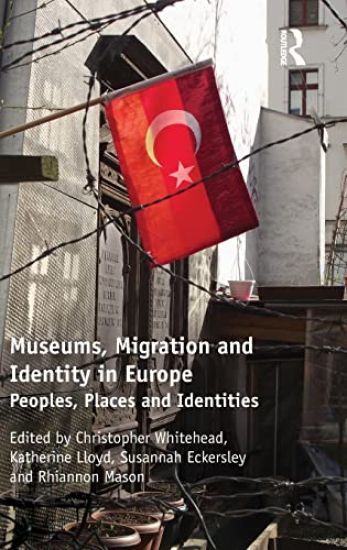
The imperatives surrounding museum representations of place have shifted from the late eighteenth century to today. The political significance of place itself has changed and continues to change at all scales, from local, civic, regional to national and supranational. At the same time, changes in population flows, migration patterns and demographic movement now underscore both cultural and political practice, be it in the accommodation of ’diversity’ in cultural and social policy, scholarly explorations of hybridity or in state immigration controls. This book investigates the historical and contemporary relationships between museums, places and identities. It brings together contributions from international scholars, academics, practitioners from museums and public institutions, policymakers, and representatives of associations and migrant communities to explore all these issues.
Museums, Migration and Identity in Europe
Christopher Whitehead; Susannah Eckersley; Katherine Lloyd; Rhiannon Mason
Routledge
2015
sidottu
The imperatives surrounding museum representations of place have shifted from the late eighteenth century to today. The political significance of place itself has changed and continues to change at all scales, from local, civic, regional to national and supranational. At the same time, changes in population flows, migration patterns and demographic movement now underscore both cultural and political practice, be it in the accommodation of ’diversity’ in cultural and social policy, scholarly explorations of hybridity or in state immigration controls. This book investigates the historical and contemporary relationships between museums, places and identities. It brings together contributions from international scholars, academics, practitioners from museums and public institutions, policymakers, and representatives of associations and migrant communities to explore all these issues.
In this pioneering book, Christopher Whitehead provides an overview and critique of art interpretation practices in museums and galleries. Covering the philosophy and sociology of art, traditions in art history and art display, the psychology of the aesthetic experience and ideas about learning and communication, Whitehead advances major theoretical frameworks for understanding interpretation from curators’ and visitors’ perspectives. Although not a manual, the book is deeply practical. It presents extensively researched European and North American case studies involving interviews with professionals engaged in significant cutting-edge interpretation projects. Finally, it sets out the ethical and political responsibilities of institutions and professionals engaged in art interpretation.Exploring the theoretical and practical dimensions of art interpretation in accessible language, this book covers: The construction of art by museums and galleries, in the form of collections, displays, exhibition and discourse; The historical and political dimensions of art interpretation; The functioning of narrative, categories and chronologies in art displays; Practices, discourses and problems surrounding the interpretation of historical and contemporary art; Visitor experiences and questions of authorship and accessibility; The role of exhibition texts, new interpretive technologies and live interpretation in art museum and gallery contexts.Thoroughly researched with immediately practical applications, Interpreting Art in Museums and Galleries will inform the practices of art curators and those studying the subject.
Museums and the Construction of Disciplines
Christopher Whitehead
Bristol Classical Press
2009
nidottu
Museums and museum politics were important elements in the development of the disciplines of Archaeology and Art History in nineteenth-century Britain. Here Christopher Whitehead explores some of the key debates and events which led to the conceptual differentiation and physical separation of 'archaeological' and 'artistic' material culture, looking especially at the ways in which objects and histories were contested within museum politics. For example, in the 1850s, the status of Egyptian antiquities as 'art' or 'archaeology' was keenly debated, and this related closely to questions about which kinds of museum should house them and the possible histories and epistemologies in which they might figure. This concise study serves as a basis for a discussion of the continued intellectual legacy of this for our understanding, management and presentation of the past in the museum and in curricula. It is argued that by understanding the politics and circumstances through which the two disciplines were delimited and distinguished from one another we may be able to glimpse, retrospectively, the possibility of alternative art histories and alternative archaeologies.
The Public Art Museum in Nineteenth Century Britain
Christopher Whitehead
Ashgate Publishing Limited
2005
sidottu
During the mid-nineteenth century a debate arose over the form and functions of the public art museum in Britain. Various occurrences caused new debates in Parliament and in the press about the purposes of the public museum which checked the relative complacency with which London's national collections had hitherto been run. This book examines these debates and their influence on the development of professionalism within the museum, trends in collecting and tendencies in museum architecture and decoration. In so doing it accounts for the general development of the London museums between 1850 and 1880, with particular reference to the National Gallery. This involves analysis of art display and its relations with art historiography, alongside institutional and architectural developments at the British Museum, the South Kensington Museum and the National Gallery. It is argued that the underpinning factor in all of these developments was a reformulation of the public museum's mission, which was in turn related to the electoral reform movement. In a potential situation of mass enfranchisement, the 'masses' should be well educated; the museum was openly identified as a useful institution in this sense. This consideration also influenced approaches to collecting and arranging artworks and to configuring their architectural setting within the museum, allowing for displays to be instructive in specific ways. Dissatisfaction with the British Museum and National Gallery buildings and their locations led to proposals to move the national collections, possibly merging and redefining them. Again the socio-political usefulness of the museum was key in determining where the national collections should be housed and in what form of building. This rich debate is analysed with full references to the various forums in and out of Parliament. Part one covers these issues in a thematic structure, examining all of the national collections, their interrelationships and their gradual development of discrete (yet sometimes arbitrary) museological territories. Part two focuses on the individual case of the National Gallery, observing how museological debate was brought to bear on the development of a specific institution. Every architectural development and redisplay is closely analysed in order to gauge the extent to which the products of debate were carried through into practice, and to comprehend the reasons why no museological grand project emerged in London.