Kirjojen hintavertailu. Mukana 12 595 353 kirjaa ja 12 kauppaa.

Kirjailija

Claire Colebrook

Kirjat ja teokset yhdessä paikassa: 30 kirjaa, julkaisuja vuosilta 2001-2024, suosituimpien joukossa Gender. Vertaile teosten hintoja ja tarkista saatavuus suomalaisista kirjakaupoista.

30 kirjaa

Kirjojen julkaisuhaarukka 2001-2024.

Gender

Gender

Claire Colebrook

Red Globe Press
2003
sidottu
Why has Western thought been so persistent in its organisation of human bodies, and other categories, in terms of the binary opposition male and female? Is gender nothing more than an ideology, or does it have its basis in sexual difference? This invaluable introductory guide offers a clear overview of the concept, and problem, of gender. Claire Colebrook places the term in its historical contexts and traces its development from the Enlightenment to the present, before moving on to the evolution of the concept of gender from within the various stances of feminist criticism, and exploring recent developments in queer theory and post-feminism. Close analysis of key literary texts, including Frankenstein, Paradise Lost and A Midsummer Night's Dream, shows how specific styles of literature enable reflection on gender.
Gender

Gender

Claire Colebrook

Red Globe Press
2003
nidottu
Why has Western thought been so persistent in its organisation of human bodies, and other categories, in terms of the binary opposition male and female? Is gender nothing more than an ideology, or does it have its basis in sexual difference? This invaluable introductory guide offers a clear overview of the concept, and problem, of gender. Claire Colebrook places the term in its historical contexts and traces its development from the Enlightenment to the present, before moving on to the evolution of the concept of gender from within the various stances of feminist criticism, and exploring recent developments in queer theory and post-feminism. Close analysis of key literary texts, including Frankenstein, Paradise Lost and A Midsummer Night's Dream, shows how specific styles of literature enable reflection on gender.

Who Would You Kill to Save the World?

Who Would You Kill to Save the World?

Claire Colebrook

University of Nebraska Press
2023
pokkari
Winner of the 2024 Hugh J. Silverman Book PrizeWho Would You Kill to Save the World? examines how postapocalyptic cinema uses images from the past and present to depict what it means to preserve the world-and who is left out of the narrative of rebuilding society. Claire Colebrook redefines “the world” as affluent Western society and “saving the world” as preventing us from becoming the othered them who are viewed in their suffering. Colebrook further examines how the use of postapocalyptic cinema is a humanist-Western, capitalist, colonizing, white, heteronormative, and individualist-creation and challenges the notion that a world built on foundations of exploitation is worth saving. Colebrook combines postapocalyptic fiction, concern over the global climate crisis, colonialism, and anti-Blackness to explain how contemporary postapocalypse blockbusters circulate ideas of whiteness and the right of the privileged to rebuild the world. Who Would You Kill to Save the World? is a provocative addition to the field of extinction studies and challenges the conceptual frames we use to define ourselves.
Understanding Deleuze

Understanding Deleuze

Claire Colebrook

Routledge
2021
sidottu
A genuine attempt to think differently, Gilles Deleuze's work challenges, provokes and frustrates. Surprisingly practical as well as innovative, it is now being seen as a 'must read' for students and scholars across the humanities and social sciences. Claire Colebrook's Understanding Deleuze offers a comprehensive and very accessible introduction to his work. hink differently. It is built on the notion of an immanent ethics: how can we have a political and ethical theory without some external foundation such as the subject or morality? He argues that the only way we can do this is with a theory of the virtual, and he sees all life (not just cyberculture) as virtual. Deleuze goes further than Foucault or Derrida in questioning the boundaries of the subject and knowledge. For Deleuze perception extends beyond the human, to animals, machines and microorganisms.Deleuze's writing is challenging and hard to read, and so far there is no introduction to his work. Claire Colebrook's primer offers an accessible introduction to the whole Deleuzian oeuvre, including the work he did with Guattari.
Agamben

Agamben

Claire Colebrook; Jason Maxwell

Polity Press
2015
sidottu
Until recently, "continental" philosophy has been tied either to the German tradition of phenomenology or to French post-structuralist concerns with the conditions of language and textuality. Giorgio Agamben draws upon and departs from both these lines of thought by directing his entire corpus to the problem of life - political life, human life, animal life, and the life of art. Influenced by the work of Martin Heidegger, Walter Benjamin, and the broader tradition of critical Marxism, Agamben's work poses the profound question for our time - just how exceptional are human beings? This beautifully written book provides a systematic, engaging overview of Agamben's writings on theology, aesthetics, political theory, and sovereignty. Covering the full range of Agamben's work to date, Claire Colebrook and Jason Maxwell explain Agamben's theology and philosophy by referring the concepts to some of today's most urgent political and ethical problems. They focus on the audacious way in which Agamben reconceptualizes life itself. Assessing the significance of the concepts key to his work, such as biopolitics, sovereignty, the "state of exception," and "bare life," they demonstrate his wide-ranging influence across the humanities.
Agamben

Agamben

Claire Colebrook; Jason Maxwell

Polity Press
2015
nidottu
Until recently, "continental" philosophy has been tied either to the German tradition of phenomenology or to French post-structuralist concerns with the conditions of language and textuality. Giorgio Agamben draws upon and departs from both these lines of thought by directing his entire corpus to the problem of life - political life, human life, animal life, and the life of art. Influenced by the work of Martin Heidegger, Walter Benjamin, and the broader tradition of critical Marxism, Agamben's work poses the profound question for our time - just how exceptional are human beings? This beautifully written book provides a systematic, engaging overview of Agamben's writings on theology, aesthetics, political theory, and sovereignty. Covering the full range of Agamben's work to date, Claire Colebrook and Jason Maxwell explain Agamben's theology and philosophy by referring the concepts to some of today's most urgent political and ethical problems. They focus on the audacious way in which Agamben reconceptualizes life itself. Assessing the significance of the concepts key to his work, such as biopolitics, sovereignty, the "state of exception," and "bare life," they demonstrate his wide-ranging influence across the humanities.
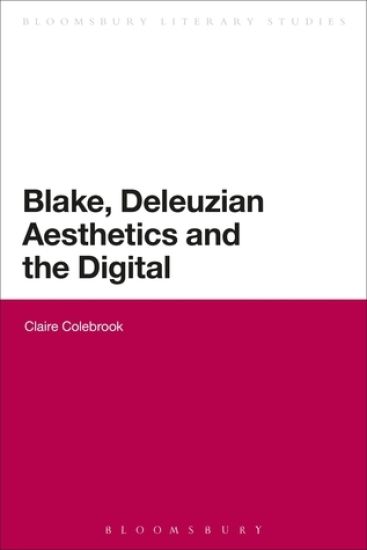
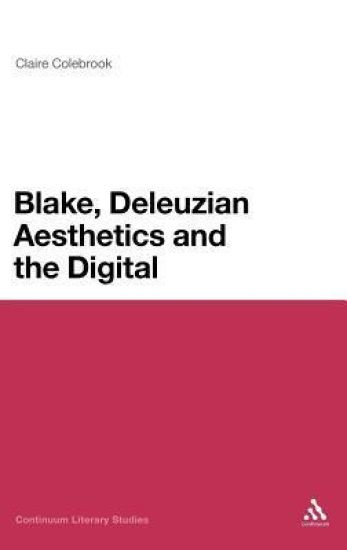
Blake, Deleuzian Aesthetics, and the Digital

Blake, Deleuzian Aesthetics, and the Digital

Claire Colebrook

Bloomsbury Academic
2013
nidottu
Drawing on recent theories of digital media and on the materiality of words and images, this fascinating study makes three original claims about the work of William Blake. First, Blake offers a critique of digital media. His poetry and method of illuminated printing is directed towards uncovering an analogical language. Second, Blake's work can be read as a performative. Finally, Blake's work is at one and the same time immanent and transcendent, aiming to return all forms of divinity and the sacred to the human imagination, stressing that 'all deities reside in the human breast,' but it also stresses that the human has powers or potentials that transcend experience and judgement: deities reside in the human breast. These three claims are explored through the concept of incarnation: the incarnation of ideas in words and images, the incarnation of words in material books and their copies, the incarnation of human actions and events in bodies, and the incarnation of spirit in matter.
Blake, Deleuzian Aesthetics, and the Digital

Blake, Deleuzian Aesthetics, and the Digital

Claire Colebrook

Continuum Publishing Corporation
2012
sidottu
This is an exploration of new aspects of Blake's work using the concept of incarnation and drawing on theories of contemporary digital media. Drawing on recent theories of digital media and on the materiality of words and images, this fascinating study makes three original claims about the work of William Blake. First, Blake offers a critique of digital media. His poetry and method of illuminated printing is directed towards uncovering an analogical language. Second, Blake's work can be read as a performative. Finally, Blake's work is at one and the same time immanent and transcendent, aiming to return all forms of divinity and the sacred to the human imagination, stressing that 'all deities reside in the human breast,' but it also stresses that the human has powers or potentials that transcend experience and judgement: deities reside in the human breast. These three claims are explored through the concept of incarnation: the incarnation of ideas in words and images, the incarnation of words in material books and their copies, the incarnation of human actions and events in bodies, and the incarnation of spirit in matter.
Deleuze and the Meaning of Life

Deleuze and the Meaning of Life

Claire Colebrook

Continuum Publishing Corporation
2011
nidottu
The intensification of interest in Deleuze over the last decade has coincided with the end of the linguistic paradigm in both continental and analytic philosophy. Indeed, the division between the two traditions appears to be closing and the philosophy of Gilles Deleuze seems to be crucial to this convergence, as he is both indebted to the phenomenological tradition at the same time as he operates with concepts drawn from the sciences. Claire Colebrook explores these ideas and offers a new and alternative assessment of Deleuze's contribution to philosophy. She argues that while Deleuze does draw upon sciences that explain the emergence of language, art and philosophy, his own thought is distinguished by a discontinuist thesis: systems may emerge from tendencies of life but always have the capacity to operate without reference to their original aim. Colebrook makes new claims regarding how Deleuze's philosophy might be used to read contemporary art and thus offers an original and crucial contribution to the Deleuzian debate.
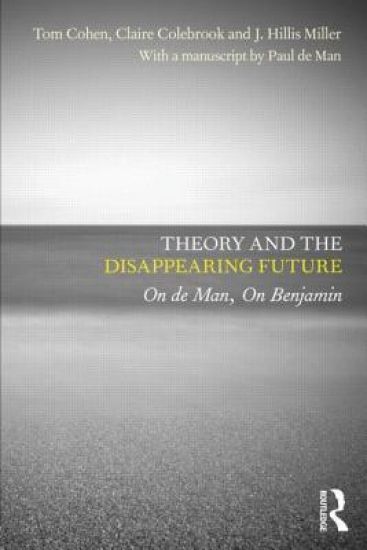
Theory and the Disappearing Future

Theory and the Disappearing Future

Tom Cohen; Claire Colebrook; J. Hillis Miller; with a manuscript by Paul de Man

Routledge
2011
sidottu
Paul de Man is often associated with an era of ‘high theory’, an era it is argued may now be coming to a close. This book, written by three leading contemporary scholars, includes both a transcript and facsimile print of a previously unpublished text by de Man of his handwritten notes for a lecture on Walter Benjamin. Challenging and relevant, this volume presents de Man’s work as a critical resource for dealing with the most important questions of the twenty-first century and argues for the place of theory within it.The humanities are flooded with crises of globalism, capitalism and terrorism, contemporary narratives of financial collapse, viral annihilation, species extinction, environmental disaster and terrorist destruction. Cohen, Colebrook and Miller draw out the implications of these crises and their narratives and, reflecting on this work by de Man, explore the limits of political thinking, of historical retrieval and the ethics of archives and cultural memory.
Theory and the Disappearing Future

Theory and the Disappearing Future

Tom Cohen; Claire Colebrook; J. Hillis Miller; with a manuscript by Paul de Man

Routledge
2011
nidottu
Paul de Man is often associated with an era of ‘high theory’, an era it is argued may now be coming to a close. This book, written by three leading contemporary scholars, includes both a transcript and facsimile print of a previously unpublished text by de Man of his handwritten notes for a lecture on Walter Benjamin. Challenging and relevant, this volume presents de Man’s work as a critical resource for dealing with the most important questions of the twenty-first century and argues for the place of theory within it.The humanities are flooded with crises of globalism, capitalism and terrorism, contemporary narratives of financial collapse, viral annihilation, species extinction, environmental disaster and terrorist destruction. Cohen, Colebrook and Miller draw out the implications of these crises and their narratives and, reflecting on this work by de Man, explore the limits of political thinking, of historical retrieval and the ethics of archives and cultural memory.
Milton, Evil and Literary History

Milton, Evil and Literary History

Claire Colebrook

Continuum Publishing Corporation
2010
nidottu
This title uses reading of Milton, in particular "Paradise Lost", to raise wider questions about current theories of literary history. Using the work of John Milton and his conflict between good and evil, Claire Colebrook shows exactly how we read literary history according to quite specific images of growth, development, progression, flourishing and succession. Colebrook illustrates not only how goodness is aligned with images of a life of expansion, creation, production and fruition, while evil is associated with the inert, non-relational, static and stagnant, but how these associations have also underpinned a distinction between good and evil notions of capitalism. Informed by an expansive corpus of philosophical texts, including Kant, Aristotle, Deleuze and Derrida, Colebrook's study presents a new, surprising, theory of literary history and makes a significant contribution to Milton studies.
Gilles Deleuze : en introduktion

Gilles Deleuze : en introduktion

Claire Colebrook

Bokförlaget Korpen
2010
nidottu
Vilka är egentligen begränsningarna i våra vanliga sätt att tänka? På vilka sätt hindrar vi våra tankar från att utvecklas och få eget liv? Gilles Deleuzes filosofi är ett försök att tänka radikalt annorlunda. Han gjorde till sin uppgift att utmana, provocera och tvinga vårt tänkande till att välja nya, outforskade vägar. Det arbetet resulterade i några av de senaste decenniernas mest uppskattade och omdiskuterade texter. Människor världen över har låtit sig influeras och inspireras av Deleuzes syn på skillnad som den grundläggande kraften i allt liv och hans betoning på processer av förändring och blivande istället för färdiga identiteter. Den här boken är en imponerande lättillgänglig genomgång av centrala idéer i Gilles Deleuzes tankevärld. Claire Colebrook redogör tydligt för hur Deleuze avvek från tidigare idéströmningar, och ger konkreta exempel på några av de nya förhållningssätt till politik, vetenskap och konst som hans texter har givit upphov till. Claire Colebrook bor och skriver på State College Pennsylvania i USA. Hon har skrivit böcker om ett flertal olika ämnen, från genus- och filmvetenskap till litteraturhistoria och poesi. Hon är professor på Penn State University.
Deleuze and the Meaning of Life

Deleuze and the Meaning of Life

Claire Colebrook

BLOOMSBURY PUBLISHING PLC
2010
sidottu
This is a new and original monograph from a leading Deleuzian scholar exploring the central issues of life, science, language and art in Deleuze's work. The intensification of interest in Deleuze over the last decade has coincided with the end of the linguistic paradigm in both continental and analytic philosophy. Indeed, the division between the two traditions appears to be closing and the philosophy of Gilles Deleuze seems to be crucial to this convergence, as he is both indebted to the phenomenological tradition at the same time as he operates with concepts drawn from the sciences.Claire Colebrook explores these ideas and offers a new and alternative assessment of Deleuze's contribution to philosophy. She argues that while Deleuze does draw upon sciences that explain the emergence of language, art and philosophy, his own thought is distinguished by a discontinuist thesis: systems may emerge from tendencies of life but always have the capacity to operate without reference to their original aim. Colebrook makes new claims regarding how Deleuze's philosophy might be used to read contemporary art and thus offers an original and crucial contribution to the Deleuzian debate.
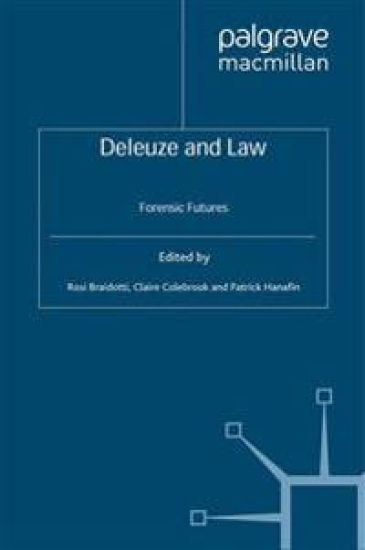
Deleuze and Law

Deleuze and Law

Rosi Braidotti; Claire Colebrook; Patrick Hanafin

Palgrave Macmillan
2009
sidottu
Drawing upon and extending the theoretical insights of Deleuze, Foucault and Agamben, this volume considers the concept of life as it operates in law, politics and contemporary culture. It focuses on key legal cases (such as the Terri Schiavo case in the US), political events (such as the post 9/11 internment camp) and new cultural phenomena.
Deleuze and Law

Deleuze and Law

Rosi Braidotti; Claire Colebrook; Patrick Hanafin

Palgrave Macmillan
2009
nidottu
Drawing upon and extending the theoretical insights of Deleuze, Foucault and Agamben, this volume considers the concept of life as it operates in law, politics and contemporary culture. It focuses on key legal cases (such as the Terri Schiavo case in the US), political events (such as the post 9/11 internment camp) and new cultural phenomena.