Kirjojen hintavertailu. Mukana 12 595 353 kirjaa ja 12 kauppaa.
Kirjailija
Clarence Jordan
Kirjat ja teokset yhdessä paikassa: 14 kirjaa, julkaisuja vuosilta 2005-2026, suosituimpien joukossa Bread and Wine. Vertaile teosten hintoja ja tarkista saatavuus suomalaisista kirjakaupoista.
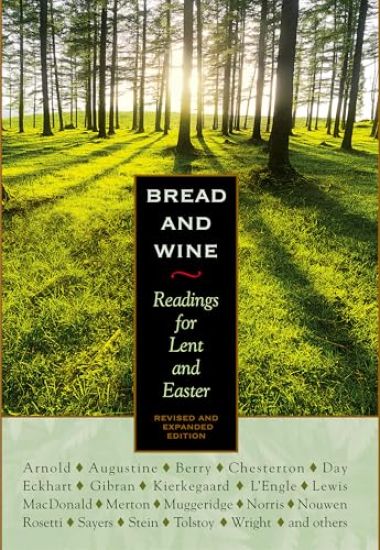
Easter is the high point of the year for millions of Christians around the world. And for most of them, there can be no Easter without Lent, the season that leads up to it. A time for self-denial, soul-searching, and spiritual preparation, Lent makes time for daily reading and reflection. This time-tested collection of devotions will deepen and stretch your faith, and can be returned to year after year. Culled from the wealth of twenty centuries, the selections are ecumenical in scope, representing the best classic and contemporary Christian writers. This expanded second edition adds dozens of voices, new and old, and takes the reader all the way through Eastertide to Pentecost. Includes ninety-six Lenten and Easter readings, plus seven chapter-opening poems, by Eberhard Arnold, Saint Augustine, Wendell Berry, Christoph Friedrich Blumhardt, Dietrich Bonhoeffer, G. K. Chesterton, Dorothy Day, Meister Eckhart, Khalil Gibran, Clarence Jordan, Soren Kierkegaard, Madeleine L'Engle, C. S. Lewis, George MacDonald, Thomas Merton, Malcolm Muggeridge, Kathleen Norris, Henri Nouwen, Christina Rosetti, Fleming Rutledge, Dorothy Sayers, Edith Stein, Mother Teresa, Leo Tolstoy, N. T. Wright, Alfred Kazin, Amy Carmichael, Barbara Brown Taylor, Barbara Cawthorne Crafton, Blaise Pascal, Brennan Manning, Dag Hammarskjöld, Dorothee Soelle, Dylan Thomas, E. Stanley Jones, Emil Brunner, Frederick Buechner, Fyodor Dostoevsky, Geoffrey Hill, Henry Drummond, J. Heinrich Arnold, Jean-Pierre de Caussade, Johann Christoph Arnold, John Dear, John Donne, John Masefield, John Stott, John Updike, Jürgen Moltmann, Karl Barth, Madeleine L’Engle, Martin Luther, Oscar Wilde, Oswald Chambers, Paul Tillich, Peter Kreeft, Philip Berrigan, Philip Yancey, Romano Guardini, Sadhu Sundar Singh , Saint Augustine, Simone Weil, Thomas à Kempis, Toyohiko Kagawa, Walter J. Ciszek, Walter Wangerin, Watchman Nee, William Willimon and others.

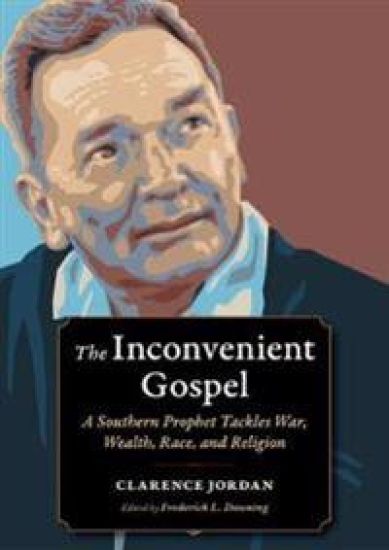
“Clarence Jordan spoke with an unwavering prophetic voice. He firmly rejected materialism, militarism, and racism as obstacles to authentic faith… He was a fearless and innovative defender of human rights.” —President Jimmy CarterOn 440 depleted acres in Sumter County, Georgia, a young Baptist preacher and farmer named Clarence Jordan gathered a few families and set out to show that Jesus intended more than spiritual fellowship. Like the first Christians, they would share their land, money, and possessions. Working together to rejuvenate the soil and the local economy, they would demonstrate racial and social justice with their lives.Black and white community members eating together at the same table scandalized local Christians, drew the ire of the KKK, and led to drive-by shootings, a firebombing, and an economic boycott.This bold experiment in nonviolence, economic justice, and sustainable agriculture was deeply rooted in Clarence Jordan’s understanding of the person and teachings of Jesus, which stood in stark contrast to the hypocrisy of churches that blessed wars, justified wealth disparity, and enforced racial segregation. “You can’t put Christianity into practice,” Jordan wrote, “You can’t make it work. As desperately as it is needed in this poor, broken world, it is not a philosophy of life to be ‘tried.’ Nor is it a social or ethical ideal which has tantalized humankind with the possibility of attainment. For Christianity is not a system you work – it is a Person who works you.”This selection from his talks and writings introduces Clarence Jordan’s radically biblical vision to a new generation of peacemakers, community builders, and activists.
WHO IS GOD? GOD is the FATHER. GOD is the SON. GOD is the HOLY GHOST. GOD is self-existing in three divine persons but united in one Godhead. GOD is from everlasting to everlasting. None came before Him and none will come after Him. GOD is Alpha and Omega; the beginning and the ending. GOD is simultaneously the past, present, and future. GOD is Omnipotent, Omniscient, and Omnipresent. "Blessed Trinity" shares with the reader-whether a new believer, seasoned believer, or non-believer in Christ-the truth about GOD'S unconditional love for ALL. We are the apple of His eye From the First Adam and how his sin in the Garden of Eden affected the entire human race to the "HERO" we now have in the Only Begotten Son Jesus Christ-the One who came to save us from the certainty of death because of our sins-"Blessed Trinity" gets to the "meat of the matter" by chronicling both Old and New Testament biblical events that prove: GOD IS THE SAME YESTERDAY, TODAY, AND FOREVER
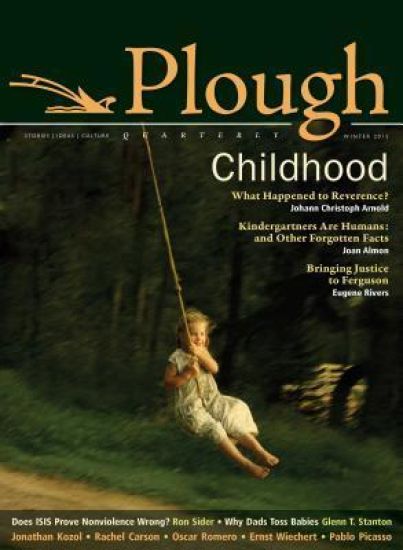
Jonathan Kozol; Glenn T. Stanton; Johann Christoph Arnold; Rachel Carson; Ron Sider; Oscar Romero; Joan Almon; Robert Lasalle-Klein; Clarence Jordan; Eugene Rivers; Ernst Wiechert; Friedrich Froebel
In this issue, we explore why children and childhood are at the heart of the gospel – and of God’s plan for restoring the world. Hear from Johann Christoph Arnold on “Discovering Reverence,” Joan Almon on “Kindergartners Are Humans,” and Glen Stanton on “Why Dads Toss Babies.” A surgeon shares what he’s learned from children with disabilities, while dispatches from Ferguson, Missouri, the US–Mexico border, and the South Bronx focus on places where childhood is especially threatened. Other contributors examine public, homeschool, and Christian education; highlight the role of fathers; and grapple with Jesus’ uncomfortable version of family values. Bold, hope-filled, and down-to-earth, Plough Quarterly features thought-provoking articles, commentary, interviews, short fiction, book reviews, poetry and artwork to inspire everyday faith and action. Each issue brings together essential voices from many traditions to give you fresh insights on a core theme such as peacemaking, biblical justice, children and family, building community, man and woman, nature and the environment, nonviolence, or simple living. Starting from the conviction that the teachings and example of Jesus can transform and renew our world, it aims to apply them to all aspects of life, seeking common ground with all people of goodwill regardless of creed.
The Cotton Patch Gospel recasts the stories of Jesus and the letters of Paul and Peter into the language of the mid-20th century South. Born out of the Civil Rights struggle, these now classic translations of much of the New Testament bring the far-away places of Scipture closer to home: Gainesville, Selma, Birmingham, Atlanta, Washington, D.C.As Jordan once wrote, "While there have been many excellent translations of the Scriptures into modern English, they still have left us stranded in the long-distant past. We need to have the good news come to us not only in our own tongue but in our own time. We want to be participants in the faith, not merely spectators."
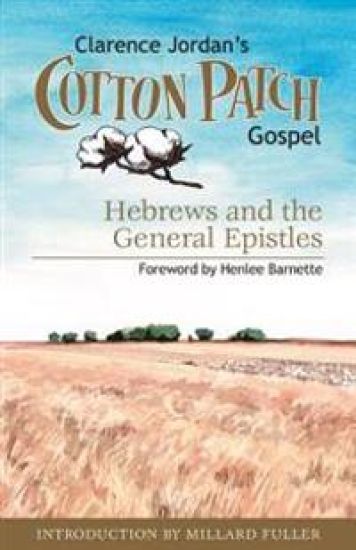
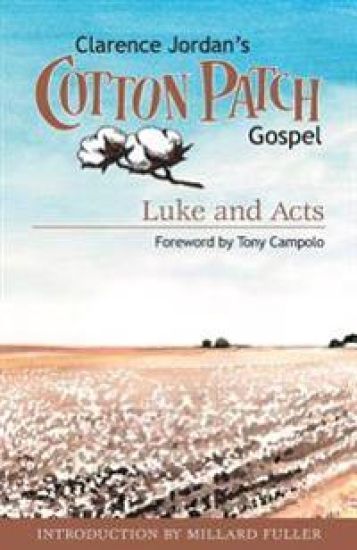
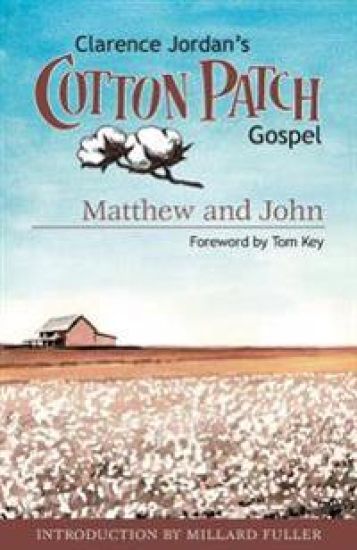
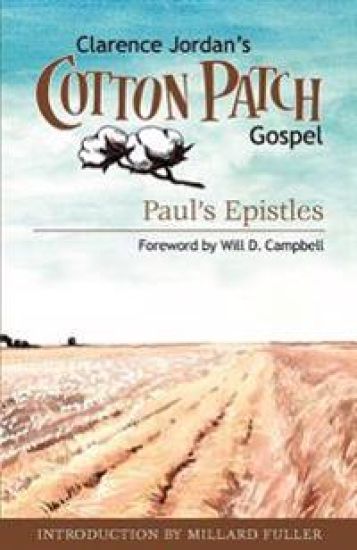
The Cotton Patch Gospel, by Koinonia Farm founder Clarence Jordan, recasts the stories of Jesus and the letters of Paul and Peter into the language and culture of the mid-20th century South. Born out of the Civil Rights struggle, these now classic translations of much of the New Testament bring the far-away places of Scripture closer to home: Gainesville, Selma, Birmingham, Atlanta, Washington, D.C. As Jordan once wrote, "While there have been many excellent translations of the Scriptures into modern English, they still have left us stranded in some faraway land in the long-distant past. We need to have the good news come to us not only in our own tongue but in our own time. We want to be participants in the faith, not merely spectators." More than a translation, The Cotton Patch Gospel continues to make clear the startling relevance of Scripture for today. These editions come complete with new Forewords and a new Introduction by Habitat for Humanity founder Millard Fuller. Smyth & Helwys Publishing is proud to help reintroduce these seminal works of Clarence Jordan to a new generation of believers.
The Cotton Patch Gospel recasts the stories of Jesus and the letters of Paul and Peter into the language of the mid-20th century South. Born out of the Civil Rights struggle, these now classic translations of much of the New Testament bring the far-away places of Scipture closer to home: Gainesville, Selma, Birmingham, Atlanta, Washington, D.C.As Jordan once wrote, "While there have been many excellent translations of the Scriptures into modern English, they still have left us stranded in the long-distant past. We need to have the good news come to us not only in our own tongue but in our own time. We want to be participants in the faith, not merely spectators."