Kirjojen hintavertailu. Mukana 12 390 323 kirjaa ja 12 kauppaa.

Kirjailija

Clark C. Gibson

Kirjat ja teokset yhdessä paikassa: 3 kirjaa, julkaisuja vuosilta 1999-2005, suosituimpien joukossa The Samaritan's Dilemma. Vertaile teosten hintoja ja tarkista saatavuus suomalaisista kirjakaupoista.

3 kirjaa

Kirjojen julkaisuhaarukka 1999-2005.

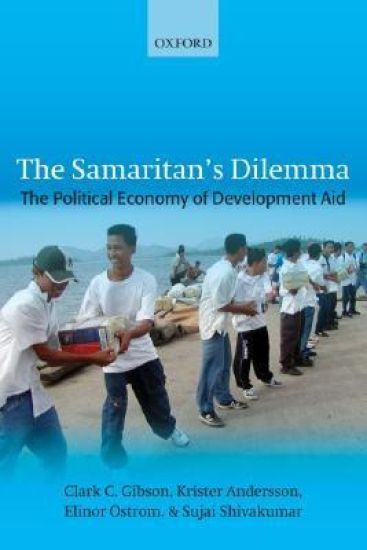
The Samaritan's Dilemma

The Samaritan's Dilemma

Clark C. Gibson; Krister Andersson; The late Elinor Ostrom; Sujai Shivakumar

Oxford University Press
2005
sidottu
What's wrong with foreign aid? Many policymakers, aid practitioners, and scholars have called into question its ability to increase economic growth, alleviate poverty, or promote social development. At the macro level, only tenuous links between development aid and improved living conditions have been found. At the micro level, only a few programs outlast donor support and even fewer appear to achieve lasting improvements. The authors of this book argue that much of aid's failure is related to the institutions that structure its delivery. These institutions govern the complex relationships between the main actors in the aid delivery system and often generate a series of perverse incentives that promote inefficient and unsustainable outcomes. In their analysis, the authors apply the theoretical insights of the new institutional economics to several settings. First, they investigate the institutions of Sida, the Swedish aid agency, to analyze how that aid agency's institutions can produce incentives inimical to desired outcomes, contrary to the desires of its own staff. Second, the authors use cases from India, a country with low aid dependence, and Zambia, a country with high aid dependence, to explore how institutions on the ground in recipient countries also mediate the effectiveness of aid. Throughout the book, the authors offer suggestions about how to improve aid's effectiveness. These suggestions include how to structure evaluations in order to improve outcomes, how to employ agency staff to gain from their on-the-ground experience, and how to engage stakeholders as "owners" in the design, resource mobilization, learning, and evaluation processes of development assistance programs.
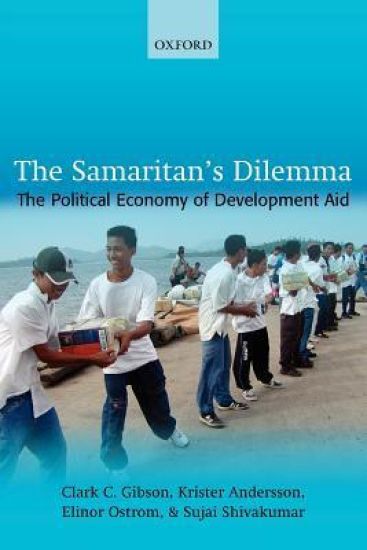
The Samaritan's Dilemma

The Samaritan's Dilemma

Clark C. Gibson; Krister Andersson; The late Elinor Ostrom; Sujai Shivakumar

Oxford University Press
2005
nidottu
What's wrong with foreign aid? Many policymakers, aid practitioners, and scholars have called into question its ability to increase economic growth, alleviate poverty, or promote social development. At the macro level, only tenuous links between development aid and improved living conditions have been found. At the micro level, only a few programs outlast donor support and even fewer appear to achieve lasting improvements. The authors of this book argue that much of aid's failure is related to the institutions that structure its delivery. These institutions govern the complex relationships between the main actors in the aid delivery system and often generate a series of perverse incentives that promote inefficient and unsustainable outcomes. In their analysis, the authors apply the theoretical insights of the new institutional economics to several settings. First, they investigate the institutions of Sida, the Swedish aid agency, to analyze how that aid agency's institutions can produce incentives inimical to desired outcomes, contrary to the desires of its own staff. Second, the authors use cases from India, a country with low aid dependence, and Zambia, a country with high aid dependence, to explore how institutions on the ground in recipient countries also mediate the effectiveness of aid. Throughout the book, the authors offer suggestions about how to improve aid's effectiveness. These suggestions include how to structure evaluations in order to improve outcomes, how to employ agency staff to gain from their on-the-ground experience, and how to engage stakeholders as "owners" in the design, resource mobilization, learning, and evaluation processes of development assistance programs.
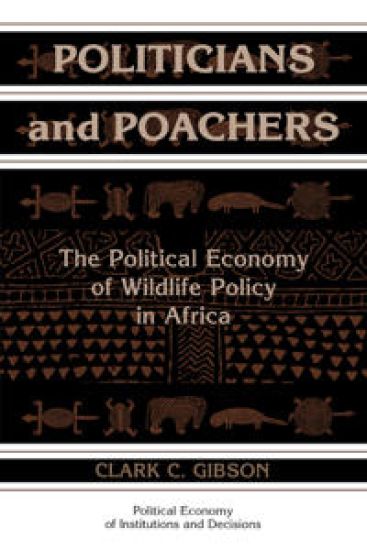
Politicians and Poachers

Politicians and Poachers

Clark C. Gibson

Cambridge University Press
1999
sidottu
Although wildlife fascinates citizens of industrialized countries, little is known about the politics of wildlife policy in Africa. In this innovative book, Clark Gibson challenges the rhetoric of television documentaries and conservation organizations to explore the politics behind the creation and change of wildlife policy in Africa. This book examines what Clark views as a central puzzle in the debate: Why do African governments create policies that apparently fail to protect wildlife? Moving beyond explanations of bureaucratic inefficiency and corrupt dictatorships, Gibson argues that biologically disastrous policies are retained because they meet the distributive goals of politicians and bureaucrats. Using evidence from Zambia, Kenya, and Zimbabwe, Gibson shows how institutions encourage politicians and bureaucrats to construct wildlife policies that further their own interests. Different configurations of electoral laws, legislatures, party structures, interest groups, and traditional authorities in each country shape the choices of policymakers - many of which are not consonant with conservation. This book will appeal to students of institutions, comparative politics, natural resource policymaking, African politics, and wildlife conservationists.