Kirjojen hintavertailu. Mukana 12 319 092 kirjaa ja 12 kauppaa.

Kirjailija

Clemens Apprich

Kirjat ja teokset yhdessä paikassa: 5 kirjaa, julkaisuja vuosilta 2017-2026, suosituimpien joukossa Errant Intelligence. Vertaile teosten hintoja ja tarkista saatavuus suomalaisista kirjakaupoista.

5 kirjaa

Kirjojen julkaisuhaarukka 2017-2026.

Errant Intelligence

Errant Intelligence

Clemens Apprich

TAYLOR FRANCIS LTD
2026
nidottu
Artificial intelligence is often framed as a quest to replicate the human brain, promising frictionless cognition and a future of seamless automation. But what if this pervasive narrative obscures a deeper, more ‘errant’ truth? Errant Intelligence challenges the prevailing biological and individualistic interpretations of machine learning, arguing instead for a radical understanding of machine intelligence. The book embraces the deviations, inconsistencies, and ‘errant behaviour’ as fundamental to the discovery of new knowledge, moving beyond the illusion of mere optimisation. Drawing on media theory, cybernetics, and a unique psychoanalytic lens, it explores the ‘technological unconscious’ of machine learning. It traces the historical roots of AI, from early automatons and the Turing machine to natural language processing and contemporary machine learning systems. Challenging the idea of an autonomous, self-generating AI, the book exposes the hidden labour, assumed logics, and inherent biases that animate its operation. It re-evaluates computational thinking, insisting on its inherently social, collective, and symbolic character, and revealing how language and logical paradoxes are not obstacles, but constitutive forces that shape intelligent machines. Errant Intelligence offers a vital new framework for understanding the profound co-evolution of human and machine learning. It’s time to ‘unlearn’ our assumptions and embrace the productive ambiguity and fallibility at the core of machine intelligence.
Errant Intelligence

Errant Intelligence

Clemens Apprich

AMSTERDAM UNIVERSITY PRESS
2026
sidottu
Artificial intelligence is often framed as a quest to replicate the human brain, promising frictionless cognition and a future of seamless automation. But what if this pervasive narrative obscures a deeper, more ‘errant’ truth? Errant Intelligence challenges the prevailing biological and individualistic interpretations of machine learning, arguing instead for a radical understanding of machine intelligence. The book embraces the deviations, inconsistencies, and ‘errant behaviour’ as fundamental to the discovery of new knowledge, moving beyond the illusion of mere optimisation. Drawing on media theory, cybernetics, and a unique psychoanalytic lens, it explores the ‘technological unconscious’ of machine learning. It traces the historical roots of AI, from early automatons and the Turing machine to natural language processing and contemporary machine learning systems. Challenging the idea of an autonomous, self-generating AI, the book exposes the hidden labour, assumed logics, and inherent biases that animate its operation. It re-evaluates computational thinking, insisting on its inherently social, collective, and symbolic character, and revealing how language and logical paradoxes are not obstacles, but constitutive forces that shape intelligent machines. Errant Intelligence offers a vital new framework for understanding the profound co-evolution of human and machine learning. It’s time to ‘unlearn’ our assumptions and embrace the productive ambiguity and fallibility at the core of machine intelligence.
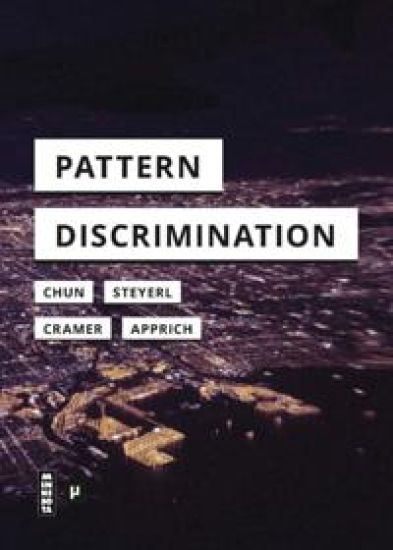
Pattern Discrimination

Pattern Discrimination

Clemens Apprich; Wendy Hui Kyong Chun; Florian Cramer; Hito Steyerl

University of Minnesota Press
2018
nidottu
How do “human” prejudices reemerge in algorithmic cultures allegedly devised to be blind to them?How do “human” prejudices reemerge in algorithmic cultures allegedly devised to be blind to them? To answer this question, this book investigates a fundamental axiom in computer science: pattern discrimination. By imposing identity on input data, in order to filter-that is, to discriminate-signals from noise, patterns become a highly political issue. Algorithmic identity politics reinstate old forms of social segregation, such as class, race, and gender, through defaults and paradigmatic assumptions about the homophilic nature of connection.Instead of providing a more “objective” basis of decision making, machine-learning algorithms deepen bias and further inscribe inequality into media. Yet pattern discrimination is an essential part of human-and nonhuman-cognition. Bringing together media thinkers and artists from the United States and Germany, this volume asks the urgent questions: How can we discriminate without being discriminatory? How can we filter information out of data without reinserting racist, sexist, and classist beliefs? How can we queer homophilic tendencies within digital cultures?
Technotopia

Technotopia

Clemens Apprich

Rowman Littlefield
2017
nidottu
Many technologies and practices that define the Internet today date back to the 1990s – such as user-generated content, participatory platforms and social media. Indeed, many early ideas about the future of the Internet have been implemented, albeit without fulfilling the envisioned political utopias. By tracing back the technotopian vision, Clemens Apprich develops a media genealogical perspecive that helps us to better understand how digital networks have transformed over the last 30 years and therefore to think beyond the current state of our socio-technical reality. This highly original book informs our understanding of new forms of media and social practices, such that have become part of our everyday culture. Apprich revisits a critical time when the Internet was not yet an everyday reality, but when its potential was already understood and fiercely debated. The historical context of net cultures provides the basis from which the author critically engages with current debates about the weal and woe of the Internet and challenges today’s predominant network model.
Technotopia

Technotopia

Clemens Apprich

Rowman Littlefield
2017
sidottu
Many technologies and practices that define the Internet today date back to the 1990s – such as user-generated content, participatory platforms and social media. Indeed, many early ideas about the future of the Internet have been implemented, albeit without fulfilling the envisioned political utopias. By tracing back the technotopian vision, Clemens Apprich develops a media genealogical perspecive that helps us to better understand how digital networks have transformed over the last 30 years and therefore to think beyond the current state of our socio-technical reality. This highly original book informs our understanding of new forms of media and social practices, such that have become part of our everyday culture. Apprich revisits a critical time when the Internet was not yet an everyday reality, but when its potential was already understood and fiercely debated. The historical context of net cultures provides the basis from which the author critically engages with current debates about the weal and woe of the Internet and challenges today’s predominant network model.