Kirjojen hintavertailu. Mukana 12 595 353 kirjaa ja 12 kauppaa.

Kirjailija

Clifford J. Cunningham

Kirjat ja teokset yhdessä paikassa: 8 kirjaa, julkaisuja vuosilta 2016-2025, suosituimpien joukossa Investigating the Origin of the Asteroids and Early Findings on Vesta. Vertaile teosten hintoja ja tarkista saatavuus suomalaisista kirjakaupoista.

8 kirjaa

Kirjojen julkaisuhaarukka 2016-2025.

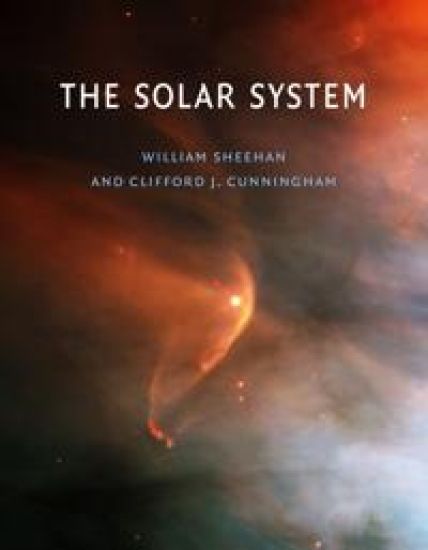
The Solar System

The Solar System

William Sheehan; Clifford J. Cunningham

REAKTION BOOKS
2025
sidottu
As recently as the dawn of the Space Age, the solar system was still largely unknown. The first probes to the Moon, Venus and Mars ushered in a golden age of planetary science, transforming planets from distant mysteries into vividly realized worlds. This book provides a comprehensive, accessible survey of the entire solar system, covering all major planets from Mercury to Saturn, the outer solar system and asteroids. It includes insights from leading scientists through in-person interviews, offering an engaging overview for general readers and amateur astronomers. Noting Earth’s small, beautiful and precarious nature, this book fills a unique niche, presenting the latest discoveries without losing sight of the broader picture, making it essential for anyone interested in our celestial neighbourhood.
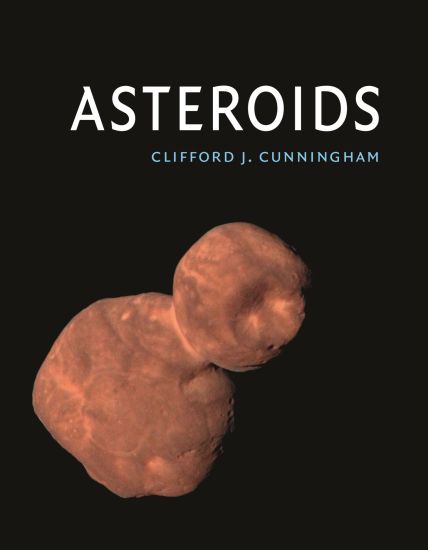
Asteroids

Asteroids

Clifford J. Cunningham

Reaktion Books
2021
sidottu
Grounded in historical studies of asteroids from the nineteenth century, Asteroids is a fully up to date view of these remarkable objects. Without resorting to any technical plots or mathematics, the author shows that asteroids are not just rocks in space, but key to understanding the life and death on Earth of both animals and humans. From space missions to the asteroids’ starring role in literature and film, Clifford J. Cunningham precisely and entertainingly looks at the place asteroids have in our solar system and how they affect our daily lives.
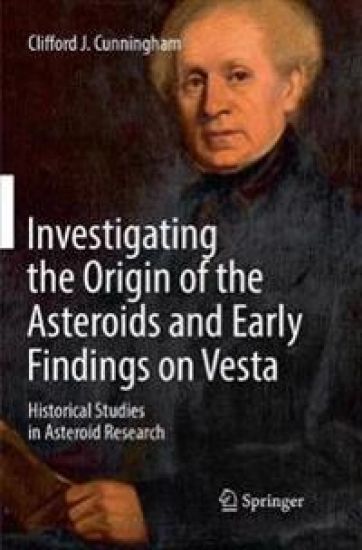
Investigating the Origin of the Asteroids and Early Findings on Vesta

Investigating the Origin of the Asteroids and Early Findings on Vesta

Clifford J. Cunningham

Springer International Publishing AG
2018
nidottu
This book assesses the origin of asteroids by analyzing the discovery of Vesta in 1807. Wilhelm Olbers, who discovered Vesta, suggested that the asteroids were the result of a primordial planet’s explosion. Cunningham studies that idea in detail through the writings of Sir David Brewster in Scotland, the era's most prolific writer about the asteroids. He also examines the link between meteorites and asteroids, revealing a synergy between Ernst Chladni, Romantic symbolism, and the music of the spheres.Vesta was a lightning rod for controversy throughout the nineteenth century with observers arguing over its size and color, and the astounding notion that it was self-luminous. It was also a major force for change, as new methods in the field of celestial mechanics were developed to study the orbital perturbations it is subject to. A large selection of private correspondence and scientific papers complete the first comprehensive historical study of Vesta ever published.With a synoptic look at the four asteroids, Ceres, Pallas, Juno and Vesta, Cunningham provides a valuable resource on asteroid origins and explains how they were integrated into the newly revealed solar system of the early nineteenth century.
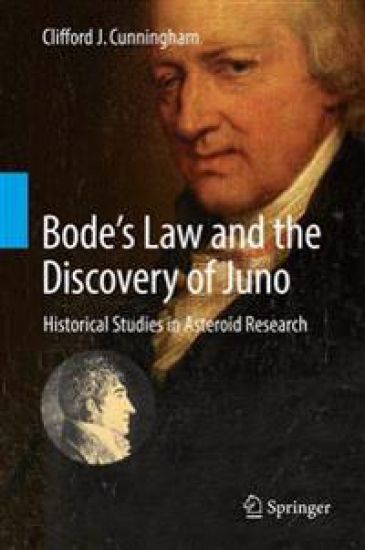
Bode’s Law and the Discovery of Juno

Bode’s Law and the Discovery of Juno

Clifford J. Cunningham

Springer International Publishing AG
2018
nidottu
Johann Bode developed a so-called law of planetary distances best known as Bode’s Law. The story of the discovery of Juno in 1804 by Karl Harding tells how Juno fit into that scheme and is examined as it relates to the philosopher Georg Hegel’s 1801 thesis that there could be no planets between Mars and Jupiter. By 1804 that gap was not only filled but had three residents: Ceres, Pallas and Juno! When Juno was discovered no one could have imagined its study would call into question Newton’s law of gravity, or be the impetus for developing the mathematics of the fast Fourier transform by Carl Gauss. Clifford Cunningham, a dedicated scholar, opens to scrutiny this critical moment of astronomical discovery, continuing the story of asteroid begun in earlier volumes of this series. The fascinating issues raised by the discovery of Juno take us on an extraordinary journey. The revelation of the existence of this new class of celestial bodiestransformed our understanding of the Solar System, the implications of which are thoroughly discussed in terms of Romantic Era science, philosophy, poetry, mathematics and astronomy. The account given here is based on both English and foreign correspondence and scientific papers, most of which are translated for the first time.
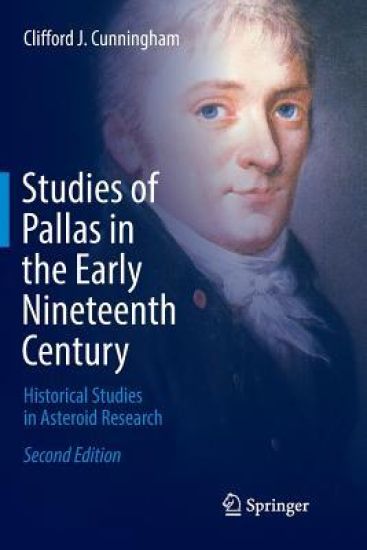
Studies of Pallas in the Early Nineteenth Century

Studies of Pallas in the Early Nineteenth Century

Clifford J. Cunningham

Springer International Publishing AG
2018
nidottu
Based on extensive primary sources, many never previously translated into English, this is the definitive account of the discovery of Pallas as it went from being classified as a new planet to reclassification as the second of a previously unknown group of celestial objects. Cunningham, a dedicated scholar of asteroids, includes a large set of newly translated correspondence as well as the many scientific papers about Pallas in addition to sections of Schroeter's 1805 book on the subject.It was Olbers who discovered Pallas, in 1802, the second of many asteroids that would be officially identified as such. From the Gold Medal offered by the Paris Academy to solve the mystery of Pallas' gravitational perturbations to Gauss' Pallas Anagram, the asteroid remained a lingering mystery to leading thinkers of the time. Representing an intersection of science, mathematics, and philosophy, the puzzle of Pallas occupied the thoughts of an amazing panorama of intellectual giants in Europe in the early 1800s.
Investigating the Origin of the Asteroids and Early Findings on Vesta

Investigating the Origin of the Asteroids and Early Findings on Vesta

Clifford J. Cunningham

Springer International Publishing AG
2017
sidottu
This book assesses the origin of asteroids by analyzing the discovery of Vesta in 1807. Wilhelm Olbers, who discovered Vesta, suggested that the asteroids were the result of a primordial planet’s explosion. Cunningham studies that idea in detail through the writings of Sir David Brewster in Scotland, the era's most prolific writer about the asteroids. He also examines the link between meteorites and asteroids, revealing a synergy between Ernst Chladni, Romantic symbolism, and the music of the spheres.Vesta was a lightning rod for controversy throughout the nineteenth century with observers arguing over its size and color, and the astounding notion that it was self-luminous. It was also a major force for change, as new methods in the field of celestial mechanics were developed to study the orbital perturbations it is subject to. A large selection of private correspondence and scientific papers complete the first comprehensive historical study of Vesta ever published.With a synoptic look at the four asteroids, Ceres, Pallas, Juno and Vesta, Cunningham provides a valuable resource on asteroid origins and explains how they were integrated into the newly revealed solar system of the early nineteenth century.
Bode’s Law and the Discovery of Juno

Bode’s Law and the Discovery of Juno

Clifford J. Cunningham

Springer International Publishing AG
2017
sidottu
Johann Bode developed a so-called law of planetary distances best known as Bode’s Law. The story of the discovery of Juno in 1804 by Karl Harding tells how Juno fit into that scheme and is examined as it relates to the philosopher Georg Hegel’s 1801 thesis that there could be no planets between Mars and Jupiter. By 1804 that gap was not only filled but had three residents: Ceres, Pallas and Juno! When Juno was discovered no one could have imagined its study would call into question Newton’s law of gravity, or be the impetus for developing the mathematics of the fast Fourier transform by Carl Gauss. Clifford Cunningham, a dedicated scholar, opens to scrutiny this critical moment of astronomical discovery, continuing the story of asteroid begun in earlier volumes of this series. The fascinating issues raised by the discovery of Juno take us on an extraordinary journey. The revelation of the existence of this new class of celestial bodiestransformed our understanding of the Solar System, the implications of which are thoroughly discussed in terms of Romantic Era science, philosophy, poetry, mathematics and astronomy. The account given here is based on both English and foreign correspondence and scientific papers, most of which are translated for the first time.
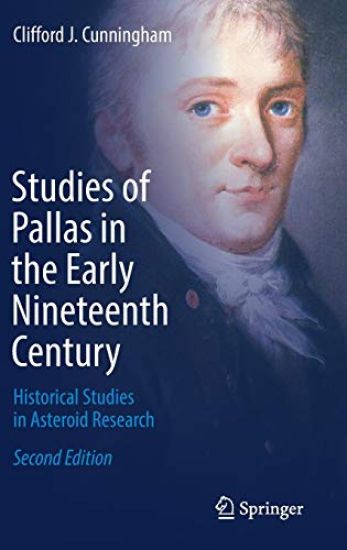
Studies of Pallas in the Early Nineteenth Century

Studies of Pallas in the Early Nineteenth Century

Clifford J. Cunningham

Springer International Publishing AG
2016
sidottu
Based on extensive primary sources, many never previously translated into English, this is the definitive account of the discovery of Pallas as it went from being classified as a new planet to reclassification as the second of a previously unknown group of celestial objects. Cunningham, a dedicated scholar of asteroids, includes a large set of newly translated correspondence as well as the many scientific papers about Pallas in addition to sections of Schroeter's 1805 book on the subject.It was Olbers who discovered Pallas, in 1802, the second of many asteroids that would be officially identified as such. From the Gold Medal offered by the Paris Academy to solve the mystery of Pallas' gravitational perturbations to Gauss' Pallas Anagram, the asteroid remained a lingering mystery to leading thinkers of the time. Representing an intersection of science, mathematics, and philosophy, the puzzle of Pallas occupied the thoughts of an amazing panorama of intellectual giants in Europe in the early 1800s.