Kirjojen hintavertailu. Mukana 12 390 323 kirjaa ja 12 kauppaa.

Kirjailija

Clive Barnett

Kirjat ja teokset yhdessä paikassa: 5 kirjaa, julkaisuja vuosilta 2003-2017, suosituimpien joukossa Globalizing Responsibility. Vertaile teosten hintoja ja tarkista saatavuus suomalaisista kirjakaupoista.

5 kirjaa

Kirjojen julkaisuhaarukka 2003-2017.

The Priority of Injustice

The Priority of Injustice

Clive Barnett

University of Georgia Press
2017
sidottu
This original and ambitious work looks anew at a series of intellectual debates about the meaning of democracy. Clive Barnett engages with key thinkers in various traditions of democratic theory and demonstrates the importance of a geographical imagination in interpreting contemporary political change.Debates about radical democracy, Barnett argues, have become trapped around a set of oppositions between deliberative and agonistic theories—contrasting thinkers who promote the possibility of rational agreement and those who seek to unmask the role of power or violence or difference in shaping human affairs. While these debates are often framed in terms of consensus versus contestation, Barnett unpacks the assumptions about space and time that underlie different understandings of the sources of political conflict and shows how these differences reflect deeper philosophical commitments to theories of creative action or revived ontologies of “the political.” Rather than developing ideal theories of democracy or models of proper politics, he argues that attention should turn toward the practices of claims-making through which political movements express experiences of injustice and make demands for recognition, redress, and re pair. By rethinking the spatial grammar of discussions of public space, democratic inclusion, and globalization, Barnett develops a conceptual framework for analyzing the crucial roles played by geographical processes in generating and processing contentious politics.
The Priority of Injustice

The Priority of Injustice

Clive Barnett

University of Georgia Press
2017
pokkari
This original and ambitious work looks anew at a series of intellectual debates about the meaning of democracy. Clive Barnett engages with key thinkers in various traditions of democratic theory and demonstrates the importance of a geographical imagination in interpreting contemporary political change.Debates about radical democracy, Barnett argues, have become trapped around a set of oppositions between deliberative and agonistic theories—contrasting thinkers who promote the possibility of rational agreement and those who seek to unmask the role of power or violence or difference in shaping human affairs. While these debates are often framed in terms of consensus versus contestation, Barnett unpacks the assumptions about space and time that underlie different understandings of the sources of political conflict and shows how these differences reflect deeper philosophical commitments to theories of creative action or revived ontologies of “the political.” Rather than developing ideal theories of democracy or models of proper politics, he argues that attention should turn toward the practices of claims-making through which political movements express experiences of injustice and make demands for recognition, redress, and re pair. By rethinking the spatial grammar of discussions of public space, democratic inclusion, and globalization, Barnett develops a conceptual framework for analyzing the crucial roles played by geographical processes in generating and processing contentious politics.
Globalizing Responsibility

Globalizing Responsibility

Clive Barnett; Paul Cloke; Nick Clarke; Alice Malpass

Wiley-Blackwell (an imprint of John Wiley Sons Ltd)
2010
sidottu
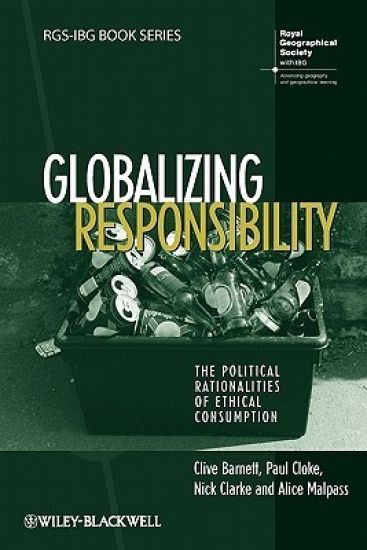
Globalizing Responsibility: The Political Rationalities of Ethical Consumption presents an innovative reinterpretation of the forces that have shaped the remarkable growth of ethical consumption. Develops a theoretically informed new approach to shape our understanding of the pragmatic nature of ethical action in consumption processesProvides empirical research on everyday consumers, social networks, and campaignsFills a gap in research on the topic with its distinctive focus on fair trade consumptionLocates ethical consumption within a range of social theoretical debates -on neoliberalism, governmentality, and globalisationChallenges the moralism of much of the analysis of ethical consumption, which sees it as a retreat from proper citizenly politics and an expression of individualised consumerism
Globalizing Responsibility

Globalizing Responsibility

Clive Barnett; Paul Cloke; Nick Clarke; Alice Malpass

Wiley-Blackwell (an imprint of John Wiley Sons Ltd)
2010
nidottu
Globalizing Responsibility: The Political Rationalities of Ethical Consumption presents an innovative reinterpretation of the forces that have shaped the remarkable growth of ethical consumption. Develops a theoretically informed new approach to shape our understanding of the pragmatic nature of ethical action in consumption processesProvides empirical research on everyday consumers, social networks, and campaignsFills a gap in research on the topic with its distinctive focus on fair trade consumptionLocates ethical consumption within a range of social theoretical debates -on neoliberalism, governmentality, and globalisationChallenges the moralism of much of the analysis of ethical consumption, which sees it as a retreat from proper citizenly politics and an expression of individualised consumerism
Culture and Democracy

Culture and Democracy

Clive Barnett

Edinburgh University Press
2003
nidottu
This book is about democracy and communication. The media and popular culture are often identified as bearing primary responsibility for the decline of active citizenship and the decay of democratic institutions. Media culture is charged with eroding the capacity of citizens to trust in public institutions and with encouraging widespread civic disengagement. In Culture and Democracy, Clive Barnett critically evaluates the conceptual underpinnings of such widespread judgements. In doing so he provides an innovative and theoretically informed exploration of the interface between culture, political economy, and public life. Through a triangulation of the ideas of Derrida, Foucault, and Habermas, he argues that deconstruction, poststructuralism, and critical theory converge around shared concerns for the possibilities of democratic public life in a globalising age. Drawing on cultural and media studies, human geography, political philosophy and social theory, and research on media policy and politics in the United States, Europe and South Africa, he demonstrates the indispensability of concepts of the public sphere, representation, and spatiality to the analysis of the politics of cultural democratisation. This book combines critical conceptualisation with policy analysis, and connects cultural studies to normative political theory. Clive Barnett demonstrates the importance of developing theoretical arguments in connection with case studies for understanding the contemporary interactions between media, culture and democracy.