Kirjailija
Colin Hay
Kirjat ja teokset yhdessä paikassa: 18 kirjaa, julkaisuja vuosilta 1999-2025, suosituimpien joukossa Political Analysis. Vertaile teosten hintoja ja tarkista saatavuus suomalaisista kirjakaupoista.
18 kirjaa
Kirjojen julkaisuhaarukka 1999-2025.
The definitive guide to politics in our polarised timesPolitics is everywhere. It touches almost every aspect of our lives. And it is present wherever individuals face collective choices. It is hardly surprising then that politics so often divides us, above all in an age in which the collective choices we face seem more daunting and more consequential than they have perhaps ever been.Exploring what it means to ‘think politically’ in these polarised times, this cutting-edge textbook reveals the many dimensions of politics. It does so by opening a series of analytic lenses through which we can make sense of politics and its impact upon societies and individuals. Each chapter, written by a leading scholar in the field, encourages us to view politics in a particular way, making a succinct and focussed case for the insight this brings to our understanding of political practice, political behaviour and political outcomes. Amongst the perspectives considered are politics as power, politics as moral choice, politics as identification, politics as ritual, politics as rhetoric and politics as crisis management.Written with the new student in mind, this probing introduction will be essential reading for all those who strive to make sense of politics in today’s world.
Exploring Political Legacies
Stephen Farrall; Colin Hay; Emily Gray
Springer Nature Switzerland AG
2021
nidottu
The concept of the political legacy, despite its importance for institutionalist and historically-minded political analysts more generally, remains both elusive and undeveloped theoretically. This book seeks to address that oversight by building on existing studies which have approached the notion of a legacy to offer a clear definition and operationalisation of the term which might be used to inform future research. Legacies we view as traces of the past in the present; the claim to the existence of a legacy is both a causal and a counter-factual claim. We propose, in the light of this, a multi-dimensional approach to gauging political legacies, reflecting on some of the theoretical, analytical and methodological concerns which need to be addressed in establishing credible claims to their existence. These we develop and illustrate with respect to the literature on Thatcherism.
Exploring Political Legacies
Stephen Farrall; Colin Hay; Emily Gray
Springer Nature Switzerland AG
2020
sidottu
The concept of the political legacy, despite its importance for institutionalist and historically-minded political analysts more generally, remains both elusive and undeveloped theoretically. This book seeks to address that oversight by building on existing studies which have approached the notion of a legacy to offer a clear definition and operationalisation of the term which might be used to inform future research. Legacies we view as traces of the past in the present; the claim to the existence of a legacy is both a causal and a counter-factual claim. We propose, in the light of this, a multi-dimensional approach to gauging political legacies, reflecting on some of the theoretical, analytical and methodological concerns which need to be addressed in establishing credible claims to their existence. These we develop and illustrate with respect to the literature on Thatcherism.
What is modernity? Do we all experience modernity in the same way? How should we understand contemporary social change? This volume explores questions of modernity through critical engagements with the work of Anthony Giddens, focusing in particular on the relationships between his social theory and political sociology. Three substantive areas - reflexivity, environment and identity - are examined theoretically through the relationships between reflexivity and rationality, life politics and institutional power, and universalism and 'difference'.As well as specifically addressing Giddens' reconstruction of sociology, the contributors also explore a wide variety of critical issues currently occupying centre stage in social theory. These include questions about the character of contemporary societies, the periodisation of social change, the processes of change by which societies are constantly made and remade by people, the relationships between the 'social' and the 'natural', the formation and maintenance of identities and matters of epistemology and methodology in social science.Theorising Modernity will be of interest to undergraduate and postgraduate students of sociology, modern political thought, social geography and social policy and to social scientists trying to make sense of the modernity debate.Martin O'Brien is Research at the University of Derby. Sue Penna is a Lecturer in Applied Social Science at Lancaster University. Colin Hay is a Lecturer in the Department of Political Science and International Studies at the University of Birmingham (UK), a Visiting Fellow of the Department of Political Science at the Massachusetts Institute of Technology (US) and Research Affiliate of the Centre for European Studies at Harvard University (US).
As we struggle with the legacy of the crisis and with the prospect of accelerating environmental degradation, it is time to ask not what we can do for capitalism but what capitalism can do for us, as citizens of a democratic society. In Civic Capitalism, Colin Hay and Anthony Payne build on their influential analysis of the crisis of the Anglo-liberal growth model to set out a coherent account of the steps required to build an alternative that is more sustainable socially, economically and environmentally.They argue that it is time to move on from the Anglo-liberal model of capitalism whose failings were so cruelly exposed by the crisis. They outline a new model that will work better in advanced capitalist societies, showing how this might be acheived in Britain today. They call this civic capitalism the governance of the market, by the state, in the name of the people, to deliver collective public goods, equity and social justice. This reverses the long ascendant logic of Anglo-liberalism in which citizens have been made to answer to the perceived logics of the capitalism they have been made to serve.The crisis shows us that we can no longer be driven by the perceived imperatives of the old model and by those who have claimed for far too long and, as it turns out, falsely to be able to discern for us the imperatives of the market. It is now time to ask what capitalism can do for us and not what we can do for capitalism.
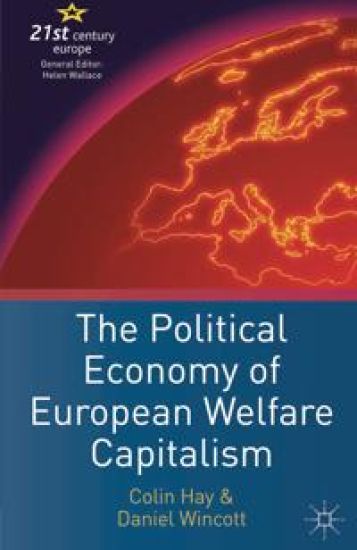
The Political Economy of European Welfare Capitalism
Colin Hay; Daniel Wincott
Red Globe Press
2012
nidottu
A state-of-the-art assessment of welfare provision, policy and reform at national and at EU level which spans the whole of Europe - East, West and Central. Uniquely broad-ranging in scope, and covering the latest research findings and theoretical debates, it provides a genuinely comparative overview text for students of 21st century Europe.
The Political Economy of European Welfare Capitalism
Colin Hay; Daniel Wincott
Red Globe Press
2012
sidottu
A state-of-the-art assessment of welfare provision, policy and reform at national and at EU level which spans the whole of Europe - East, West and Central. Uniquely broad-ranging in scope, and covering the latest research findings and theoretical debates, it provides a genuinely comparative overview text for students of 21st century Europe.
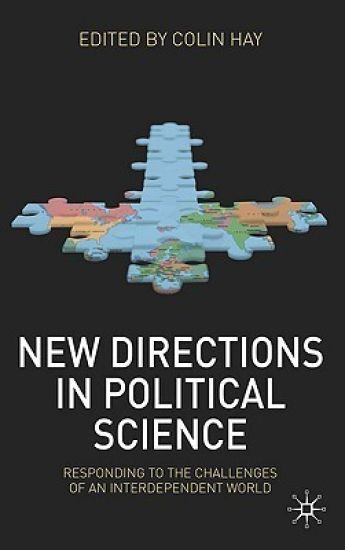
Written by a team of leading scholars, this new text focuses on a range of key challenges posed by developments in 21st century politics to provide a state-of-the-art assessment of current thinking and future directions in Political Science and International Relations.
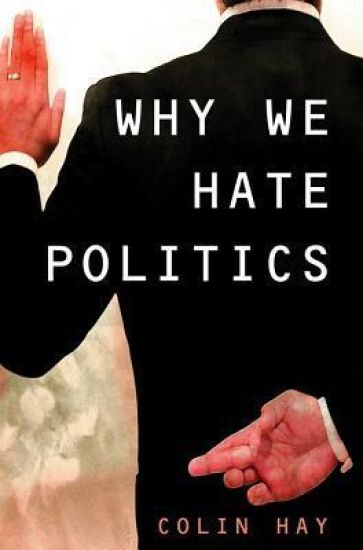
Politics was once a term with an array of broadly positive connotations, associated with public scrutiny, deliberation and accountability. Yet today it is an increasingly dirty word, typically synonymous with duplicity, corruption, inefficiency and undue interference in matters both public and private. How has this come to pass? Why do we hate politics and politicians so much? How pervasive is the contemporary condition of political disaffection? And what is politics anyway? In this lively and original work, Colin Hay provides a series of innovative and provocative answers to these questions. He begins by tracing the origins and development of the current climate of political disenchantment across a broad range of established democracies. Far from revealing a rising tide of apathy, however, he shows that a significant proportion of those who have withdrawn from formal politics are engaged in other modes of political activity. He goes on to develop and defend a broad and inclusive conception of politics and the political that is far less formal, less state-centric and less narrowly governmental than in most conventional accounts. By demonstrating how our expectations of politics and the political realities we witness are shaped decisively by the assumptions about human nature that we project onto political actors, Hay provides a powerful and highly distinctive account of contemporary political disenchantment. Why We Hate Politics will be essential reading for all those troubled by the contemporary political condition of the established democracies.
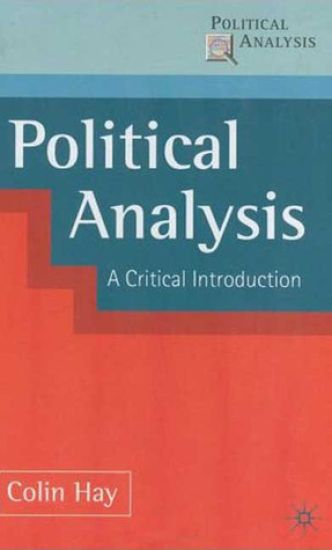
Political Analysis provides an accessible and engaging yet original introduction and distinctive contribution, to the analysis of political structures, institutions, ideas and behaviours, and above all, to the political processes through which they are constantly made and remade. Following an innovative introduction to the main approaches and concepts in political analysis, the text focuses thematically on the key issues which currently concern and divide political analysts, including the boundaries of the political; the question of structure, agency and power; the dynamics of political change; the relative significance of ideas and material factors; and the challenge posed by postmodernism which the author argues the discipline can strengthen itself by addressing without allowing it to become a recipe for paralysis.
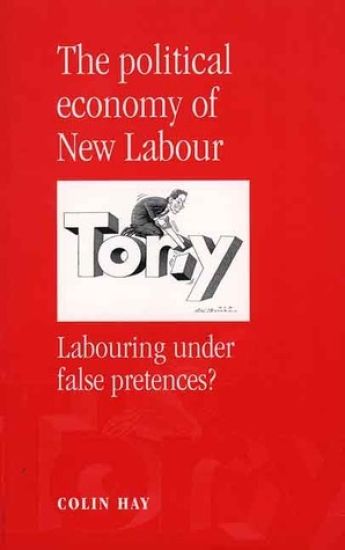
The Political Economy of New Labour provides one of the first systematic assessments and accessible evaluations of the modernization of the British Labour Party in the light of its landslide electoral victory in 1997. It also represents a rare attempt to locate Labour’s modernization in terms of the distinctive political economy of contemporary British capitalism and the impact of globalization, the evolution and transformation of the British State in the post-war period, the legacy of Thatcherism, and the specifics of electoral strategy and competition in contemporary Britain. In doing so, it provides a genuinely interdisciplinary account and analysis of Labour’s modernization and the strategic terrain within which this has been played out, as well as an assessment of the strategic alternatives available to a New Labour administration in an era of globalization, and an evaluation of the prospects for a decisive break with the Thatcher-Major legacy.
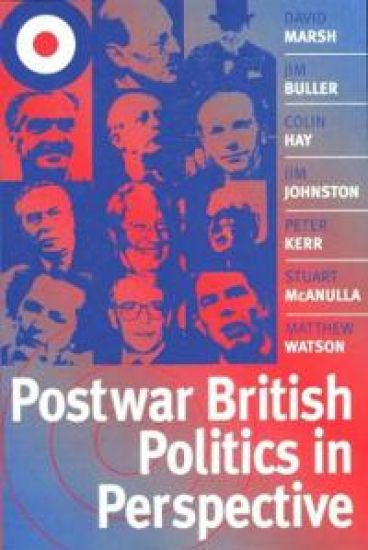
Postwar British Politics in Perspective
David Marsh; Jim Buller; Colin Hay; Jim Johnston; Peter Kerr; Stuart McAnulla; Matthew Watson
Polity Press
1999
nidottu
Providing an engagement with late-1990s perspectives on the development of the British State in the postwar period, this text challenges many of the well-established orthodoxies. It focuses on conceptions of consensus, evolution and transformation, and continuity and discontinuity.
Postwar British Politics in Perspective
David Marsh; Jim Buller; Colin Hay; Jim Johnston; Peter Kerr; Stuart McAnulla; Matthew Watson
Polity Press
1999
sidottu
This broad-ranging and original text provides an accessible introduction to British politics since 1945, challenging many well-established orthodoxies.