Kirjojen hintavertailu. Mukana 12 595 353 kirjaa ja 12 kauppaa.

Kirjailija

Colin Mayer

Kirjat ja teokset yhdessä paikassa: 10 kirjaa, julkaisuja vuosilta 1990-2024, suosituimpien joukossa Principles of Financial Regulation. Vertaile teosten hintoja ja tarkista saatavuus suomalaisista kirjakaupoista.

10 kirjaa

Kirjojen julkaisuhaarukka 1990-2024.

Principles of Financial Regulation

Principles of Financial Regulation

John Armour; Dan Awrey; Paul Davies; Luca Enriques; Jeffrey N. Gordon; Colin Mayer; Jennifer Payne

Oxford University Press
2016
nidottu
The financial crisis of 2007-9 revealed serious failings in the regulation of financial institutions and markets, and prompted a fundamental reconsideration of the design of financial regulation. As the financial system has become ever-more complex and interconnected, the pace of evolution continues to accelerate. It is now clear that regulation must focus on the financial system as a whole, but this poses significant challenges for regulators. Principles of Financial Regulation describes how to address those challenges. Examining the subject from a holistic and multidisciplinary perspective, Principles of Financial Regulation considers the underlying policies and the objectives of regulation by drawing on economics, finance, and law methodologies. The volume examines regulation in a purposive and dynamic way by framing the book in terms of what the financial system does, rather than what financial regulation is. By analysing specific regulatory measures, the book provides readers to the opportunity to assess regulatory choices on specific policy issues and encourages critical reflection on the design of regulation.
Principles of Financial Regulation

Principles of Financial Regulation

John Armour; Dan Awrey; Paul Davies; Luca Enriques; Jeffrey N. Gordon; Colin Mayer; Jennifer Payne

Oxford University Press
2016
sidottu
The financial crisis of 2007-9 revealed serious failings in the regulation of financial institutions and markets, and prompted a fundamental reconsideration of the design of financial regulation. As the financial system has become ever-more complex and interconnected, the pace of evolution continues to accelerate. It is now clear that regulation must focus on the financial system as a whole, but this poses significant challenges for regulators. Principles of Financial Regulation describes how to address those challenges. Examining the subject from a holistic and multidisciplinary perspective, Principles of Financial Regulation considers the underlying policies and the objectives of regulation by drawing on economics, finance, and law methodologies. The volume examines regulation in a purposive and dynamic way by framing the book in terms of what the financial system does, rather than what financial regulation is. By analysing specific regulatory measures, the book provides readers to the opportunity to assess regulatory choices on specific policy issues and encourages critical reflection on the design of regulation.
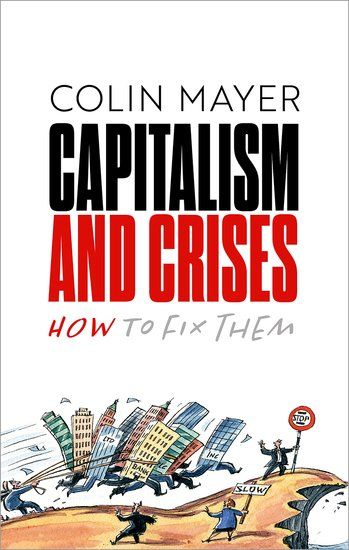
Capitalism and Crises

Capitalism and Crises

Colin Mayer

Oxford University Press
2024
sidottu
The world is encountering multiple crises - climate, droughts, floods, energy, food, and pandemics, to name a few. We have a problem, this is the solution. Capitalism and Crises is about how capitalism can fix them - how it can solve not cause them. The reason why it has caused them is that we have misconceived the nature of our capitalist system. We have failed to understand the key institution at the heart of it - business - and as a result we have allowed it to cause as well as solve problems. This book describes why this has happened and what needs to change to address it: it will take you through how the capitalist system operates, where it fails and why, and it will demonstrate that at the core of the problem is the key driver of capitalism and that is profit - the way in which we resource and reward those who run the system. Currently, profit comes from causing as well as solving problems. It must not, if we are to prevent the problems. Drawing on history, philosophy, psychology, and biology as well economics, law, and finance, Mayer describes what has gone wrong, what needs to change, and how to fix it. He sets out the big challenges that capitalism must address and how it should set about doing that, and discusses how financial institutions should be at the heart of this, and how the public sector can work with the private on a common purpose of solving problems and creating shared prosperity. Capitalism and Crises provides an inspiring and motivational roadmap of how we as practitioners, policymakers, consumers, employees, communities, students, and citizens of the world can together tackle the challenges of the 21st century - to flourish and survive.
Prosperity

Prosperity

Colin Mayer

Oxford University Press
2021
nidottu
What is business for? Day one of a business course will tell you: it is to maximise shareholder profit. This single idea pervades all our thinking and teaching about business around the world but it is fundamentally wrong, Colin Mayer argues. It has had disastrous and damaging consequences for our economies, environment, politics, and societies. In this urgent call for reform, Prosperity challenges the fundamentals of business thinking. It sets out a comprehensive new agenda for establishing the corporation as a unique and powerful force for promoting economic and social wellbeing in its fullest sense - for customers and communities, today and in the future. First Professor and former Dean of the Säid Business School in Oxford, Mayer is a leading figure in the global discussion about the purpose and role of the corporation. In Prosperity, he presents a radical and carefully considered prescription for corporations, their ownership, governance, finance, and regulation. Drawing together insights from business, law, economics, science, philosophy, and history, he shows how the corporation can realize its full potential to contribute to economic and social wellbeing of the many, not just the few. Prosperity tells us not only how to create and run successful businesses but also how policy can get us there and fix our broken system.
Prosperity

Prosperity

Colin Mayer

Oxford University Press
2018
sidottu
What is business for? Day one of a business course will tell you: it is to maximise shareholder profit. This single idea pervades all our thinking and teaching about business around the world but it is fundamentally wrong, Colin Mayer argues. It has had disastrous and damaging consequences for our economies, environment, politics, and societies. In this urgent call for reform, Prosperity challenges the fundamentals of business thinking. It sets out a comprehensive new agenda for establishing the corporation as a unique and powerful force for promoting economic and social wellbeing in its fullest sense - for customers and communities, today and in the future. First Professor and former Dean of the Säid Business School in Oxford, Mayer is a leading figure in the global discussion about the purpose and role of the corporation. In Prosperity, he presents a radical and carefully considered prescription for corporations, their ownership, governance, finance, and regulation. Drawing together insights from business, law, economics, science, philosophy, and history, he shows how the corporation can realize its full potential to contribute to economic and social wellbeing of the many, not just the few. Prosperity tells us not only how to create and run successful businesses but also how policy can get us there and fix our broken system.
Firm Commitment

Firm Commitment

Colin Mayer

Oxford University Press
2014
nidottu
The corporation is one of the most important and remarkable institutions in the world. It affects all our lives continuously. It feeds, entertains, houses and, employs us. It generates vast amounts of revenue for those who own it and it invests a substantial proportion of the wealth that we possess. But the corporation is also the cause of immense problems and suffering, a source of poverty and pollution, and its failures are increasing. How is the corporation failing us? Why is it happening? What should we do to restore trust in it? While governments are subject to repeated questioning and scrutiny, the corporation receives relatively little attention. Firm Commitment provides a lucid and insightful account of the role of the corporation in modern society and explains why its problems are growing. It gives a fresh perspective on the crises in financial markets, developing countries, and the environment. Based on decades of analysis and research, it describes a new approach to thinking about the firm which not only stops it destroying us but turns it into the means of protecting our environment, addressing social problems, and creating new sources of entrepreneurship and innovation. It sets out an agenda for converting the corporation into a twenty-first century organization that we will value and trust. It takes you on a journey that starts in the Galapagos, ends in Ancient Egypt, and in the process brings you to a new level of appreciation of the economic world we inhabit.
Firm Commitment

Firm Commitment

Colin Mayer

Oxford University Press
2013
sidottu
The corporation is one of the most important and remarkable institutions in the world. It affects all our lives continuously. It feeds, entertains, houses and, employs us. It generates vast amounts of revenue for those who own it and it invests a substantial proportion of the wealth that we possess. But the corporation is also the cause of immense problems and suffering, a source of poverty and pollution, and its failures are increasing. How is the corporation failing us? Why is it happening? What should we do to restore trust in it? While governments are subject to repeated questioning and scrutiny, the corporation receives relatively little attention. Firm Commitment provides a lucid and insightful account of the role of the corporation in modern society and explains why its problems are growing. It gives a fresh perspective on the crises in financial markets, developing countries, and the environment.Based on decades of analysis and research, it describes a new approach to thinking about the firm which not only stops it destroying us but turns it into the means of protecting our environment, addressing social problems, and creating new sources of entrepreneurship and innovation. It sets out an agenda for converting the corporation into a twenty-first century organization that we will value and trust. It takes you on a journey that starts in the Galapagos, ends in Ancient Egypt, and in the process brings you to a new level of appreciation of the economic world we inhabit.
Asset Management and Investor Protection

Asset Management and Investor Protection

Julian Franks; Colin Mayer; Luis Correia da Silva

Oxford University Press
2003
sidottu
This comparative survey of European and US consumer protection schemes offers detailed information on how much protection investors really have in these troubled times. Consumer confidence is at a low ebb as consumers feel unprotected, a result of disasters involving companies such as Enron.
Asset Management and Investor Protection

Asset Management and Investor Protection

Julian Franks; Colin Mayer; Luis Correia da Silva

Oxford University Press
2003
nidottu
Asset management is a major industry playing an increasingly important role in economic activity around the world. Asset managers provide services to individuals, governments, public agencies, banks, pension funds, insurance companies, and charities, to name a few. Traditionally, asset management has been primarily associated with the 'stock market' economies of the UK and the USA, but, as this book shows, some of the most spectacular growth in activity of recent years has occurred in Continental Europe. This has presented opportunities and challenges. New forms of financial instruments and institutions have emerged in countries that have traditionally relied on debt and non-market forms of intermediation. Competition has intensified, and entry has occurred both within and across national markets. However, this growth has been accompanied by potential problems: while investors enjoy a wider range of products and services, they face more complex instruments and transactions. Therefore, the potential for failures, such as misdealing and fraud, may have increased. The natural response is to strengthen regulation, but there is a fine balance to be struck between inadequate and excessive regulation of asset managers. This is particularly complicated in the context of European capital markets. European countries have traditionally had very different financial systems and asset management businesses, therefore it is no surprise to discover many different approaches to regulating asset managers. How should the European Commission respond to this diversity? Should it seek to create greater uniformity via common regulatory rules? The particular focus of this book is financial resource requirements. There is currently an active debate about the role capital requirements should play in asset management, particularly in the European context. In order to address this issue, the authors argue that it is necessary to understand the nature of the asset management business in different countries and the risks that it faces. They therefore discuss how the asset management business operates; how it is organized; the nature and size of risks in the business, who bears them, and how they are financed; and what the alternative forms of investor protection are, together with their associated costs and benefits.
Risk, Regulation, and Investor Protection

Risk, Regulation, and Investor Protection

Julian Franks; Colin Mayer

Clarendon Press
1990
sidottu
This unique and authoritative study of the investment management business focuses on the use of capital requirements for investment managers as a means of investor protection. Commissioned by the Investment Management Regulatory Organization and drawing on extensive discussions with investment managers themselves, it provides an account of this burgeoning sector that is both comprehensive in its coverage and penetrating in its analysis. The authors review the way in which the investment management business is organized and its inherent risks; they examine the causes and incidence of market failures as well as the dangers to investors through mismanagement and malpractice. The book includes an extensive treatment of fraud, with a full listing of fraud cases in the UK since the early 1970s. The report concludes with a summary of the evidence on the nature and scale of the risks faced by investors and recommendations for appropriate forms of protection; and, on the basis of existing regulatory structures in the UK and USA, sets out a proposed structure in accordance with the thrust of the authors' analysis. While specific in its coverage, much of the argument presented here is closely applicable to other financial sectors in which regulation is a crucial issue; and it is especially pertinent to current debates on financial regulation in the run-up to the completion of the European internal market in 1992.