Kirjojen hintavertailu. Mukana 12 152 606 kirjaa ja 12 kauppaa.

Kirjailija

Colin Richards

Kirjat ja teokset yhdessä paikassa: 42 kirjaa, julkaisuja vuosilta 1999-2025, suosituimpien joukossa Allen 'Red' Bailey. Vertaile teosten hintoja ja tarkista saatavuus suomalaisista kirjakaupoista.

42 kirjaa

Kirjojen julkaisuhaarukka 1999-2025.
Stone Circles

Stone Circles

Colin Richards; Vicki Cummings

YALE UNIVERSITY PRESS
2024
pokkari
The definitive guide to the stone circles of Britain and Ireland From Stonehenge and the Ring of Brogdar to the Rollright Stones and Avebury, the British and Irish Isles are scattered with the stone circles of our prehistoric ancestors. Although there have been many theories to explain them, to this day there is no consensus about their purpose. Colin Richards and Vicki Cummings provide a clear and illuminating field guide to 424 key stone circle sites in Britain and Ireland. Organised by region, this handy volume sets out the features of these megalithic monuments, including their landscape position, construction, and physical properties. The authors take stock of cutting-edge research and recent excavations stone circles that were previously lost to time. They present new insights on the chronology, composition, and roles of different circles to transform our understanding the sites. Beautifully illustrated with photographs, maps, and plans, this is an essential guide to Britain and Ireland’s most mysterious prehistoric monuments.
Stonehenge for the Ancestors

Stonehenge for the Ancestors

Mike Parker Pearson; Joshua Pollard; Colin Richards; Julian Thomas; Kate Welham

Sidestone Press
2020
sidottu
For many centuries, scholars and enthusiasts have been fascinated by Stonehenge, the world’s most famous stone circle. In 2003 a team of archaeologists commenced a long-term fieldwork project for the first time in decades. The Stonehenge Riverside Project (2003-2009) aimed to investigate the purpose of this unique prehistoric monument by considering it within its wider archaeological context.This is the first of four volumes which present the results of that campaign. It includes investigations of the monuments and landscape that pre-dated Stonehenge on Salisbury Plain as well as of excavation at Stonehenge itself. The main discovery at Stonehenge was of cremated human remains from many individuals, allowing their demography, health and dating to be established. With a revised radiocarbon-dated chronology for Stonehenge’s five stages of construction, these burials can now be considered within the context of the monument’s development. The different types of stone from which Stonehenge is formed – bluestones from Wales and sarsen silcretes from more local sources – are investigated both at Stonehenge and in its surroundings. These surrounding monuments include single standing stones, the Cuckoo Stone and the Tor Stone, as well as the newly discovered circle of Bluestonehenge at West Amesbury beside the River Avon. The ceremonial Stonehenge Avenue, linking Stonehenge to Bluestonehenge, is also included, based on a series of excavations along its length.The working hypothesis behind the Stonehenge Riverside Project links Stonehenge with a complex of timber monuments upstream at the great henge of Durrington Walls and neighbouring Woodhenge. Whilst these other sites are covered in a later volume (Volume 3), this volume explores the role of the River Avon and its topographic and environmental evidence.With contributions by:Umberto Albarella, Michael Allen, Olaf Bayer, Wayne Bennett, Richard Bevins, Christopher Bronk Ramsey, Chris Casswell, Andrew Chamberlain, Benjamin Chan, Rosamund Cleal, Gordon Cook, Glyn Davies, David Field, Charles French, Robert Ixer, Neil Linford, Peter Marshall, Louise Martin, Claudia Minniti, Doug Mitcham, Bob Nunn, Andy Payne, Mike Pitts, Rebecca Pullen, Julian Richards, David Robinson, Clive Ruggles, Jim Rylatt, Rob Scaife, Ellen Simmons, Charlene Steele, James Sugrue, Anne Teather, Sarah Viner, Tony Waldron, Katy Whitaker and Christie Willis
Stonehenge

Stonehenge

Mike Parker Pearson; Joshua Pollard; Colin Richards; Julian Thomas; Kate Welham

Council for British Archaeology
2015
nidottu
Stonehenge is an iconic monument for people all around the world. Built around 5000 years ago, it stands for mystery and forgotten secrets waiting to be decoded. In this latest book in the Council for British Archaeology’s ‘Archaeology for All’ series, Professor Mike Parker Pearson presents an up-to-date interpretation of Stonehenge and its landscape. Drawing on his years of research and excavation, the author presents a highly readable account that is lavishly illustrated with images by the renowned photographer Adam Stanford and the reconstruction artist Peter Dunn.
Animating the Dead

Animating the Dead

Jane Downes; Colin Richards

Casemate Publishers
2025
sidottu
This book provides the exciting results of a long-term project examining Bronze Age round barrow construction and burial practices in Orkney, Scotland. A main focus of this research is on the act of cremation; a technology of bodily metamorphosis as articulated through complex mortuary practices, which produced a distinctive form of funerary architecture. This, and other topical themes, are explored through the results of extensive excavations at several barrow cemeteries including Linga Fiold, Gitterpitten, Varme Dale, Vestrafiold and the Knowes of Trotty, the latter being famous for rich grave goods including gold discs and amber beads. In this context, in being built on the ruins of an early Neolithic settlement, Knowes of Trotty provides an intersection of relational fields, fusing local tradition with faraway places. At Linga Fiold, the barrow cemetery was almost entirely excavated, and by employing sophisticated recovery techniques and analyses, unique evidence is presented for a complex sequence of barrow building and mortuary practices. This enables the reconstruction of an extraordinary ritual journey of the deceased from cremation pyre to final interment. Additionally, several cist excavations are published here for the first time. This evidence allows an appraisal of the developing cist burial tradition in Orkney through the Chalcolithic and Bronze Age, from the insertion of remains into chambered tombs and large re-enterable unobtrusive cists, to the development of imposing linear barrow cemeteries, to the drawing in of the dead closer to home. Overall, the new findings presented here allow a reconsideration of the chronology and specifics of changing Orcadian burial technologies and traditions: clearly, such results have significance beyond Orkney for understanding the complexities of Bronze Age cremation and burial practices across Britain and north-west Europe.
Stonehenge for the Ancestors

Stonehenge for the Ancestors

Mike Parker Pearson; Joshua Pollard; Colin Richards; Julian Thomas; Kate Welham

Sidestone Press
2022
nidottu
For many centuries, scholars and enthusiasts have been fascinated by Stonehenge, the world’s most famous stone circle. In 2003 a team of archaeologists commenced a long-term fieldwork project for the first time in decades. The Stonehenge Riverside Project (2003-2009) aimed to investigate the purpose of this unique prehistoric monument by considering it within its wider archaeological context.This is the second of four volumes which present the results of that campaign. It includes studies of the lithics from excavations, both from topsoil sampling and from excavated features, as well as of the petrography of the famous bluestones, as identified from chippings recovered during excavations. Other specialist syntheses are those of the land mollusca. The volume provides an overview of Stonehenge in its landscape over millennia from before the monument was built to the last of its five constructional stages. It concludes with a chapter placing Stonehenge in its full context within Britain and western Europe during the third millennium BC.With contributions by:Umberto Albarella, Michael Allen, Richard Bevins, Benjamin Chan, Robert Ixer, Claudia Minniti, Doug Mitcham and Sarah Viner-Daniels
Stonehenge for the Ancestors

Stonehenge for the Ancestors

Mike Parker Pearson; Joshua Pollard; Colin Richards; Julian Thomas; Kate Welham
Sidestone Press
2022
sidottu
For many centuries, scholars and enthusiasts have been fascinated by Stonehenge, the world’s most famous stone circle. In 2003 a team of archaeologists commenced a long-term fieldwork project for the first time in decades. The Stonehenge Riverside Project (2003-2009) aimed to investigate the purpose of this unique prehistoric monument by considering it within its wider archaeological context.This is the second of four volumes which present the results of that campaign. It includes studies of the lithics from excavations, both from topsoil sampling and from excavated features, as well as of the petrography of the famous bluestones, as identified from chippings recovered during excavations. Other specialist syntheses are those of the land mollusca. The volume provides an overview of Stonehenge in its landscape over millennia from before the monument was built to the last of its five constructional stages. It concludes with a chapter placing Stonehenge in its full context within Britain and western Europe during the third millennium BC.With contributions by:Umberto Albarella, Michael Allen, Richard Bevins, Benjamin Chan, Robert Ixer, Claudia Minniti, Doug Mitcham and Sarah Viner-Daniels
Monuments in the Making

Monuments in the Making

Vicki Cummings; Colin Richards

Windgather Press
2021
nidottu
In this book we offer an exciting new perspective on a distinctive form of megalithic monument that is found across most areas of northern Europe. In order to achieve this we have abandoned outmoded typological classifications and re-introduced the term ‘dolmen’ to embrace a range of sites that share a common form of megalithic architecture: the elevation and display of a substantial stone. By critically assessing the traditionally assigned role of these monuments and their architecture as megalithic tombs, the presence of the dead is reassessed and argued to form part of a process generating vibrancy to the materiality of the dolmen. As such this book argues that the megalithic architecture identified as a dolmen is not a chambered tomb at all but instead is a qualitatively different form of monument. We also provide an entirely different conception of the utility of this extraordinary megalithic architecture – one that seeks to emphasise its building as articulating discourses of wonder as a broad social strategy. In this respect it is important to remember that many of these monuments were erected very early in the Neolithic and as a consequence of new people entering new lands, or social transformation. In short, dolmens are monumental constructions employing experimental and emergent technologies to raise huge stones, which, once built, enchant those who come within their spaces. Our claim is that dolmens were megalithic installations of affect, magical and extraordinary in construction and strategically positioned to induce both drama and awe in their encounter.
Stonehenge for the Ancestors

Stonehenge for the Ancestors

Mike Parker Pearson; Joshua Pollard; Colin Richards; Julian Thomas; Kate Welham
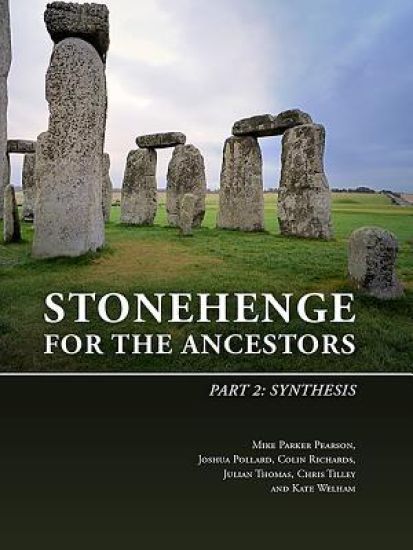
Sidestone Press
2020
nidottu
For many centuries, scholars and enthusiasts have been fascinated by Stonehenge, the world’s most famous stone circle. In 2003 a team of archaeologists commenced a long-term fieldwork project for the first time in decades. The Stonehenge Riverside Project (2003-2009) aimed to investigate the purpose of this unique prehistoric monument by considering it within its wider archaeological context.This is the first of four volumes which present the results of that campaign. It includes investigations of the monuments and landscape that pre-dated Stonehenge on Salisbury Plain as well as of excavation at Stonehenge itself. The main discovery at Stonehenge was of cremated human remains from many individuals, allowing their demography, health and dating to be established. With a revised radiocarbon-dated chronology for Stonehenge’s five stages of construction, these burials can now be considered within the context of the monument’s development. The different types of stone from which Stonehenge is formed – bluestones from Wales and sarsen silcretes from more local sources – are investigated both at Stonehenge and in its surroundings. These surrounding monuments include single standing stones, the Cuckoo Stone and the Tor Stone, as well as the newly discovered circle of Bluestonehenge at West Amesbury beside the River Avon. The ceremonial Stonehenge Avenue, linking Stonehenge to Bluestonehenge, is also included, based on a series of excavations along its length.The working hypothesis behind the Stonehenge Riverside Project links Stonehenge with a complex of timber monuments upstream at the great henge of Durrington Walls and neighbouring Woodhenge. Whilst these other sites are covered in a later volume (Volume 3), this volume explores the role of the River Avon and its topographic and environmental evidence.With contributions by:Umberto Albarella, Michael Allen, Olaf Bayer, Wayne Bennett, Richard Bevins, Christopher Bronk Ramsey, Chris Casswell, Andrew Chamberlain, Benjamin Chan, Rosamund Cleal, Gordon Cook, Glyn Davies, David Field, Charles French, Robert Ixer, Neil Linford, Peter Marshall, Louise Martin, Claudia Minniti, Doug Mitcham, Bob Nunn, Andy Payne, Mike Pitts, Rebecca Pullen, Julian Richards, David Robinson, Clive Ruggles, Jim Rylatt, Rob Scaife, Ellen Simmons, Charlene Steele, James Sugrue, Anne Teather, Sarah Viner, Tony Waldron, Katy Whitaker and Christie Willis
The Dying Nurse

The Dying Nurse

Colin Richards

Lulu.com
2019
pokkari
A saga covering almost a century, The ravages of war, love and intrigue, Gold and diamonds from Africa retrieved from an ancient civilization, and the recovery of the English countryside after the two world wars, Further intrigue as Australian bomber pilots fly ex RAF planes to the outback.