Kirjojen hintavertailu. Mukana 12 595 353 kirjaa ja 12 kauppaa.

Kirjailija

Colin S. Gray

Kirjat ja teokset yhdessä paikassa: 66 kirjaa, julkaisuja vuosilta 1982-2025, suosituimpien joukossa Fighting Talk. Vertaile teosten hintoja ja tarkista saatavuus suomalaisista kirjakaupoista.

Mukana myös kirjoitusasut: Colin S Gray

66 kirjaa

Kirjojen julkaisuhaarukka 1982-2025.

Fighting Talk

Fighting Talk

Colin S. Gray

Praeger Publishers Inc
2007
sidottu
Gray presents an inventive treatise on the nature of strategy, war, and peace, organized around forty maxims. This collection of mini-essays will forearm politicians, soldiers, and the attentive general public against many—probably most—fallacies that abound in contemporary debates about war, peace, and security. While one can never guarantee strategic success, which depends on policy, military prowess, and the quality of the dialogue between the two, a strategic education led by the judgments in these maxims increases the chances that one's errors will be small rather than catastrophic. The maxims are grouped according to five clusters. War and Peace tackles the larger issues of strategic history that drive the demand for the services of strategic thought and practice. Strategy presses further, into the realm of strategic behavior, and serves as a bridge between the political focus of part one and the military concerns that follow. In Military Power and Warfare turns to the pragmatic business of military performance: operations, tactics, and logistics. Part four, Security and Insecurity examines why strategy is important, including a discussion of the nature, dynamic character, and functioning of world politics. Finally, History and the Future is meant to help strategists better understand the processes of historical change.
What Should the U.S. Army Learn From History? - Determining the Strategy of the Future through Understanding the Past
This monograph examines the potential utility of history as a source of education and possible guidance for the U.S. Army. The author considers the worth in the claim that since history (more accurately termed the past) is all done and gone, it can have no value for today as we try to look forward. This point of view did not find much favor here. The monograph argues that although history does not repeat itself in detail, it certainly does so roughly in parallel circumstances. Of course, much detail differs from one historical case to another, but nonetheless, there are commonly broad and possibly instructive parallels that can be drawn from virtually every period of history, concerning most circumstances. Contents: Should the U.S. Army Learn From History? Understanding the Past: A Foreign Country? Persisting Concerns and Enduring Hazards A Familiar Past? Parallels and Analogies What Changes and What Does Not? What Can the U.S. Army Learn From History? Recommendations for the U.S. Army
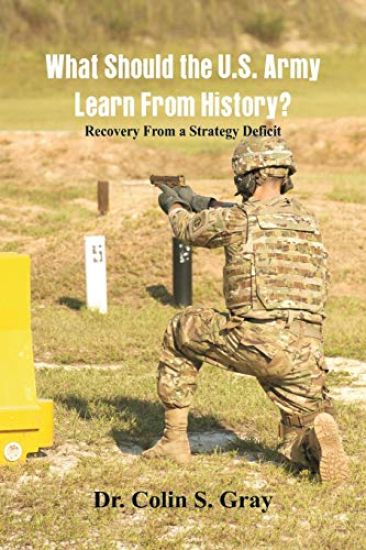
What Should the U.S. Army Learn From History? Recovery From a Strategy Deficit
Does history repeat itself? This monograph clearly answers "no," firmly. However, it does not argue that an absence of repetition in the sense of analogy means that history can have no utility for the soldier today. This monograph argues for a "historical parallelism," in place of shaky or false analogy. The past, even the distant and ancient past, provides evidence of the potency of lasting virtues of good conduct. This monograph concludes by offering four recommendations: 1. Behave prudently. 2. Remember the concept of the great stream of time. 3. Do not forget that war nearly always is a gamble. 4. War should only be waged with strategic sense.
Theory of Strategy

Theory of Strategy

Colin S. Gray

Oxford University Press
2018
sidottu
This book provides a short and accessible introduction to the theory of strategy, examines the general theory of strategy in accordance with 23 key Principles and explains its nature, functions, and intended consequences. Theory of Strategy makes the radical argument that the familiar structure of strategy's general theory (political ends, strategic ways, military means - and assumptions) holds as sound for security at all times and in all places, of human necessity. Strategy is ever-varying in its character, but not in its nature, which is unchanging.
Theory of Strategy

Theory of Strategy

Colin S. Gray

Oxford University Press
2018
nidottu
This book provides a short and accessible introduction to the theory of strategy, examines the general theory of strategy in accordance with 23 key Principles and explains its nature, functions, and intended consequences. Theory of Strategy makes the radical argument that the familiar structure of strategy's general theory (political ends, strategic ways, military means - and assumptions) holds as sound for security at all times and in all places, of human necessity. Strategy is ever-varying in its character, but not in its nature, which is unchanging.
What Should The U.S. Army Learn From History? Recovery From A Strategy Deficit
What is commonly known as history is really the past, as it is often selected and preserved both by professional historians and by non-specialist citizens. The past is such a large and diverse repository of happenings, thoughts, and experiences that it requires treatment with a disciplined respect. Frequently, respect for the truth about the past is a victim of contemporary circumstance. In this monograph, Dr. Colin S. Gray seeks to explore how historical data might best be used for the benefit of the U.S. Army and, therefore, the United States. He pulls no punches in explaining how challenging it is to penetrate the fog that obscures much of the past. Since the future cannot be foreseen reliably, we are left rather uncomfortably with a seemingly ever changing today.
The Strategy Bridge

The Strategy Bridge

Colin S. Gray

Oxford University Press
2016
nidottu
The Strategy Bridge: Theory for Practice is an original contribution to the general theory of strategy. While heavily indebted to Carl von Clausewitz, Sun-tzu, and the very few other classic authors, this book presents the theory, rather than merely comments on the theory as developed by others. The author explains that the purpose of strategy is to connect purposefully politics and policy with the instruments they must use. The primary focus of attention is on military strategy, but this focus is well nested in discussion of grand strategy, for which military strategy is only one strand. The book presents the general theory of strategy comprehensively and explains the utility of this general theory for the particular strategies that strategists need to develop in order to meet their historically unique challenges. The book argues that strategy's general theory provides essential education for practicing strategists at all times and in all circumstances. As general theory, The Strategy Bridge is as relevant to understanding strategic behaviour in the Peloponnesian War as it is for the conflicts of the twenty-first century. The book proceeds from exposition of general strategic theory, to address three basic issue areas that are not at all well explained, let alone understood with a view to advancing better practice, in the extant literature. Specifically, the book tackles the problems that harass and imperil strategic performance; it probes deeply into the hugely underexamined subject of just what it is that the strategist produces-strategic effect; and it 'joins up the dots' from theory through practice to consequences by means of a close examination of command performance. The author takes a holistic view of strategy, and it is rigorously attentive to the significance of the contexts within which and for which strategies are developed and applied. The book regards the strategist as a hero, charged with the feasible, but awesomely difficult, task of converting the threat and use of force (for military strategy) into desired political consequences. He seeks some control over the rival or enemy via strategic effect, the instrumental produce of his instrumental labours. In order to maximise his prospects for success, the practicing strategist requires all the educational assistance that strategic theory can provide.
Perspectives on Strategy

Perspectives on Strategy

Colin S. Gray

Oxford University Press
2016
nidottu
Perspectives on Strategy examines in depth five aspects of strategy. Strategic thought and behaviour are explored and explained from the perspectives of intellect, morality, culture, geography, and technology. Each perspective has attracted persisting controversy. Perspectives on Strategy is strongly complementary to the author's previous book, The Strategy Bridge: Theory for Practice (OUP, 2010). This new work takes a notably holistic view of strategic phenomena, which serves as a master framework within which detailed examination of strategic history and issues can usefully be pursued in the light of particular perspectives. Foundational for the argument in Perspectives on Strategy is the proposition that distinctive aspects of strategy (e.g. ethics, culture, inter alia) can only be appreciated properly when they are regarded in context. The author shares this view with T. E. Lawrence (of Arabia), who wrote of the 'whole house of war'. Perspectives on Strategy gratefully adapts Lawrence and writes about the 'whole house of strategy'. The book insists that the nature of strategy is best represented by a Venn diagram that shows overlapping perspectives. Thus, the subject of each chapter is shown as having meaning for, and in turn is influenced by, the subjects of the other chapters. For example, the book explores the importance of strategic ideas relative to the significance of the material weapons of war. The author poses the hardest of questions pertinent to each chosen perspective (e.g. do ideas matter more than muscle?--in practice how robust is the ethical code with which warfare is waged?--is geography destiny, as some theorists have claimed?--and do technically superior weapons win wars?)Perspectives on Strategy demonstrates that it is possible to look closely at strategic matters from limited but arguably powerful perspectives, without being captured by them. This book asks and answers the most challenging and rewarding questions that can be posed in order to reveal the persisting universal nature, but ever changing character, of strategy.
Strategy and Defence Planning

Strategy and Defence Planning

Colin S. Gray

Oxford University Press
2016
nidottu
Strategy and Defence Planning: Meeting the Challenge of Uncertainty explores and examines why and how security communities prepare purposefully for their future defence. The author explains that defence planning is the product of interplay among political process, historical experience, and the logic of strategy. The theory of strategy best reveals both the nature and the working of defence planning. Political 'ends', strategic 'ways', and military 'means' all fed by reigning, if not always recognized, assumptions, organize the subject well with a template that can serve any time, place, and circumstance. The book is designed to help understanding of what can appear to be a forbiddingly complex as well as technical subject. A good part of the problem for officials charged with defence planning duties is expressed in the second part of the book's title. The real difficulty, which rarely is admitted by those tasked with defence planning duty, is that defence planning can only be guesswork. But, because defence preparation is always expensive, not untypically is politically unpopular, yet obviously can be supremely important, claims to knowledge about the truly unknowable persist. In truth, we cannot do defence planning competently, because our ignorance of the future precludes understanding of what our society will be shown by future events to need. The challenge faced by the author was to identify ways in which our problems with the inability to know the future in any detail in advance-the laws of nature, in other words-may best be met and mitigated. Professor Gray argues that our understanding of human nature, of politics, and of strategic history, does allow us to make prudent choices in defence planning that hopefully will prove 'good enough'.
Strategy and Politics

Strategy and Politics

Colin S. Gray

Routledge
2016
sidottu
This book examines the subject of strategy and its relationship with politics. Despite the fact that strategy is always the product of political process, the relationship between the two concepts and their ancillary activities has scarcely been touched by scholars. This book corrects that serious deficiency, and explains the high relevance of political factors for matters of general defence. Each chapter aims to show how and why strategy and politics interact and how this interaction has had significant consequences historically. Neither strategy nor politics can make sense if considered alone. Strategy requires direction that can only be provided by political process, while politics cannot be implemented without strategy.In summary, this volume will explain: what strategy is (and is not) why strategy is essential what strategy does and how it does it how strategy is made and executed Written by a leading scholar and former practitioner, this book will be essential reading for all students of military strategy, strategic studies, security studies and war and conflict studies.