Kirjojen hintavertailu. Mukana 12 417 779 kirjaa ja 12 kauppaa.

Kirjailija

Colin Whitcomb Clark

Kirjat ja teokset yhdessä paikassa: 3 kirjaa, julkaisuja vuosilta 1987-1989, suosituimpien joukossa Natural Resource Economics. Vertaile teosten hintoja ja tarkista saatavuus suomalaisista kirjakaupoista.

3 kirjaa

Kirjojen julkaisuhaarukka 1987-1989.

Natural Resource Economics

Natural Resource Economics

Jon M. Conrad; Colin Whitcomb Clark

Cambridge University Press
1987
sidottu
In this book, Jon Conrad and Colin Clark develop the theory of resource economics. To begin, they provide an introduction to the required techniques of dynamic optimization. Throughout the book they build the reader’s understanding with many fully-worked problems and numerical examples. The authors have written this text in the belief that the theory and concepts of resource are more quickly learned, more effectively made operational, and more truly understood if the reader is exposed to carefully explained numerical examples. By working through the problems at the end of each chapter, students will learn the techniques to be used in empirical studies of natural resource systems. The first chapter provides an introduction to optimization, including constrained optimization, dynamic allocation problems, dynamic programming, continuous time problems, and the maximum principle, and a discussion of various numerical and graphical techniques. The remaining chapters deal in depth with the economics of renewable resources, nonrenewable resources, with environmental management and with stochastic resource models.
Natural Resource Economics

Natural Resource Economics

Jon M. Conrad; Colin Whitcomb Clark

Cambridge University Press
1987
pokkari
In this book, Jon Conrad and Colin Clark develop the theory of resource economics. To begin, they provide an introduction to the required techniques of dynamic optimization. Throughout the book they build the reader’s understanding with many fully-worked problems and numerical examples. The authors have written this text in the belief that the theory and concepts of resource are more quickly learned, more effectively made operational, and more truly understood if the reader is exposed to carefully explained numerical examples. By working through the problems at the end of each chapter, students will learn the techniques to be used in empirical studies of natural resource systems. The first chapter provides an introduction to optimization, including constrained optimization, dynamic allocation problems, dynamic programming, continuous time problems, and the maximum principle, and a discussion of various numerical and graphical techniques. The remaining chapters deal in depth with the economics of renewable resources, nonrenewable resources, with environmental management and with stochastic resource models.
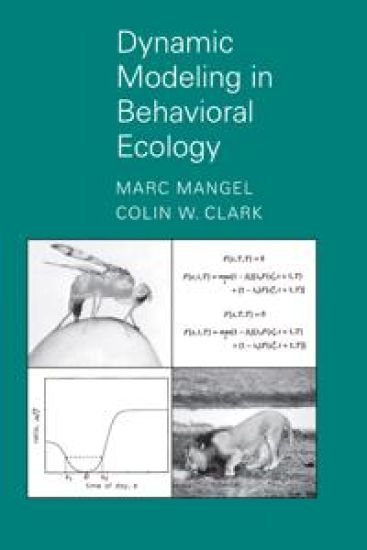
Dynamic Modeling in Behavioral Ecology

Dynamic Modeling in Behavioral Ecology

Marc Mangel; Colin Whitcomb Clark

Princeton University Press
1989
pokkari
This book describes a powerful and flexible technique for the modeling of behavior, based on evolutionary principles. The technique employs stochastic dynamic programming and permits the analysis of behavioral adaptations wherein organisms respond to changes in their environment and in their own current physiological state. Models can be constructed to reflect sequential decisions concerned simultaneously with foraging, reproduction, predator avoidance, and other activities. The authors show how to construct and use dynamic behavioral models. Part I covers the mathematical background and computer programming, and then uses a paradigm of foraging under risk of predation to exemplify the general modeling technique. Part II consists of five "applied" chapters illustrating the scope of the dynamic modeling approach. They treat hunting behavior in lions, reproduction in insects, migrations of aquatic organisms, clutch size and parental care in birds, and movement of spiders and raptors. Advanced topics, including the study of dynamic evolutionarily stable strategies, are discussed in Part III.