Kirjojen hintavertailu. Mukana 12 537 522 kirjaa ja 12 kauppaa.

Kirjailija

Colleen E. Carney

Kirjat ja teokset yhdessä paikassa: 12 kirjaa, julkaisuja vuosilta 2009-2021, suosituimpien joukossa Quiet Your Mind & Get to Sleep. Vertaile teosten hintoja ja tarkista saatavuus suomalaisista kirjakaupoista.

Mukana myös kirjoitusasut: Colleen E Carney

12 kirjaa

Kirjojen julkaisuhaarukka 2009-2021.

Goodnight Mind for Teens

Goodnight Mind for Teens

Colleen E Carney

Readhowyouwant
2021
pokkari
Millions of teens struggle with sleep and feel exhausted as a result. Goodnight Mind for Teens will help teens cope with the anxious and over-stimulating thoughts that can lead to insomnia, identify and work with their own circadian rhythm, and set up a new sleep schedule so they can improve their alertness, feel more energetic, and be in a better mood throughout the day.
Goodnight Mind for Teens

Goodnight Mind for Teens

Colleen E. Carney

New Harbinger Publications
2020
pokkari
Turn off the light. Turn off your phone. Turn off anxious thoughts.Do you have trouble getting to sleep at night? You aren't alone. There are so many reasons teens today have a difficult time going to sleep-including early school start times, too much late-night screen time, or just being anxious about what the future holds. You are at an important crossroads in your life, so it's natural to feel overwhelmed at times. But it's essential that you get the sleep you need. This book can help.Written by a renowned sleep expert, Goodnight Mind for Teens offers tips based in proven-effective cognitive behavioral therapy (CBT) to help you get your zzzs and be your best during the daytime. You'll learn how to set your own ideal sleep schedule, overcome sleep lag, cope with sleep anxiety, and manage the anxious, over-stimulating thoughts and worries that are keeping you up at night.If you're ready to start feeling better, less cranky during the day, and more at ease at bedtime, this book has everything you need to... zzzz...
KBT vid sömnproblem : terapeutmanual vid individanpassad behandling

KBT vid sömnproblem : terapeutmanual vid individanpassad behandling

Rachel Manber; Colleen E. Carney

Natur Kultur Läromedel och Akademi
2016
sidottu
Detta är en komplett, forskningsbaserad behandlingsmanual vid sömnproblem. Den vägleder dig som kliniker att lägga upp en sömnintervention utifrån kognitiv beteendeterapi som är anpassad efter varje patients specifika behov – även om de samtidigt har en annan diagnos, såsom depression eller ångestsyndrom. I och med ett unikt fokus på skräddarsydd behandling och samsjuklighet är manualen värdefull även för kliniker som tidigare har arbetat med KBT vid sömnproblem.Bokens första del ger information om sömn och sömnlöshet, hur normal sömn fungerar och regleras, hur beteenden påverkar sömnregleringen samt hur olika tillstånd och sjukdomar inverkar på sömnen. Den andra delen av boken går igenom bedömningen och behandlingens olika komponenter. Författarna beskriver hur den mest relevanta komponenten väljs ut, i vilken ordning komponenter ska introduceras och när standardutförandet bör förändras. De lär även ut en fallkonceptualisering som ger underlag för viktiga kliniska beslut, samt tar upp försiktighetsåtgärder och riskfaktorer. Samsjuklighet och användning av sömnmedel diskuteras ingående liksom när och hur terapin bör justeras med hänsyn till detta. Slutligen åskådliggörs en fullständig behandling genom två fallbeskrivningar.Boken riktar sig till studerande och kliniskt verksamma behandlare som möter patienter med sömnproblem; exempelvis psykologer, psykoterapeuter, kuratorer, sjuksköterskor och läkare.
Cognitive Behavior Therapy for Insomnia in Those with Depression
Cognitive Behavior Therapy for Insomnia in Those with Depression is the book for clinicians who recognize that insomnia is more often a comorbid condition that merits separate treatment attention. These clinicians know that two thirds of those who present for depression treatment also complain of significant insomnia and that one third of such patients are already taking sleep medication, and they may be familiar with the research showing that treating insomnia is often important in the management of depression. But what strategies should clinicians use for treating insomnia? How can motivation be enhanced? What about medications? Students and professionals alike will find the pages of Cognitive Behavior Therapy for Insomnia in Those with Depression replete with advanced tools to address the adherence problems often encountered in this group, and they’ll come away from the book with a wealth of techniques for improving both sleep and overall symptom management as well as for treating the insomnia that occurs in comorbid disorders.
Cognitive Behavior Therapy for Insomnia in Those with Depression
Cognitive Behavior Therapy for Insomnia in Those with Depression is the book for clinicians who recognize that insomnia is more often a comorbid condition that merits separate treatment attention. These clinicians know that two thirds of those who present for depression treatment also complain of significant insomnia and that one third of such patients are already taking sleep medication, and they may be familiar with the research showing that treating insomnia is often important in the management of depression. But what strategies should clinicians use for treating insomnia? How can motivation be enhanced? What about medications? Students and professionals alike will find the pages of Cognitive Behavior Therapy for Insomnia in Those with Depression replete with advanced tools to address the adherence problems often encountered in this group, and they’ll come away from the book with a wealth of techniques for improving both sleep and overall symptom management as well as for treating the insomnia that occurs in comorbid disorders.
Treatment Plans and Interventions for Insomnia

Treatment Plans and Interventions for Insomnia

Rachel Manber; Colleen E. Carney

Guilford Press
2015
nidottu
From leading authorities, this treatment planner outlines cognitive-behavioral therapy for insomnia (CBT-I) and shows how to tailor the treatment to individual clients' needs. Clinicians get a solid understanding of how sleep is regulated and the factors that promote or hinder optimal sleep. The book describes CBT-I components and discusses how to select and sequence them for particular clients, including those with psychiatric comorbidities such as anxiety or depressive disorders. Two chapter-length case examples illustrate the use of a comprehensive case conceptualization as the basis for effective intervention. In a convenient large-size format, the book includes reproducible assessment tools, planning forms, and handouts. Purchasers get access to a Web page where they can download and print the reproducible materials. The American College of Physicians recommends CBT-I as the initial treatment for all adult patients with chronic insomnia disorder.
Overcoming Insomnia

Overcoming Insomnia

Jack D. Edinger; Colleen E. Carney

Oxford University Press Inc
2014
nidottu
It is estimated that one in ten U.S. adults suffers from chronic insomnia. If left untreated, chronic insomnia reduces quality of life and increases risk for psychiatric and medical disease, especially depression and anxiety. The Overcoming Insomnia treatment program uses evidence-based cognitive-behavioral therapy (CBT) methods to correct poor sleep habits. CBT has been proven in multiple studies to improve sleep by reducing time spent in bed before sleep onset, reducing time spent awake after first sleep onset, and increasing the quality and efficiency of sleep. This second edition has been thoroughly updated by the program developers, Jack D. Edinger and Colleen E. Carney. Patients use the Workbook in conjunction with the treatment they receive from their therapist. Patients will receive information about healthy sleep and the reasons for improving sleep habits, and the therapist will develop a program to address that patient's specific sleep problems. Use of a sleep diary, assessment forms, and other homework (all provided in the Workbook) allows patient and therapist to work together to develop an effective sleep regimen tailored specifically for each patient.
Overcoming Insomnia

Overcoming Insomnia

Jack D. Edinger; Colleen E. Carney

Oxford University Press Inc
2014
nidottu
It is estimated that one in ten U.S. adults suffers from chronic insomnia. If left untreated, chronic insomnia reduces quality of life and increases risk for psychiatric and medical disease, especially depression and anxiety. The Overcoming Insomnia treatment program uses evidence-based cognitive-behavioral therapy (CBT) methods to correct poor sleep habits. CBT has been proven in multiple studies to improve sleep by reducing time spent in bed before sleep onset, reducing time spent awake after first sleep onset, and increasing the quality and efficiency of sleep. Developed by Jack D. Edinger and Colleen E. Carney, this second edition has been thoroughly updated according to the DSM-5, which now conceptualizes insomnia as a sleep-wake disorder, rather than a sleep disorder only. The DSM-5 has also eliminated the differentiation between primary and secondary insomnias, so this program provides an expanded discussion of daytime related issues as well as delivery issues specific to those with comorbid mental and medical problems. Patients are first given information about healthy sleep and the reasons for improving sleep habits, then a behavioral program is developed to address that patient's specific sleep problems. Use of a sleep diary, assessment forms, and other homework (all provided in the corresponding patient Workbook) allows client and therapist to work together to develop an effective sleep regimen tailored specifically for each client, and several sessions are dedicated to increasing compliance and problem-solving.
Goodnight Mind

Goodnight Mind

Colleen E. Carney

New Harbinger Publications
2013
pokkari
Do you find yourself lying awake at night, ruminating about the events of the day? Do you toss and turn, worrying about what you have to do in the morning or what you did earlier in the day? If so, you are not alone. In fact, insomnia is the most common sleep disorder faced by the general population today. The most common complaint in those who have trouble sleeping is having a "noisy mind." Sometimes, no matter how hard you try, it seems like you cannot silence all the internal dialogue. So what do you do when your mind is spinning and your thoughts just won't stop?Accessible, enjoyable, and grounded in evidence-based cognitive behavioral therapy (CBT), Goodnight Mind directly addresses the effects of rumination-or having an overactive brain-on your ability to sleep well.Written by two psychologists who specialize in sleep disorders, the book contains helpful exercises and insights into how you can better manage your thoughts at bedtime, and finally get some sleep. Traditional treatment for insomnia is usually focused on medications that promote sedation rather than on the behavioral causes of insomnia. Unfortunately, medication can often lead to addiction, and a host of other side effects. This is a great a book for anyone who is looking for effective therapy to treat insomnia without the use of medication. This informative, small-format book is easy-to-read and lightweight, making it perfect for late-night reading.
Insomnia and Anxiety

Insomnia and Anxiety

Colleen E. Carney; Jack D. Edinger

Springer-Verlag New York Inc.
2012
nidottu
The statistics show that as much as twenty percent of the population suffers from chronic insomnia—and one-fourth of those with the condition eventually develop an anxiety disorder. As comorbid conditions, they contribute to any number of physical and social problems. Yet too often insomnia is undiagnosed, or treated as merely a symptom of the patient’s anxiety. Insomnia and Anxiety is the first clinician guidebook that considers the evaluation and management of insomnia and related sleep disturbances that occur conjointly with the common anxiety disorders. By exploring the ways that one condition may exacerbate the other, its authors present robust evidence of the limitations of viewing insomnia as secondary to GAD, agoraphobia, PTSD, and others in the anxiety spectrum. The book reviews cognitive and emotional factors common to anxiety and sleep disorders, and models a cognitive-behavioral approach to therapy in which improved sleep is a foundation for improved symptom management. Beginning and veteran practitioners alike will find vital insights into all areas of these challenging cases, including: Diagnostic and assessment guidelines. Cognitive-behavior therapy for insomnia. Behavioral strategies for managing insomnia in the context of anxiety. Cognitive strategies for managing comorbid anxiety and insomnia. Sleep-related cognitive processes. Pharmacological treatment considerations. Insomnia and Anxiety is highly useful to clinical psychologists given the range of treatment strategies it describes and to researchers because of its emphasis on the theoretical and empirical bases for its interventions. In addition, its accessible style makes it an excellent training tool for students of therapy and psychopathology.
Insomnia and Anxiety

Insomnia and Anxiety

Colleen E. Carney; Jack D. Edinger

Springer-Verlag New York Inc.
2010
sidottu
The statistics show that as much as twenty percent of the population suffers from chronic insomnia—and one-fourth of those with the condition eventually develop an anxiety disorder. As comorbid conditions, they contribute to any number of physical and social problems. Yet too often insomnia is undiagnosed, or treated as merely a symptom of the patient’s anxiety. Insomnia and Anxiety is the first clinician guidebook that considers the evaluation and management of insomnia and related sleep disturbances that occur conjointly with the common anxiety disorders. By exploring the ways that one condition may exacerbate the other, its authors present robust evidence of the limitations of viewing insomnia as secondary to GAD, agoraphobia, PTSD, and others in the anxiety spectrum. The book reviews cognitive and emotional factors common to anxiety and sleep disorders, and models a cognitive-behavioral approach to therapy in which improved sleep is a foundation for improved symptom management. Beginning and veteran practitioners alike will find vital insights into all areas of these challenging cases, including: Diagnostic and assessment guidelines. Cognitive-behavior therapy for insomnia. Behavioral strategies for managing insomnia in the context of anxiety. Cognitive strategies for managing comorbid anxiety and insomnia. Sleep-related cognitive processes. Pharmacological treatment considerations. Insomnia and Anxiety is highly useful to clinical psychologists given the range of treatment strategies it describes and to researchers because of its emphasis on the theoretical and empirical bases for its interventions. In addition, its accessible style makes it an excellent training tool for students of therapy and psychopathology.
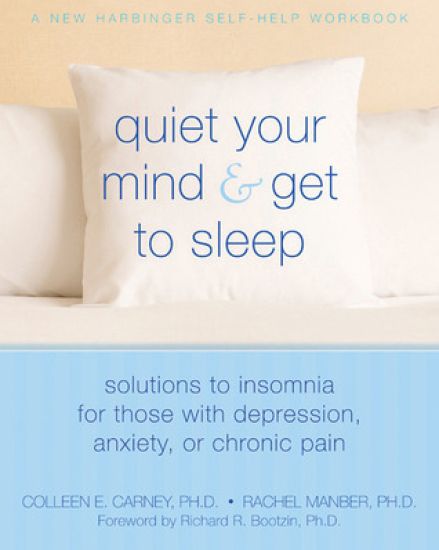
Quiet Your Mind & Get to Sleep

Quiet Your Mind & Get to Sleep

Colleen E. Carney; Rachel Manber

New Harbinger Publications
2009
pokkari
Insomnia usually appears in the presence of at least one other disorder. Particularly common co-occurring conditions include major depression, generalized anxiety, attention deficit/hyperactivity in children, and chronic pain. In sleep clinics, insomnia patients with co-occurring psychological disorders outnumber those with only insomnia two-to-one yet there are no books currently available to help those with insomnia comorbid with another mental health condition. "Quiet Your Mind and Get to Sleep" offers solutions to this sizeable population in a practical, step-by-step manner that simulates the experience of visiting a sleep therapist. This programme in this workbook is based on a proven-effective cognitive behaviour therapy (CBT) treatment program created by coauthor Colleen Carney. Readers will learn new skills for dealing with insomnia and complete simple worksheets and assignments that will help them evaluate their insomnia as well as their comorbid condition.