Kirjojen hintavertailu. Mukana 12 390 323 kirjaa ja 12 kauppaa.

Kirjailija

Columba Peoples

Kirjat ja teokset yhdessä paikassa: 5 kirjaa, julkaisuja vuosilta 2009-2024, suosituimpien joukossa Critical Security Studies. Vertaile teosten hintoja ja tarkista saatavuus suomalaisista kirjakaupoista.

5 kirjaa

Kirjojen julkaisuhaarukka 2009-2024.

Security in Crisis

Security in Crisis

Columba Peoples

Oxford University Press
2024
sidottu
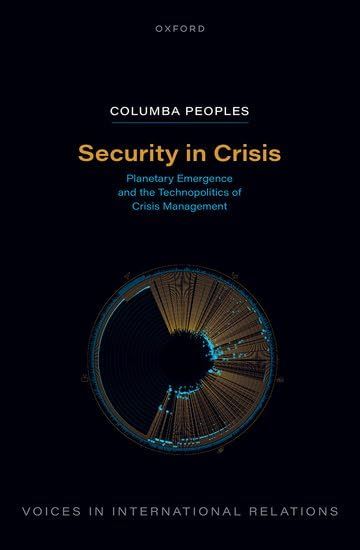
The concept of crisis is a recurrent staple in representations of modern forms of insecurity - from nuclear proliferation to cyber-security, armed conflict, the instability of political institutions, from pandemics to risks of social and financial collapse. Amidst this seeming ubiquity and ever-presence, the onset of climate and ecological emergencies as potential planetary-scale threats to the habitability of the Earth raise particularly urgent questions for how we conceive of and deal with crisis insecurity. How these forms of planetary insecurity come to be known, understood, and managed is thus of pressing importance. Security in Crisis seeks to provide an analysis of the complex combinations of political and technological understandings entailed in what it terms as 'planetary crisis management'. Arguing that the emergence, scope and scale of planetary insecurity and crisis management challenge traditional disciplinary boundaries of the study of International Relations and security, the book adopts an interdisciplinary outlook. It integrates ideas and approaches from across political theory and anthropology (on conceptions of crisis) including climate science and the wider study of environment and ecology in the 'Anthropocene' (on planetary insecurities and ideas of geoengineering); science and technology studies (on the 'technopolitics' of crisis management and the 'sociotechnical imagination' of planetary futures); and critical security studies (on critical approaches to the international and to security). In the process, the book considers how technopolitical 'fixes' for planetary crisis and emergency are often bound up with vexed questions of who 'we' are, and what it means to imagine and secure a planetary future. ABOUT THE SERIES: Voices in International Relations, published under the auspices of the European International Studies Association (EISA), furthers the development of research at the frontiers of International Relations (IR). It expands the remit of the field by including innovative scholarship that broadens key debates in the discipline, but it is more interested in reconfiguring such debates by approaching them from inside and outside the conventional core. Thematically, we aim to publish research that pushes the limits of IR conventionally defined from within and connects it to debates developing outside the discipline. We are committed to furthering diversity and inclusion in terms of authorship, location, topics and approaches from both inside and outside Europe. We have an inclusive approach to neighbouring disciplines, be it sociology, history, anthropology, geography, economics, political theory or law. Series editors: Debbie Lisle, Tanja Aalberts, Anna Leander, and Laura Sjoberg.
Critical Security Studies

Critical Security Studies

Columba Peoples; Nick Vaughan-Williams

Routledge
2020
sidottu
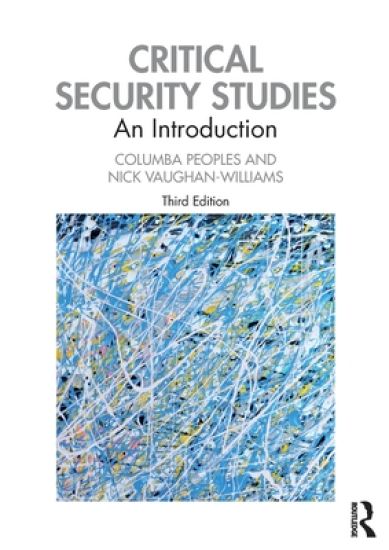
This textbook introduces students to the sub-field of critical security studies through a detailed yet accessible survey of emerging theories and practices. This third edition contains two new chapters – on ‘Ontological security’ and ‘(In)Security and the everyday’ – and has been fully revised and updated.Written in an accessible and clear manner, Critical Security Studies: offers a comprehensive and up-to-date introduction to critical security studies locates critical security studies within the broader context of social and political theory evaluates fundamental theoretical positions in critical security studies against a backdrop of new security challenges. The book is divided into two main parts. Part I, ‘Approaches’, surveys the newly extended and contested theoretical terrain of critical security studies: constructivist theories, Critical Theory, feminist and gender approaches, postcolonial perspectives, poststructuralism and International Political Sociology, Ontological security, and securitisation theory. Part II, ‘Issues’, examines how these various theoretical approaches have been put to work in critical considerations of environmental and planetary security; health, human security and development; information, technology and warfare; migration and border security; (in)security and the everyday; and terror, risk and resilience. The historical and geographical scope of the book is deliberately broad and each of the chapters in Part II concretely illustrates one or more of the approaches discussed in Part I, with clear internal referencing allowing the text to act as a holistic learning tool for students.This book is essential reading for upper level students of critical security studies, and an important resource for students of international/global security, political theory and international relations.
Critical Security Studies

Critical Security Studies

Columba Peoples; Nick Vaughan-Williams

Routledge
2020
nidottu
This textbook introduces students to the sub-field of critical security studies through a detailed yet accessible survey of emerging theories and practices. This third edition contains two new chapters – on ‘Ontological security’ and ‘(In)Security and the everyday’ – and has been fully revised and updated.Written in an accessible and clear manner, Critical Security Studies: offers a comprehensive and up-to-date introduction to critical security studies locates critical security studies within the broader context of social and political theory evaluates fundamental theoretical positions in critical security studies against a backdrop of new security challenges. The book is divided into two main parts. Part I, ‘Approaches’, surveys the newly extended and contested theoretical terrain of critical security studies: constructivist theories, Critical Theory, feminist and gender approaches, postcolonial perspectives, poststructuralism and International Political Sociology, Ontological security, and securitisation theory. Part II, ‘Issues’, examines how these various theoretical approaches have been put to work in critical considerations of environmental and planetary security; health, human security and development; information, technology and warfare; migration and border security; (in)security and the everyday; and terror, risk and resilience. The historical and geographical scope of the book is deliberately broad and each of the chapters in Part II concretely illustrates one or more of the approaches discussed in Part I, with clear internal referencing allowing the text to act as a holistic learning tool for students.This book is essential reading for upper level students of critical security studies, and an important resource for students of international/global security, political theory and international relations.
Justifying Ballistic Missile Defence

Justifying Ballistic Missile Defence

Columba Peoples

Cambridge University Press
2009
sidottu
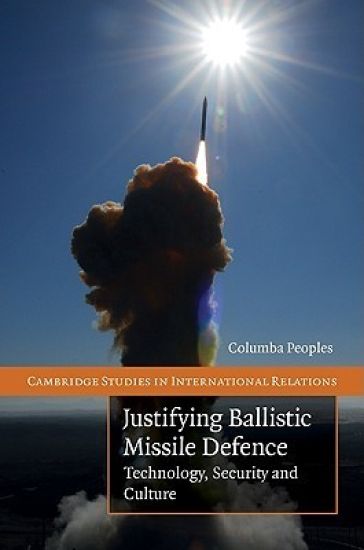
Technology is championed as the solution to modern security problems, but also blamed as their cause. This book assesses the way in which these two views collide in the debate over ballistic missile defence: a complex, costly and controversial system intended to defend the United States from nuclear missile attacks. Columba Peoples shows how, in the face of strong scientific and strategic critique, advocates of missile defence seek to justify its development by reference to broader culturally embedded perceptions of the promises and perils of technological development. Unpacking the assumptions behind the justification of missile defence initiatives, both past and present, this book illustrates how common-sense understandings of technology are combined and used to legitimate this controversial and costly defence programme. In doing so it engages fundamental debates over understandings of technological development, human agency and the relationship between technology and security.
Justifying Ballistic Missile Defence

Justifying Ballistic Missile Defence

Columba Peoples

Cambridge University Press
2009
pokkari
Technology is championed as the solution to modern security problems, but also blamed as their cause. This book assesses the way in which these two views collide in the debate over ballistic missile defence: a complex, costly and controversial system intended to defend the United States from nuclear missile attacks. Columba Peoples shows how, in the face of strong scientific and strategic critique, advocates of missile defence seek to justify its development by reference to broader culturally embedded perceptions of the promises and perils of technological development. Unpacking the assumptions behind the justification of missile defence initiatives, both past and present, this book illustrates how common-sense understandings of technology are combined and used to legitimate this controversial and costly defence programme. In doing so it engages fundamental debates over understandings of technological development, human agency and the relationship between technology and security.