Kirjojen hintavertailu. Mukana 12 595 353 kirjaa ja 12 kauppaa.

Kirjailija

Corneliu Constantinescu

Kirjat ja teokset yhdessä paikassa: 4 kirjaa, julkaisuja vuosilta 1998-2013, suosituimpien joukossa Ideale Ränder Riemannscher Flächen. Vertaile teosten hintoja ja tarkista saatavuus suomalaisista kirjakaupoista.

4 kirjaa

Kirjojen julkaisuhaarukka 1998-2013.

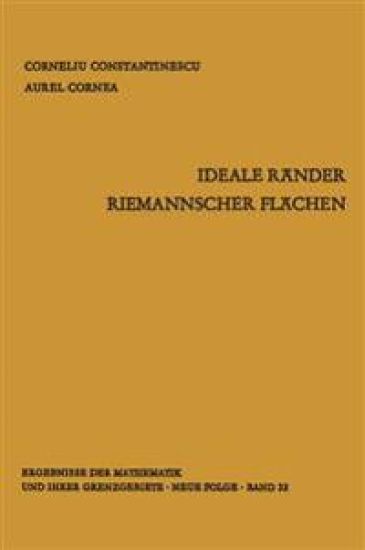
Ideale Ränder Riemannscher Flächen

Ideale Ränder Riemannscher Flächen

Corneliu Constantinescu; Aurel Cornea

Springer-Verlag Berlin and Heidelberg GmbH Co. K
2013
nidottu
Die Einflihrung der idealen Rander in der Theorie der Riemannschen FIachen solI der Erweiterung der Satze aus der Funktionentheorie auf den Fall der beliebigen Riemannschen Flachen dienen, und zwar jener Satze, die sich auf die relativen Rander der schlicht en Gebiete beziehen, wie z. B. das Dirichletsche Problem, das Poissonsche Integral, die Satze von FATOU-NEVANLINNA, BEURLING, PLESSNER, RIEsz. AuBer- dem bieten sie ein wertvolles Untersuchungsmittel - mit einer starken intuitiven Basis - flir verschiedene Probleme der Riemannschen Flachen und ermoglichen eine einfachere und durchsichtigere Beweis- flihrung. Diese doppeIte Funktion der idealen Rander flihrt zu ihrer Einteilung in zwei Kategorien. Die erste Kategorie besteht aus ein- facheren und nattirlicheren idealen Randern, die im Fall der gentigend regularen schlicht en Gebiete mit den relativen Randern zusammenfallen. Sie erlauben die Ausdehnung der obenerwahnten klassischen Satze aus der Funktionentheorie auf den Fall der Riemannschen FIachen, flihren zu eleganten Aussagen, sind aber im allgemeinen unbequem zu hand- haben. Die idealen Rander der zweiten Kategorie sind sehr kompliziert, flihren aber zu einfacheren Beweisen. Sie sind in einigen Klassifikations- fragen sehr wertvoll.

Advanced Integration Theory

Advanced Integration Theory

Corneliu Constantinescu; Wolfgang Filter; Karl Weber

Springer
2012
nidottu
Since about 1915 integration theory has consisted of two separate branches: the abstract theory required by probabilists and the theory, preferred by analysts, that combines integration and topology. As long as the underlying topological space is reasonably nice (e.g., locally compact with countable basis) the abstract theory and the topological theory yield the same results, but for more compli­ cated spaces the topological theory gives stronger results than those provided by the abstract theory. The possibility of resolving this split fascinated us, and it was one of the reasons for writing this book. The unification of the abstract theory and the topological theory is achieved by using new definitions in the abstract theory. The integral in this book is de­ fined in such a way that it coincides in the case of Radon measures on Hausdorff spaces with the usual definition in the literature. As a consequence, our integral can differ in the classical case. Our integral, however, is more inclusive. It was defined in the book "C. Constantinescu and K. Weber (in collaboration with A.
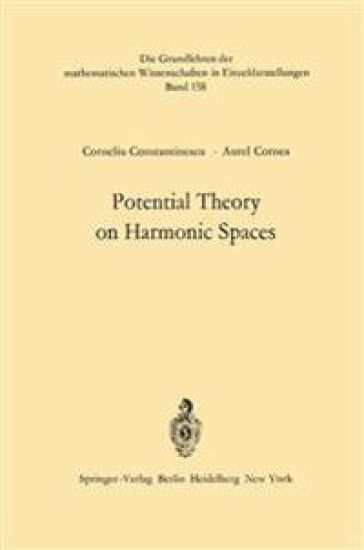
Potential Theory on Harmonic Spaces

Potential Theory on Harmonic Spaces

Corneliu Constantinescu; Aurel Cornea

Springer-Verlag Berlin and Heidelberg GmbH Co. K
2012
nidottu
There has been a considerable revival of interest in potential theory during the last 20 years. This is made evident by the appearance of new mathematical disciplines in that period which now-a-days are considered as parts of potential theory. Examples of such disciplines are: the theory of Choquet capacities, of Dirichlet spaces, of martingales and Markov processes, of integral representation in convex compact sets as well as the theory of harmonic spaces. All these theories have roots in classical potential theory. The theory of harmonic spaces, sometimes also called axiomatic theory of harmonic functions, plays a particular role among the above mentioned theories. On the one hand, this theory has particularly close connections with classical potential theory. Its main notion is that of a harmonic function and its main aim is the generalization and unification of classical results and methods for application to an extended class of elliptic and parabolic second order partial differential equations. On the other hand, the theory of harmonic spaces is closely related to the theory of Markov processes. In fact, all important notions and results of the theory have a probabilistic interpretation.
Advanced Integration Theory

Advanced Integration Theory

Corneliu Constantinescu; Wolfgang Filter; Karl Weber

Springer
1998
sidottu
Since about 1915 integration theory has consisted of two separate branches: the abstract theory required by probabilists and the theory, preferred by analysts, that combines integration and topology. As long as the underlying topological space is reasonably nice (e.g., locally compact with countable basis) the abstract theory and the topological theory yield the same results, but for more compli­ cated spaces the topological theory gives stronger results than those provided by the abstract theory. The possibility of resolving this split fascinated us, and it was one of the reasons for writing this book. The unification of the abstract theory and the topological theory is achieved by using new definitions in the abstract theory. The integral in this book is de­ fined in such a way that it coincides in the case of Radon measures on Hausdorff spaces with the usual definition in the literature. As a consequence, our integral can differ in the classical case. Our integral, however, is more inclusive. It was defined in the book "C. Constantinescu and K. Weber (in collaboration with A.