Kirjojen hintavertailu. Mukana 12 595 353 kirjaa ja 12 kauppaa.

Kirjailija

Costas Panagopoulos

Kirjat ja teokset yhdessä paikassa: 11 kirjaa, julkaisuja vuosilta 2007-2024, suosituimpien joukossa Battleground. Vertaile teosten hintoja ja tarkista saatavuus suomalaisista kirjakaupoista.

11 kirjaa

Kirjojen julkaisuhaarukka 2007-2024.

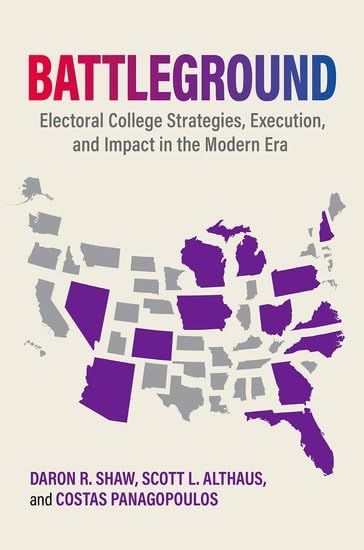
Battleground

Battleground

Daron R. Shaw; Scott L. Althaus; Costas Panagopoulos

OXFORD UNIVERSITY PRESS INC
2024
sidottu
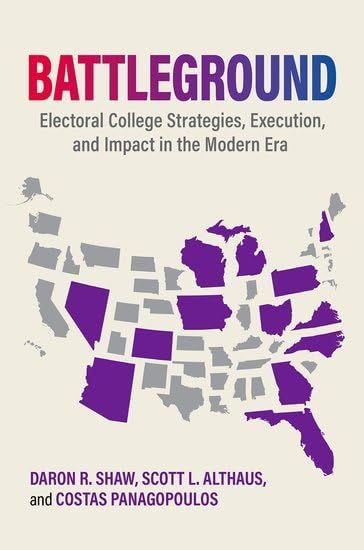
Covering the beginning of the television era to the present, Battleground provides an unprecedented look at the Electoral College strategies used by US presidential campaigns from 1952 to 2020 and what difference they make on election day. Although US presidential campaigns are among the most closely followed events in the world, academic research tends to conclude that they are much less important for shaping election-day outcomes than broader economic conditions and more gradual socio-political trends. If so, then what campaigners do and say might be entertaining, but should rarely have a decisive influence on who wins the White House. Yet because academic studies typically treat presidential elections as singular events, there is surprisingly little research that considers the strategies that parties pursue in presidential campaigning across multiple election years, how those strategies have evolved over time, or what difference those strategies might make on election day. Drawing on internal campaign records and novel data sources covering every presidential election from 1952 through 2020, Battleground identifies the Electoral College strategies for every major presidential campaign in the modern era, assesses how well they executed their plans, and illuminates what difference their state-by-state allocation of candidate visits and television spending made on election day. From Eisenhower to Trump, Daron R. Shaw, Scott Althaus, and Costas Panagopoulos show how battleground states have been selected and contested, and why campaign strategies are important for shaping Electoral College outcomes. They find that presidential campaigns in the modern era have been consistently strategic, sophisticated, and effective. As a result, campaign strategies can still be pivotal for shaping Electoral College outcomes, even if their influence looks somewhat different today than in 1952. Battleground provides readers with a sophisticated yet straightforward look at how (and how much) presidential campaigns affect the selection of the most powerful person in the world.
Battleground

Battleground

Daron R. Shaw; Scott L. Althaus; Costas Panagopoulos

OXFORD UNIVERSITY PRESS INC
2024
nidottu
Covering the beginning of the television era to the present, Battleground provides an unprecedented look at the Electoral College strategies used by US presidential campaigns from 1952 to 2020 and what difference they make on election day. Although US presidential campaigns are among the most closely followed events in the world, academic research tends to conclude that they are much less important for shaping election-day outcomes than broader economic conditions and more gradual socio-political trends. If so, then what campaigners do and say might be entertaining, but should rarely have a decisive influence on who wins the White House. Yet because academic studies typically treat presidential elections as singular events, there is surprisingly little research that considers the strategies that parties pursue in presidential campaigning across multiple election years, how those strategies have evolved over time, or what difference those strategies might make on election day. Drawing on internal campaign records and novel data sources covering every presidential election from 1952 through 2020, Battleground identifies the Electoral College strategies for every major presidential campaign in the modern era, assesses how well they executed their plans, and illuminates what difference their state-by-state allocation of candidate visits and television spending made on election day. From Eisenhower to Trump, Daron R. Shaw, Scott Althaus, and Costas Panagopoulos show how battleground states have been selected and contested, and why campaign strategies are important for shaping Electoral College outcomes. They find that presidential campaigns in the modern era have been consistently strategic, sophisticated, and effective. As a result, campaign strategies can still be pivotal for shaping Electoral College outcomes, even if their influence looks somewhat different today than in 1952. Battleground provides readers with a sophisticated yet straightforward look at how (and how much) presidential campaigns affect the selection of the most powerful person in the world.
Congressional Challengers

Congressional Challengers

Costas Panagopoulos

Routledge
2021
sidottu
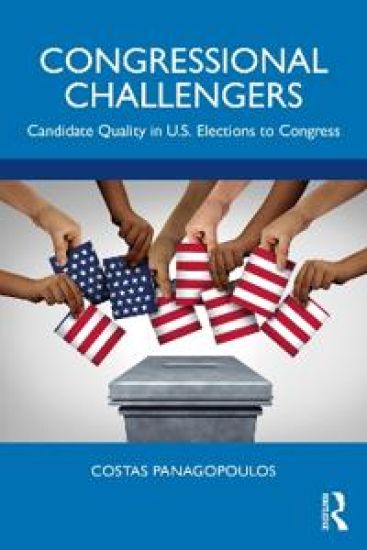
In this book, Costas Panagopoulos examines patterns of candidate emergence in congressional elections over the past five decades—specifically, the quality of challengers who seek to unseat U.S. House incumbents, as measured by prior political experience. Panagopoulos demonstrates that fewer and fewer experienced challengers have tossed their hats into the ring since the early 1970s. Inexperienced candidates often face electoral challenges that are difficult to overcome. Looking at factors including campaign spending, district-level partisan composition, and institutional reforms such as term limits, Panagopoulos evaluates explanations and consequences for these developments over time. He points to important implications for the study of congressional elections and democracy in the United States, including reforms in recruitment and candidate selection strategies to heighten electoral competition and ultimately, to enhance democratic representation in Congress. For students and scholars of the U.S. Congress and elections, this book addresses public concern about representation as well.
Congressional Challengers

Congressional Challengers

Costas Panagopoulos

TAYLOR FRANCIS LTD
2021
nidottu
In this book, Costas Panagopoulos examines patterns of candidate emergence in congressional elections over the past five decades—specifically, the quality of challengers who seek to unseat U.S. House incumbents, as measured by prior political experience. Panagopoulos demonstrates that fewer and fewer experienced challengers have tossed their hats into the ring since the early 1970s. Inexperienced candidates often face electoral challenges that are difficult to overcome. Looking at factors including campaign spending, district-level partisan composition, and institutional reforms such as term limits, Panagopoulos evaluates explanations and consequences for these developments over time. He points to important implications for the study of congressional elections and democracy in the United States, including reforms in recruitment and candidate selection strategies to heighten electoral competition and ultimately, to enhance democratic representation in Congress. For students and scholars of the U.S. Congress and elections, this book addresses public concern about representation as well.
Bases Loaded

Bases Loaded

Costas Panagopoulos

Oxford University Press Inc
2020
nidottu
Presidential campaigns in recent years have shifted their strategy to focus increasingly on base partisans, a shift that has had significant consequences for democracy in America. Over the past few decades, political campaign strategy in US elections has experienced a fundamental shift. Campaigns conducted by both Republicans and Democrats have gradually refocused their attention increasingly toward their respective partisan bases. In Bases Loaded, Costas Panagopoulos documents this shift toward base mobilization and away from voter persuasion in presidential elections between 1956 and 2016. His analyses show that this phenomenon is linked to several developments, including advances in campaign technology and voter targeting capabilities as well as insights from behavioral social science focusing on voter mobilization. Demonstrating the broader implications of the shift toward base mobilization, he links the phenomenon to growing turnout rates among strong partisans and rising partisan polarization. A novel, data-rich account of how presidential campaigns have evolved in the past quarter century, Bases Loaded argues that what campaigns do matters--not only for election outcomes, but also for political processes in the US and for American democracy.
Bases Loaded

Bases Loaded

Costas Panagopoulos

Oxford University Press Inc
2020
sidottu
Presidential campaigns in recent years have shifted their strategy to focus increasingly on base partisans, a shift that has had significant consequences for democracy in America. Over the past few decades, political campaign strategy in US elections has experienced a fundamental shift. Campaigns conducted by both Republicans and Democrats have gradually refocused their attention increasingly toward their respective partisan bases. In Bases Loaded, Costas Panagopoulos documents this shift toward base mobilization and away from voter persuasion in presidential elections between 1956 and 2016. His analyses show that this phenomenon is linked to several developments, including advances in campaign technology and voter targeting capabilities as well as insights from behavioral social science focusing on voter mobilization. Demonstrating the broader implications of the shift toward base mobilization, he links the phenomenon to growing turnout rates among strong partisans and rising partisan polarization. A novel, data-rich account of how presidential campaigns have evolved in the past quarter century, Bases Loaded argues that what campaigns do matters--not only for election outcomes, but also for political processes in the US and for American democracy.
Congressional Elections

Congressional Elections

Paul S. Herrnson; Costas Panagopoulos; Kendall L. Bailey

SAGE Publications Inc
2020
nidottu
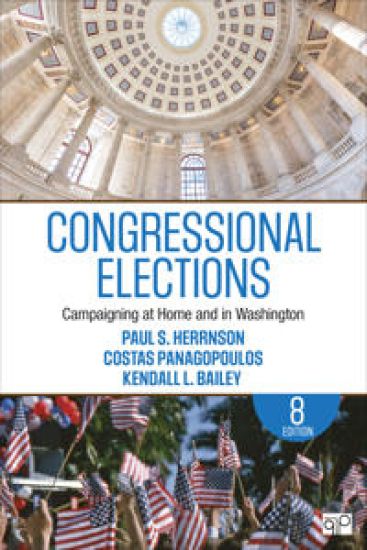
"It is the gold standard for texts on congressional campaigns and elections." — Bruce A. Larson, Gettysburg College In Congressional Elections: Campaigning at Home and in Washington authors Paul Herrnson and Costas Panagopoulos combine top-notch research with real-world politics as they argues that successful candidates run two campaigns: one for votes, the other for resources. Using campaign finance data, original survey research, and hundreds of interviews with candidates and political insiders, Herrnson and Panagopoulos look at how this dual strategy affects who wins and how it ultimately shapes the entire electoral system. The Eighth Edition considers the impact of the Internet and social media on campaigning in the 2018 elections; the growing influence of interest groups; and the influence of new voting methods on candidate, party, and voter mobilization tactics.
Political Campaigns: Concepts, Context, and Consequences

Political Campaigns: Concepts, Context, and Consequences

Costas Panagopoulos

Oxford University Press
2016
nidottu
In Political Campaigns: Concepts, Context, and Consequences, Costas Panagopoulos provides students with insight into the inner workings of contemporary campaign structures by combining findings drawn from vast amounts of scholarly research with an astute insider's perspective. The text focuses on three key elements of contemporary campaigning-"Concepts, Context, and Consequences"-examining the significance of each element as it relates to the topics discussed. "Context" refers to the political, institutional, legal, and regulatory landscapes in which contemporary campaigns operate. These conditions impact a campaign's decision-making strategies. In turn, these choices yield important implications, or "Consequences," not only for the individual campaign but also for society at large. Topics discussed include parties, interest groups, and the media; money and the modern campaign; campaign strategy; getting out the vote; technology and contemporary campaigns; and much more. Political Campaigns is part of the Oxford Series on Elections, Campaigns, and Democracy. Edited by Michael R. Alvarez (California Institute of Technology), this new series features comprehensive and accessible, as well as specialized, texts for courses in elections, public opinion, and voting behavior.
A Citizen's Guide to U.S. Elections

A Citizen's Guide to U.S. Elections

Costas Panagopoulos; Aaron Weinschenk

Routledge
2015
nidottu
Political observers routinely lament that American democracy is broken, and many of them blame electoral malfunction. But is the system really broken? Panagopoulos and Weinschenk make the case that citizens are empowered to fix what’s wrong with electoral politics and renew democracy in America, all within the institutional setup and framework of the existing system. Put simply, much of what is broken can be fixed if people stop throwing up their arms and start rolling up their sleeves to do the hard work of building our democracy. This book provides an overview of the basic features that characterize contemporary elections in the United States and includes discussions about voter participation and decision-making patterns, money in elections, and the role of parties and the media in presidential, congressional and state and local races. It also outlines some of the most important trends and challenges in the current system. As a call to action, each chapter features potential solutions to the challenges that exist in U.S. elections.
A Citizen's Guide to U.S. Elections

A Citizen's Guide to U.S. Elections

Costas Panagopoulos; Aaron Weinschenk

Routledge
2015
sidottu
Political observers routinely lament that American democracy is broken, and many of them blame electoral malfunction. But is the system really broken? Panagopoulos and Weinschenk make the case that citizens are empowered to fix what’s wrong with electoral politics and renew democracy in America, all within the institutional setup and framework of the existing system. Put simply, much of what is broken can be fixed if people stop throwing up their arms and start rolling up their sleeves to do the hard work of building our democracy. This book provides an overview of the basic features that characterize contemporary elections in the United States and includes discussions about voter participation and decision-making patterns, money in elections, and the role of parties and the media in presidential, congressional and state and local races. It also outlines some of the most important trends and challenges in the current system. As a call to action, each chapter features potential solutions to the challenges that exist in U.S. elections.
All Roads Lead to Congress

All Roads Lead to Congress

Costas Panagopoulos; Joshua Schank

CQ Press
2007
nidottu
While learning procedures like the markup or cloture, the legislative process can seem mechanical and dry. What students hunger for, and greatly benefit from, is seeing lawmaking from the inside—the backroom politics that makes the process so fascinating, so real, so compelling. All Roads Lead to Congress drives students through one piece of legislation—the surface transportation bill—showing them the maneuvering and negotiating that go on among members of Congress and their staffers as they haggle over a huge pot of money. The bill provides an example of both sides of the domestic legislative coin, as members of Congress formulating the bill fight over both policy issues (mostly along party lines) and money (mostly along regional lines).While working on the Hill, Costas Panagopoulos and Joshua Schank were able to follow the path of this legislation from inception to law, observing firsthand the twists and turns of its journey. While filled with details and dialogue reminiscent of a good novel, All Roads is sure to explain the various rules that structure legislation, the leadership styles and strategies at play, the tensions among levels of government, and the impact of the executive. Students are not only likely to read this intriguing case study of Hill life cover to cover, but they also might seriously consider an internship or future career on the Hill. More important, they will have absorbed conceptual ideas about Congress effortlessly.