Kirjojen hintavertailu. Mukana 12 152 606 kirjaa ja 12 kauppaa.

Kirjailija

Craig A. Smith

Kirjat ja teokset yhdessä paikassa: 10 kirjaa, julkaisuja vuosilta 1994-2025, suosituimpien joukossa A Vision of Voices. Vertaile teosten hintoja ja tarkista saatavuus suomalaisista kirjakaupoista.

Mukana myös kirjoitusasut: Craig a Smith

10 kirjaa

Kirjojen julkaisuhaarukka 1994-2025.

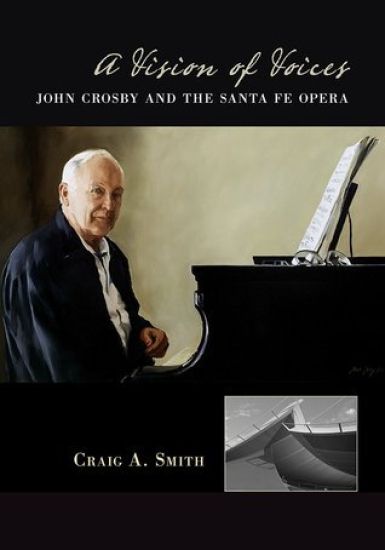
A Vision of Voices

A Vision of Voices

Craig A. Smith

University of New Mexico Press
2015
nidottu
A destination for thousands of opera lovers every year and the anchor of Santa Fe’s thriving arts scene, the Santa Fe Opera owes its existence to the vision and hard work of one man: John O’Hea Crosby (1926–2002), who created the company when he was only thirty years old and guided its fortunes for the next forty-five years. This book, the first in-depth exploration of Crosby’s career, shows how the Opera reflected his passions for music and the arts.A Vision of Voices depicts the many sides of Crosby—a dreamer and tough-minded businessman, an artistic explorer and conservative programmer, and a competent conductor and sharp critic. His devotion to quality and his obsessive oversight bore an enduring harvest that forever changed Santa Fe, the state of New Mexico, and the operatic world.
The River

The River

Craig A Smith

Into Creative
2025
nidottu
The River is a life-spanning epic novel about death and new beginnings. There's a saying, beloved of Scottish grannies: "Whit's fur ye will no' go by ye". Seemingly embracing this maxim, Lachlan McCormack lives his life as aimless as a piece of driftwood, but somehow gets to where he always wanted to be - where the river meets the sea. The novel is a love story, both to his childhood sweetheart, and to Scotland, and follows Lachlan's journey through seven decades of the nation's political, sporting and cultural history (and disappointments). Along the way, it appears that only death has the power to propel him onward, and the novel revisits the seven significant deaths that have shaped him and mapped his journey. It explores the cyclical nature of life, love, happiness, and Scotland's ongoing struggle with its place in the world.
Chinese Asianism, 1894–1945

Chinese Asianism, 1894–1945

Craig A. Smith

Harvard University, Asia Center
2021
sidottu
Chinese Asianism examines Chinese intellectual discussions of East Asian solidarity, analyzing them in connection with Chinese nationalism and Sino–Japanese relations. Beginning with texts written after the first Sino–Japanese War of 1894 and concluding with Wang Jingwei’s failed government in World War II, Craig Smith engages with a period in which the Chinese empire had crumbled and intellectuals were struggling to adapt to imperialism, new and hegemonic forms of government, and radically different epistemes. He considers a wide range of writings that show the depth of the pre-war discourse on Asianism and the influence it had on the rise of nationalism in China.Asianism was a “call” for Asian unity, Smith finds, but advocates of a united and connected Asia based on racial or civilizational commonalities also utilized the packaging of Asia for their own agendas, to the extent that efforts towards international regionalism spurred the construction of Chinese nationalism. Asianism shaped Chinese ideas of nation and region, often by translating and interpreting Japanese perspectives, and leaving behind a legacy in the concepts and terms that persist in the twenty-first century. As China plays a central role in regional East Asian development, Asianism is once again of great importance today.
The White House Speaks

The White House Speaks

Craig A. Smith; Kathy B. Smith

Praeger Publishers Inc
1994
sidottu
This work treats presidential leadership as persuasive communication. The major theories of presidential leadership found in the literature establish the central role of persuasion, and introduce the interpretive systems approach to political communication as a theoretical framework for the study of presidential leadership as persuasion. Case studies examine recent presidents' use of public persuasion to perform their leadership functions. Particular attention is devoted to coalitional constraints on presidential pardoning rhetoric, presidential leadership through the politics of division, the political significance of conflicting political narratives, the sermonic nature of much 20th-century presidential discourse, the difficulties inherent in persuading the public to make sacrifices, and the dangers of relying too heavily on public rhetoric. The concluding chapter considers the rhetoric that contributed to the demise of the Bush presidency, the election of Bill Clinton, and the challenges facing the Clinton presidency.