Kirjojen hintavertailu. Mukana 12 497 315 kirjaa ja 12 kauppaa.

Kirjailija

Craig Volden

Kirjat ja teokset yhdessä paikassa: 6 kirjaa, julkaisuja vuosilta 2005-2021, suosituimpien joukossa Revolving Gridlock. Vertaile teosten hintoja ja tarkista saatavuus suomalaisista kirjakaupoista.

6 kirjaa

Kirjojen julkaisuhaarukka 2005-2021.

Why Bad Policies Spread (and Good Ones Don't)

Why Bad Policies Spread (and Good Ones Don't)

Charles R. Shipan; Craig Volden

Cambridge University Press
2021
sidottu
Building on a deep theoretical foundation and drawing on numerous examples, we examine how policies spread across the American states. We argue that for good policies to spread while bad policies are pushed aside, states must learn from one another. The three ingredients for this positive outcome are observable experiments, time to learn, and favorable incentives and expertise among policymakers. Although these ingredients are sometimes plentiful, we also note causes for concern, such as when policies are complex or incompatible with current practices, when policymakers give in to underlying political biases, or when political institutions lack the capacity for cultivating expertise. Under such conditions, states may rely on competition, imitation, and coercion, rather than learning, which can allow bad policies, rather than good ones, to spread. We conclude with lessons for reformers and policymakers and an assessment of our overall argument based on state responses to the COVID-19 pandemic.
Why Bad Policies Spread (and Good Ones Don't)

Why Bad Policies Spread (and Good Ones Don't)

Charles R. Shipan; Craig Volden

Cambridge University Press
2021
pokkari
Building on a deep theoretical foundation and drawing on numerous examples, we examine how policies spread across the American states. We argue that for good policies to spread while bad policies are pushed aside, states must learn from one another. The three ingredients for this positive outcome are observable experiments, time to learn, and favorable incentives and expertise among policymakers. Although these ingredients are sometimes plentiful, we also note causes for concern, such as when policies are complex or incompatible with current practices, when policymakers give in to underlying political biases, or when political institutions lack the capacity for cultivating expertise. Under such conditions, states may rely on competition, imitation, and coercion, rather than learning, which can allow bad policies, rather than good ones, to spread. We conclude with lessons for reformers and policymakers and an assessment of our overall argument based on state responses to the COVID-19 pandemic.
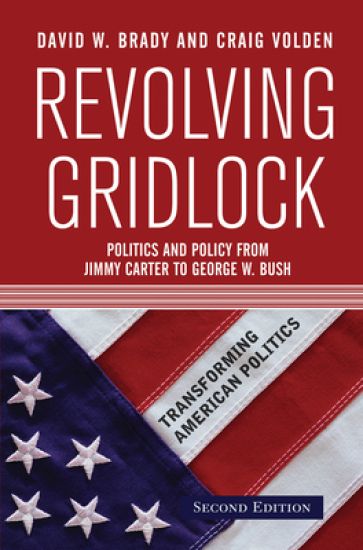
Revolving Gridlock

Revolving Gridlock

David W. Brady; Craig Volden

Routledge
2019
sidottu
Despite the early prospects for bipartisan unity on terrorism initiatives, government gridlock continues on most major issues in the wake of the 2004 elections. In this fully revised edition, political scientists David W. Brady and Craig Volden demonstrate that gridlock is not a product of divided government, party politics, or any of the usual scapegoats. It is, instead, an instrumental part of American government, built into our institutions and sustained by leaders acting rationally not only to achieve set goals but to thwart foolish inadvertencies. Looking at key legislative issues from the divided government under Reagan, through Clinton's Democratic government to complete unified Republican control under George W. Bush, the authors clearly and carefully analyze important crux points in lawmaking: the swing votes, the veto, the filibuster, and the rise of tough budget politics. They show that when it comes to government gridlock, it doesn't matter who's in the White House or who's in control of Congress; it's as American as apple pie, and its results may ultimately be as sweet in ensuring stability and democracy.
Legislative Effectiveness in the United States Congress

Legislative Effectiveness in the United States Congress

Craig Volden; Alan E. Wiseman

Cambridge University Press
2014
sidottu
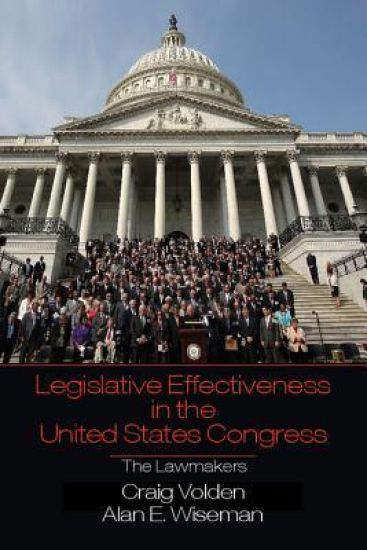
This book explores why some members of Congress are more effective than others at navigating the legislative process and what this means for how Congress is organized and what policies it produces. Craig Volden and Alan E. Wiseman develop a new metric of individual legislator effectiveness (the Legislative Effectiveness Score) that will be of interest to scholars, voters, and politicians alike. They use these scores to study party influence in Congress, the successes or failures of women and African Americans in Congress, policy gridlock, and the specific strategies that lawmakers employ to advance their agendas.
Legislative Effectiveness in the United States Congress

Legislative Effectiveness in the United States Congress

Craig Volden; Alan E. Wiseman

Cambridge University Press
2014
pokkari
This book explores why some members of Congress are more effective than others at navigating the legislative process and what this means for how Congress is organized and what policies it produces. Craig Volden and Alan E. Wiseman develop a new metric of individual legislator effectiveness (the Legislative Effectiveness Score) that will be of interest to scholars, voters, and politicians alike. They use these scores to study party influence in Congress, the successes or failures of women and African Americans in Congress, policy gridlock, and the specific strategies that lawmakers employ to advance their agendas.
Revolving Gridlock

Revolving Gridlock

Craig Volden; David W. Brady

Westview Press Inc
2005
pokkari
Despite the early prospects for bipartisan unity on terrorism initiatives, government gridlock continues on most major issues in the wake of the 2004 elections. In this fully revised edition, political scientists David W. Brady and Craig Volden demonstrate that gridlock is not a product of divided government, party politics, or any of the usual scapegoats. It is, instead, an instrumental part of American government,built into our institutions and sustained by leaders acting rationally not only to achieve set goals but to thwart foolish inadvertencies. Looking at key legislative issues from the divided government under Reagan, through Clinton's Democratic government to complete unified Republican control under George W. Bush, the authors clearly and carefully analyze important crux points in lawmaking: the swing votes, the veto, the filibuster, and the rise of tough budget politics. They show that when it comes to government gridlock, it doesn't matter who's in the White House or who's in control of Congress it's as American as apple pie, and its results may ultimately be as sweet in ensuring stability and democracy.