Kirjojen hintavertailu. Mukana 12 595 353 kirjaa ja 12 kauppaa.

Kirjailija

Csaba Szabo

Kirjat ja teokset yhdessä paikassa: 6 kirjaa, julkaisuja vuosilta 2018-2025, suosituimpien joukossa Unreliable. Vertaile teosten hintoja ja tarkista saatavuus suomalaisista kirjakaupoista.

Mukana myös kirjoitusasut: Csaba Szabó

6 kirjaa

Kirjojen julkaisuhaarukka 2018-2025.

Unreliable

Unreliable

Csaba Szabo

Columbia University Press
2025
sidottu
Reproducibility is fundamental to the scientific method. After reading a paper describing research findings, a scientist should be able to repeat the experiment and obtain the same results. Yet an alarming number—perhaps as high as 90 percent—of published biomedical research papers face challenges in independent replication. Such issues range from honest mistakes to outright fraud. The scope of this crisis, however, underscores deeper systemic issues within the scientific community: its culture, incentives, and institutions.In Unreliable, the distinguished scientist Csaba Szabo examines the causes and consequences of the reproducibility crisis in biomedical research, showing why the factors that encourage misconduct stem from flaws in real-world science. There are many culprits, including commonplace research methods and dubious statistical techniques. Academic career incentives, hypercompetition for grant funding, and a bias toward publishing positive results have exacerbated the problem. Deliberate data manipulation and fabricated findings churned out by “paper mills” are disturbingly common. Academic institutions and publishers, for their part, have perpetuated a culture of impunity.Szabo explores how these failures have hindered scientific progress and impeded the development of new treatments, and he introduces readers to the “science sleuths” who tirelessly uncover misconduct. He proposes comprehensive reforms, from scientific training to the grant system through the publication process, to address the root causes of the crisis. Written in clear language and leavened with a keen sense of irony, Unreliable is an essential account of the reproducibility crisis that gives readers an inside look at how science is actually done.

Unreliable

Unreliable

Csaba Szabo

Columbia University Press
2025
pokkari
Reproducibility is fundamental to the scientific method. After reading a paper describing research findings, a scientist should be able to repeat the experiment and obtain the same results. Yet an alarming number—perhaps as high as 90 percent—of published biomedical research papers face challenges in independent replication. Such issues range from honest mistakes to outright fraud. The scope of this crisis, however, underscores deeper systemic issues within the scientific community: its culture, incentives, and institutions.In Unreliable, the distinguished scientist Csaba Szabo examines the causes and consequences of the reproducibility crisis in biomedical research, showing why the factors that encourage misconduct stem from flaws in real-world science. There are many culprits, including commonplace research methods and dubious statistical techniques. Academic career incentives, hypercompetition for grant funding, and a bias toward publishing positive results have exacerbated the problem. Deliberate data manipulation and fabricated findings churned out by “paper mills” are disturbingly common. Academic institutions and publishers, for their part, have perpetuated a culture of impunity.Szabo explores how these failures have hindered scientific progress and impeded the development of new treatments, and he introduces readers to the “science sleuths” who tirelessly uncover misconduct. He proposes comprehensive reforms, from scientific training to the grant system through the publication process, to address the root causes of the crisis. Written in clear language and leavened with a keen sense of irony, Unreliable is an essential account of the reproducibility crisis that gives readers an inside look at how science is actually done.
Sanctuaries in Roman Dacia

Sanctuaries in Roman Dacia

Csaba Szabo

Archaeopress
2018
nidottu
This book is the first comprehensive work focusing on lived ancient religious communication in Roman Dacia. Testing for the first time the ‘Lived Ancient Religion’ approach in terms of a peripheral province from the Danubian area, this work looks at the role of ‘sacralised’ spaces, known commonly as sanctuaries in the religious communication of the province. The author analyses the role of space sacralisation, religious appropriation, embodiment and the social impact of religious communication in urban contexts (Apulum), military contexts (Porolissum and Mehadia), and numerous examples from rural (non-urban) environments (Ampelum, Germisara, Ad Mediam, and many others). The book concentrates not only on the creation and maintenance of sacralised spaces in public and secondary locations, but also on their role at the micro-level of objects, semi-micro level of spaces (settlements), and the macro-level of the province and the Danubian region as a whole. Innovatively as regards provincial archaeological research, this book emphasises the spatial aspects of lived ancient religion by analysing for the first time the sanctuaries as spaces of religious communication in Dacia. The work also contains a significant chapter on the so-called ‘small-group’ religions (the Bacchic, Mithraic and Dolichenian groups of the province), which are approached for the first time in detail. The study also gives the first comprehensive list of archaeologicallyepigraphically- attested, and presumed sacralised spaces within Dacia.
Roman Religion in the Danubian Provinces
The Danubian provinces represent one of the largest macro-units within the Roman Empire, with a large and rich heritage of Roman material evidence. Although the notion itself is a modern 18th-century creation, this region represents a unique area, where the dominant, pre-Roman cultures (Celtic, Illyrian, Hellenistic, Thracian) are interconnected within the new administrative, economic and cultural units of Roman cities, provinces and extra-provincial networks. This book presents the material evidence of Roman religion in the Danubian provinces through a new, paradigmatic methodology, focusing not only on the traditional urban and provincial units of the Roman Empire, but on a new space taxonomy. Roman religion and its sacralised places are presented in macro-, meso- and micro-spaces of a dynamic empire, which shaped Roman religion in the 1st-3rd centuries AD and created a large number of religious glocalizations and appropriations in Raetia, Noricum, Pannonia Superior, Pannonia Inferior, Moesia Superior, Moesia Inferior and Dacia. Combining the methodological approaches of Roman provincial archaeology and religious studies, this work intends to provoke a dialogue between disciplines rarely used together in central-east Europe and beyond. The material evidence of Roman religion is interpreted here as a dynamic agent in religious communication, shaped by macro-spaces, extra-provincial routes, commercial networks, but also by the formation and constant dynamics of small group religions interconnected within this region through human and material mobilities. The book also presents for the first time a comprehensive list of sacralised spaces and divinities in the Danubian provinces.
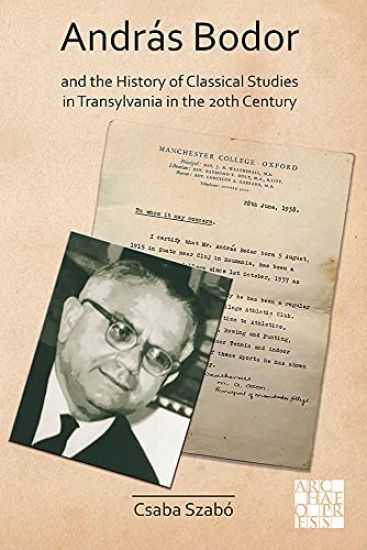
András Bodor and the History of Classical Studies in Transylvania in the 20th century
András Bodor and the history of classical studies in Transylvania in the 20th century is the first comprehensive work focusing on the life of a classicist from Transylvania, presenting in detail the life and academic heritage of András Bodor (1915-1999). Based on 1348 newly identified letters, 209 photographs (including 25 portraits), András Bodor’s complete bibliography and his unpublished memoir from 1915-1959, the work offers also the first publication of Bodor’s academic correspondence (107 letters) and also extracts from his unpublished journal. Based on a large number of unpublished documents and the major works of Bodor, the book tries to reconstruct the life and academic heritage of a classicist from the periphery of Europe, a region that changed so many times over the long course of the 20th century. András Bodor appears as a student torn between theology and classical studies, a Transylvanian Hungarian who ended up at Oxford, a lecturer at the Hungarian University of Cluj, a researcher who had the idea of establishing a new school of classics, marginalised and compromising, a quiet teacher of the newly established Babe?-Bolyai University and also a senior professor engaged in education policy. The personality and work of Bodor is presented through the short history of classics in Transylvania, Romania, reflecting on the European and global changes of the discipline.
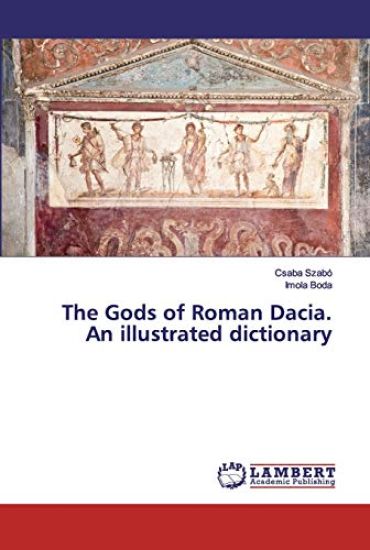
The Gods of Roman Dacia. An illustrated dictionary

The Gods of Roman Dacia. An illustrated dictionary

Csaba Szabó; Imola Boda

LAP Lambert Academic Publishing
2019
pokkari
This dictionary is a revised and extended version of the mythological dictionary of the Bibliography of Roman Religion in Dacia (BRRD) published in 2014. The main aim of the dictionary of the BRRD was to offer the first comprehensive mythological dictionary and list of divinities and personifications attested on epigraphic and figural monuments from Dacia, mostly for students and the greater public. The pictures (more than 100 illustrations) represent in most of the cases some iconographic analogies found in the territory of Dacia or - when there is no figurative representation - inscriptions. Because the results of the CSIR projects focusing on Roman material of Romania are still not published, most of the pictures are from the monumental work of Ortolf Harl, the Bilddatenbank Ubi Erat Lupa (abbreviated as lupa in the text with the register number of the picture) and from the digital catalogue of bronze statuettes of Roman Dacia. Other photos are used from publications mentioned in the bibliography.