Kirjojen hintavertailu. Mukana 12 595 353 kirjaa ja 12 kauppaa.

Kirjailija

D. Allan Bromley

Kirjat ja teokset yhdessä paikassa: 4 kirjaa, julkaisuja vuosilta 1994-2013, suosituimpien joukossa Quantum Mechanics. Vertaile teosten hintoja ja tarkista saatavuus suomalaisista kirjakaupoista.

4 kirjaa

Kirjojen julkaisuhaarukka 1994-2013.

A Century of Physics

A Century of Physics

D. Allan Bromley

Springer-Verlag New York Inc.
2013
nidottu
In this amazing tour d'horizon, D. Allan Bromley uses the occasion of the centenary of the American Physical Society to reflect upon the growth of physics over the past 100 years, its fragmentation into numerous subdisciplines, the impact physics has had upon modern technology, and the re-emergence of the fundamental unity of the discipline in recent years. Hundreds of historical illustrations accompany the text. Bromley conveys much of the excitement and wonder that research in physics generated in the 20th century and asks what new things are in store in the next century. He covers such topics as relativity and quantum mechanics, the Manhattan project, superconductivity, transistors and the revolution brought about by solid-state electronics, protein folding, the uses of nuclear and atomic physics in biology and medicine, plate tectonics, the expansion of the universe and the Big Bang, and gravitational radiation. Bromley, the Sterling Professor of the Sciences and Dean of Yale University, served as Assistant to the President for Science and Technology Policy 1989-1993 and was president of the American Physical Society in 1997. One of the World's leading nuclear scientists, he was founder and director of Yale's nuclear structure laboratory and has received numerous medals and awards, including the National Medal of Science.

A Century of Physics

A Century of Physics

D. Allan Bromley

Springer-Verlag New York Inc.
2001
sidottu
In this amazing tour d'horizon, D. Allan Bromley uses the occasion of the centenary of the American Physical Society to reflect upon the growth of physics over the past 100 years, its fragmentation into numerous subdisciplines, the impact physics has had upon modern technology, and the re-emergence of the fundamental unity of the discipline in recent years. Hundreds of historical illustrations accompany the text. Bromley conveys much of the excitement and wonder that research in physics generated in the 20th century and asks what new things are in store in the next century. He covers such topics as relativity and quantum mechanics, the Manhattan project, superconductivity, transistors and the revolution brought about by solid-state electronics, protein folding, the uses of nuclear and atomic physics in biology and medicine, plate tectonics, the expansion of the universe and the Big Bang, and gravitational radiation. Bromley, the Sterling Professor of the Sciences and Dean of Yale University, served as Assistant to the President for Science and Technology Policy 1989-1993 and was president of the American Physical Society in 1997. One of the World's leading nuclear scientists, he was founder and director of Yale's nuclear structure laboratory and has received numerous medals and awards, including the National Medal of Science.

Quantum Mechanics

Quantum Mechanics

Walter Greiner; D. Allan Bromley

Springer-Verlag Berlin and Heidelberg GmbH Co. K
2000
nidottu
This text lays the foundations for the rest of the course on advanced quantum mechanics and field theory. Starting from black-body radiation, the photoelectric effect, and wave-particle duality, the author goes on to discuss the uncertainty relations, spin, many-body systems, and other topics.
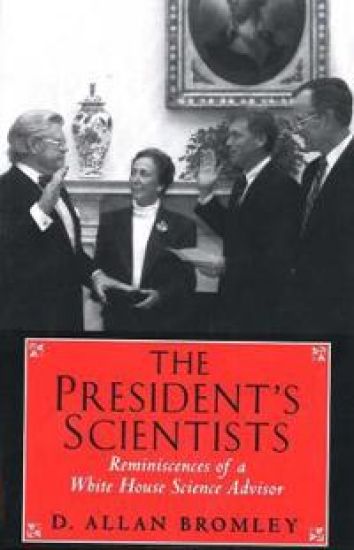
The President’s Scientists

The President’s Scientists

D. Allan Bromley

Yale University Press
1994
pokkari
D. Allan Bromley, one of the world's leading nuclear physicists, was The Assistant to President George Bush for Science and Technology Policy from August 1989 to January 1993. He was the first Science Advisor to have this Cabinet-level rank.In this engrossing memoir of his years at the White House, Bromley brings the unique perspective of a scientist to the political realities of policy making with the President and his other Senior Assistants. Bromley recalls his efforts to rebuild the Office of Science and Technology Policy and the Federal Coordinating Council for Science, Engineering, and Technology, organizations that develop science policy and that oversee the federal agencies responsible for the science and technology enterprise of the United States; the Bush Administration initiatives to improve the global environment, the health and quality of life of all Americans, national security, international science and technology, and funding of U.S. science and technology; and the landmark reports prepared under his supervision that called for a revamping of the science and mathematics curricula in U.S. precollege education and a rethinking of the relationships between the research intensive universities and the federal government. He discusses the people with whom he interacted—George Bush, John Sununu (Bromley's strongest ally in the White House), Richard Darman, Senator Al Gore, and many others—and he includes provocative anecdotes about his attempts—many successful—to foster closer cooperative scientific ventures with other countries. Bromley's memoir is both a broad overview of the role of science and technology in the Bush Administration and an insider's account of the ambiance, personalities, and politics that mold specific policy decisions in Washington. It is fascinating and thought-provoking reading.