Kirjojen hintavertailu. Mukana 12 152 606 kirjaa ja 12 kauppaa.

Kirjailija

D. Brooks

Kirjat ja teokset yhdessä paikassa: 3 kirjaa, julkaisuja vuodelta 2011, suosituimpien joukossa NHS Data Book. Vertaile teosten hintoja ja tarkista saatavuus suomalaisista kirjakaupoista.

3 kirjaa

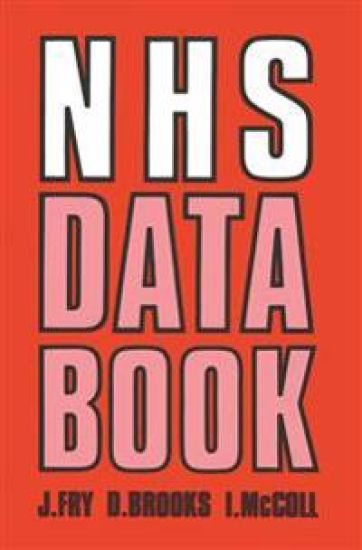
NHS Data Book

NHS Data Book

John Fry; D. Brooks

Springer
2011
nidottu
Administering the National Health Service (NHS) is asking to navigate without reliable and sufficient information. It is amazing how a national service costing more than £15,OOOM (1984) and employing more than 1 million has existed since 1948. It is likely that with better appropriate data there could be economies and great efficiency and effectiveness. Paradoxically there is much data on the NHS, published and unpublished, that has remained unexploited and unused. In this book we have taken up the challenges of showing the availability of data and its presentation so that clinicians, adminis­ trators, committee members and politicians can better understand the state and needs of the NHS. Why this book? Because it is not possible to make decisions without facts. There is too much data around that is unrelated to the needs of clinicians, administrators, committee members and politicians. It can be brought together to provide bases for de­ cisions and, more important, to show the gaps that exist and the need for more information. What does it contain? It includes social and demographic data, NHS facts and figures, manpower data on the use of the NHS and some examples of how quality can be assessed and promoted.
Infectious Diseases

Infectious Diseases

D. Brooks; Edward M. Dunbar

Springer
2011
nidottu
DDDDDDDDDDDD Effective management logically follows accurate diagnosis. Such logic often is difficult to apply in practice. Absolute diagnostic accuracy may not be possible, particularly in the field of primary care, when management has to be on analysis of symptoms and on knowledge of the individual patient and family. This series follows that on Problems in Practice which was con­ cerned more with diagnosis in the widest sense and this series deals more definitively with general care and specific treatment of symp­ toms and diseases. Good management must include knowledge of the nature, course and outcome of the conditions, as well as prominent clinical features and assessment and investigations, but the em­ phasis is on what to do best for the patient. Family medical practitioners have particular difficu1ties and ad­ vantages in their work_ Because they often work in professional isolation in the community and deal with relatively small numbers of near-normal patients their experience with the more serious and more rare conditions is restricted. They find it difficult to remain up-to-date with medical advances and even more difficult to decide on the suitability and application of new and relatively untried methods compared with those that are 'old' and well proven. Their advantages are that because of long-term continuous care for their patients they have come to know them and their families FOREWORD well and are able to become familiar with the more common and less serious diseases of their communities.
Disease Data Book

Disease Data Book

John Fry; G. Sandler; D. Brooks

Springer
2011
nidottu
Herewe offer anew approach to understanding and managing common medical conditions. With the needs of our readers in mind we present clearer, more extensive and more expansive views on them. Traditional medical textbooks are wordy tomes with well worn patterns dealing in set order with 'causes, symptoms and signs, diagnosis and treatment'. They offer formal instant snapshots of diseases. We have devised an economic synoptic style, and we have endeavoured to give acomprehensive and an on-going long term movepicture ofeach condition and to relate this to the analysisofsymptoms and signs, to diagnostic assessment and to management and treatment. We have selected 22 important conditions and for eachhave followed the same sequence of questions and answers: • What is it? giving a brief summary of the current understanding of the nature of the condition. • Who gets it when? showing the age-sex distributions and influence ofother factors such as social class, international comparisons, andtheirlikelyfrequency ingeneralpractice and at the district general hospital. • What happens? analysing the significance of symptoms and signs, the likely course and outcome and how these influence care. • What to do? an appreciation of the nature and presentation of the condition, and their relevance to diagnosis and management.