Kirjojen hintavertailu. Mukana 12 112 296 kirjaa ja 12 kauppaa.

Kirjailija

D. L. Borchers

Kirjat ja teokset yhdessä paikassa: 4 kirjaa, julkaisuja vuosilta 2002-2016, suosituimpien joukossa Modelling Population Dynamics. Vertaile teosten hintoja ja tarkista saatavuus suomalaisista kirjakaupoista.

Mukana myös kirjoitusasut: D.L. Borchers

4 kirjaa

Kirjojen julkaisuhaarukka 2002-2016.

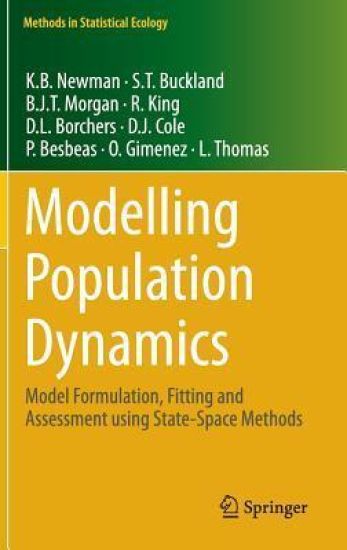
Modelling Population Dynamics

Modelling Population Dynamics

K. B. Newman; S. T. Buckland; B. J. T. Morgan; R. King; D. L. Borchers; D. J. Cole; P. Besbeas; O. Gimenez; L. Thomas

Springer-Verlag New York Inc.
2014
sidottu
This book gives a unifying framework for estimating the abundance of open populations: populations subject to births, deaths and movement, given imperfect measurements or samples of the populations. The focus is primarily on populations of vertebrates for which dynamics are typically modelled within the framework of an annual cycle, and for which stochastic variability in the demographic processes is usually modest. Discrete-time models are developed in which animals can be assigned to discrete states such as age class, gender, maturity, population (within a metapopulation), or species (for multi-species models).The book goes well beyond estimation of abundance, allowing inference on underlying population processes such as birth or recruitment, survival and movement. This requires the formulation and fitting of population dynamics models. The resulting fitted models yield both estimates of abundance and estimates of parameters characterizing the underlying processes.
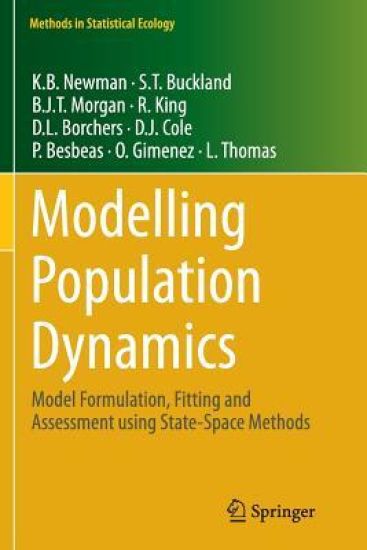
Modelling Population Dynamics

Modelling Population Dynamics

K. B. Newman; S. T. Buckland; B. J. T. Morgan; R. King; D. L. Borchers; D. J. Cole; P. Besbeas; O. Gimenez; L. Thomas

Springer-Verlag New York Inc.
2016
nidottu
This book gives a unifying framework for estimating the abundance of open populations: populations subject to births, deaths and movement, given imperfect measurements or samples of the populations. The focus is primarily on populations of vertebrates for which dynamics are typically modelled within the framework of an annual cycle, and for which stochastic variability in the demographic processes is usually modest. Discrete-time models are developed in which animals can be assigned to discrete states such as age class, gender, maturity, population (within a metapopulation), or species (for multi-species models).The book goes well beyond estimation of abundance, allowing inference on underlying population processes such as birth or recruitment, survival and movement. This requires the formulation and fitting of population dynamics models. The resulting fitted models yield both estimates of abundance and estimates of parameters characterizing the underlying processes.
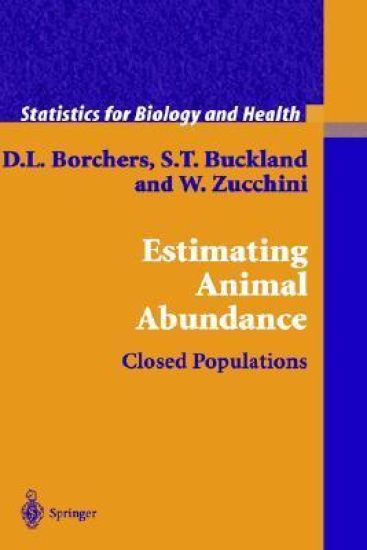
Estimating Animal Abundance

Estimating Animal Abundance

D.L. Borchers; Stephen T. Buckland; Walter Zucchini

Springer London Ltd
2010
nidottu
We hope this book will make the bewildering variety of methods for estimat­ ing the abundance of animal populations more accessible to the uninitiated and more coherent to the cogniscenti. We have tried to emphasize the fun­ damental similarity of many methods and to draw out the common threads that underlie them. With the exception of Chapter 13, we restrict ourselves to closed populations (those that do not change in composition over the period(s) being considered). Open population methods are in many ways simply extensions of closed population methods, and we have tried to pro­ vide the reader with a foundation on which understanding of both closed and open population methods can develop. We would like to thank Miguel Bernal for providing the St Andrews example dataset used frequently in the book; Miguel Bernal and Jeff Laake for commenting on drafts of the book; Jeff Laake for providing Figure 10.1; NRC Research Press for allowing us to use Figures 10.2, 10.3, 10.4, 10.5, 10.6 and10.7; the International Whaling Commission for allowing us to use Figure 12.1; Sharon Hedley for providing Figures 12.1 and 12.2. D.L.B. is eternally indebted to Carol, Alice and Aidan for their support through writing the book, and for the many evenings and weekends that it has taken from them.
Estimating Animal Abundance

Estimating Animal Abundance

D.L. Borchers; Stephen T. Buckland; Walter Zucchini

Springer London Ltd
2002
sidottu
We hope this book will make the bewildering variety of methods for estimat­ ing the abundance of animal populations more accessible to the uninitiated and more coherent to the cogniscenti. We have tried to emphasize the fun­ damental similarity of many methods and to draw out the common threads that underlie them. With the exception of Chapter 13, we restrict ourselves to closed populations (those that do not change in composition over the period(s) being considered). Open population methods are in many ways simply extensions of closed population methods, and we have tried to pro­ vide the reader with a foundation on which understanding of both closed and open population methods can develop. We would like to thank Miguel Bernal for providing the St Andrews example dataset used frequently in the book; Miguel Bernal and Jeff Laake for commenting on drafts of the book; Jeff Laake for providing Figure 10.1; NRC Research Press for allowing us to use Figures 10.2, 10.3, 10.4, 10.5, 10.6 and10.7; the International Whaling Commission for allowing us to use Figure 12.1; Sharon Hedley for providing Figures 12.1 and 12.2. D.L.B. is eternally indebted to Carol, Alice and Aidan for their support through writing the book, and for the many evenings and weekends that it has taken from them.