Kirjojen hintavertailu. Mukana 12 595 353 kirjaa ja 12 kauppaa.

Kirjailija

D. L. Mayfield

Kirjat ja teokset yhdessä paikassa: 9 kirjaa, julkaisuja vuosilta 2016-2022, suosituimpien joukossa Plough Quarterly No. 9. Vertaile teosten hintoja ja tarkista saatavuus suomalaisista kirjakaupoista.

Mukana myös kirjoitusasut: D L Mayfield, D.L. Mayfield

9 kirjaa

Kirjojen julkaisuhaarukka 2016-2022.

Plough Quarterly No. 9

Plough Quarterly No. 9

Stanley Hauerwas; Rick Warren; Leonardo Boff; Chiara Lubich; C. S. Lewis; Jean Vanier; Henri J. M. Nouwen; Eberhard Arnold; D. L. Mayfield

Plough Publishing House
2016
pokkari
With the concept of socialism back in mainstream conversations and increasing numbers of Christians unhappy with “Sunday Christianity,” it’s time to give the lifestyle of Jesus’ first followers another look. This issue of Plough Quarterly does just that, profiling intentional Christian communities past and present and gleaning wisdom on the daily practicalities and pitfalls of communal living from those with years of experience in following Jesus together. Hear from Stanley Hauerwas, Rick Warren, Leonardo Boff, Chiara Lubich, C. S. Lewis, Jean Vanier, Henri J. M. Nouwen, Eberhard Arnold, and D. L. Mayfield. Then there’s new poetry, book reviews, a children’s story by Kwon Jong-saeng, and world-class art by Salvador Dali, Wassily Kandinsky, Juan Rizi, Marianne Stokes, Francisco de Zurbarán, Dong-Sung Kim, Christian Schussele, Gustave Caillebotte. Plough Quarterly features stories, ideas, and culture for people eager to put their faith into action. Each issue brings you in-depth articles, interviews, poetry, book reviews, and art to help you put Jesus’ message into practice and find common cause with others.
Plough Quarterly No. 16 - America's Prophet

Plough Quarterly No. 16 - America's Prophet

Edwidge Danticat; Susannah Heschel; Eugene F. Rivers III; Brandon M. Terry; Gary Dorrien; D. L. Mayfield; Chris Gibson; Oscar Romero; Oddny Gumaer; Nathaniel Peters; Philip Britts

Plough Publishing House
2018
pokkari
What if Martin Luther King Jr., this name-branded, oft-sanitized preacher from Atlanta, is a prophet whose message America has yet to fully reckon with? Ten days before Martin Luther King Jr.’s assassination, Rabbi Abraham Joshua Heschel said, “Where in America today do we hear a voice like the voice of the prophets of Israel? Martin Luther King is a sign that God has not forsaken the United States of America. God has sent him to us.” What if Heschel’s words about King are true? What if this name-branded, oft-sanitized, Super-Bowl-ad-commercialized, National-Mall-memorialized preacher from Atlanta . . . is a prophet whose message America has yet to fully reckon with? This issue of Plough Quarterly looks at King’s unfinished struggle against the three evils of racism, materialism, and militarism. Perspectives from Edwidge Danticat, Gary Dorrien, Brandon M. Terry, D. L. Mayfield, Eugene Rivers, and Susannah Heschel explore the ways King’s message of nonviolence, justice, and love of neighbor still matters today: to refugees and immigrants, soldiers and veterans, preachers and prisoners, black lives matter activists and the white working class. Also in this issue: original poetry by Naomi Shihab Nye; reviews of new books by James Forman Jr., Steve Krivák, Jim Forest, and Christopher de Hamel; and art by Yvan Lamothe, Roberson Joseph, Barry Moser, Benny Andrews, Zoe Cromwell, Julian Peters, Asuka Hishiki, Mark Smith, Mary Kang, Marc Chagall, John Partipilo, Yuri Kozyrev, Vinicius Barajas, Iain Stewart, Giovanni Bellini. Plough Quarterly features stories, ideas, and culture for people eager to put their faith into action. Each issue brings you in-depth articles, interviews, poetry, book reviews, and art to help you put Jesus’ message into practice and find common cause with others.
The Myth of the American Dream – Reflections on Affluence, Autonomy, Safety, and Power
>2020 ECPA Top Shelf Book Cover Award Publishers Weekly starred review. Affluence, autonomy, safety, and power. These are the central values of the American dream. But are they compatible with Jesus' command to love our neighbor as ourselves? In essays grouped around these four values, D. L. Mayfield asks us to pay attention to the ways they shape our own choices, and the ways those choices affect our neighbors. Where did these values come from? How have they failed those on the edges of our society? And how can we disentangle ourselves from our culture's headlong pursuit of these values and live faithful lives of service to God and our neighbors?
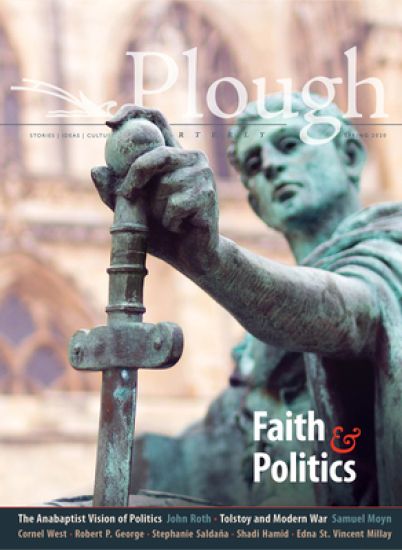
Plough Quarterly No. 24 – Faith and Politics

Plough Quarterly No. 24 – Faith and Politics

Cornel West; Robert P. Geroge; Stephanie Saldaña; Samuel Moyn; Shadi Hamid; Sally Thomas; John D. Roth; John Huleatt; D. L. Mayfield; Julian Peters; Abraham Joshua Heschel; Mesissa Ohden

Plough Publishing House
2020
pokkari
No matter who wins the next election, Caesar will remain Caesar, doing some good and some bad. But Christians report to a different king. This issue starts with a provocation. In his opening letter, editor Peter Mommsen suggests Christians are too excited about the wrong politics: “Questions of public justice should matter deeply to Christians. We dare not be indifferent about securing healthcare for all and ending interventionist wars; we must seek to reduce abortions and strengthen families. When an election comes, we should pray and then, perhaps, lend our support to a candidate we judge may, on balance, advance social righteousness. But if the early Christians and the Anabaptists are right, this isn’t the politics that matters most. And so, as a matter of faithfulness, we should question how much it deserves of our passion and time. Our allegiance belongs elsewhere.” In contrast to an election campaign, this politics may feel grittier and less glamorous. This issue of Plough Quarterly explores what this alternate vision of faithful Christian witness in the political sphere might look like. You’ll find articles on: What two leading political theorists of left and right agree on What persecution taught Anabaptists about politics The Bruderhof’s interactions with the state Tolstoy’s case against making war more humane How some Christians read Romans 13 under fascism
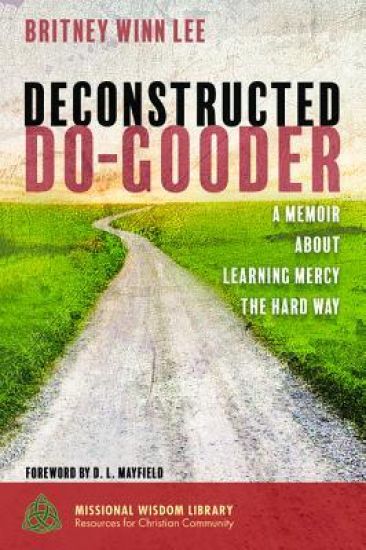
Deconstructed Do-Gooder

Deconstructed Do-Gooder

Britney Winn Lee; D L Mayfield

Cascade Books
2019
pokkari
In a Christian culture driven by answer-knowing and movement-making, we have largely become addicted to figuring out the way and ensuring that others are walking it as well in order to be counted faithful. An addict to this end herself, Britney Winn Lee is no stranger to the question posed by the lawmaker in the story of the Good Samaritan: ""Teacher, what must I do . . . ?"" Here, she takes us through her journey of becoming every character in the parable--from Priest to Innkeeper, from Robber to Wounded. Lee offers us an invitation to find ourselves in the story, be that in conservative evangelicalism, overseas missions, new monastic communities, cynical doubts, or the pain of postpartum depression and ministries ending. Her complicated road of theological deconstructions (expressed through narrative) exposes the harm that can be caused by a deep desire to do good as well as the mercy that can be found when all of one's religious paths and purposes are lost. ""What does it look like to love one other after we've been stripped of pride and certainty, or knocked down by exhaustion and grief? In Deconstructed Do-Gooder, Britney Winn Lee invites us into her journey from bright-eyed optimism to holy hustle, and ultimately, to the acceptance that she is spectacularly human. Her story vibrates with tension and sparkles with ordinary life. In the end, she reminds us that surrendering to the gospel can only mean surrendering to mercy. I wish I'd read this decades ago."" --Shannan Martin, author of The Ministry of Ordinary Places and Falling Free ""This is a memoir of new monasticism, a work of narrative theology, a story of continual deconstruction and reconstruction. And in the end, it invites the reader to think about their own roles in this, the most famous story of Jesus. The hero, the villain--or something in between? May you read it, be encouraged, and consider what it might mean to work towards entire systems that are built to take care of our most vulnerable."" --from the foreword by D.L. Mayfield, author of Assimilate or Go Home Britney Winn Lee is one of those rare voices in contemporary Christian discourse whose joyful truth-telling is as generous as her theology, who doesn't withhold grace. We need more of her. --Sarah Arthur, author of A Light So Lovely: The Spiritual Legacy of Madeleine L'Engle and A Wrinkle in Time Britney Winn Lee is a writer and community arts director for a United Methodist church in Shreveport, LA where she lives with her husband and son. Follow her on her blog at britneywinnlee.com.
Deconstructed Do-Gooder

Deconstructed Do-Gooder

Britney Winn Lee; D L Mayfield

Cascade Books
2019
sidottu
In a Christian culture driven by answer-knowing and movement-making, we have largely become addicted to figuring out the way and ensuring that others are walking it as well in order to be counted faithful. An addict to this end herself, Britney Winn Lee is no stranger to the question posed by the lawmaker in the story of the Good Samaritan: ""Teacher, what must I do . . . ?"" Here, she takes us through her journey of becoming every character in the parable--from Priest to Innkeeper, from Robber to Wounded. Lee offers us an invitation to find ourselves in the story, be that in conservative evangelicalism, overseas missions, new monastic communities, cynical doubts, or the pain of postpartum depression and ministries ending. Her complicated road of theological deconstructions (expressed through narrative) exposes the harm that can be caused by a deep desire to do good as well as the mercy that can be found when all of one's religious paths and purposes are lost. ""What does it look like to love one other after we've been stripped of pride and certainty, or knocked down by exhaustion and grief? In Deconstructed Do-Gooder, Britney Winn Lee invites us into her journey from bright-eyed optimism to holy hustle, and ultimately, to the acceptance that she is spectacularly human. Her story vibrates with tension and sparkles with ordinary life. In the end, she reminds us that surrendering to the gospel can only mean surrendering to mercy. I wish I'd read this decades ago."" --Shannan Martin, author of The Ministry of Ordinary Places and Falling Free ""This is a memoir of new monasticism, a work of narrative theology, a story of continual deconstruction and reconstruction. And in the end, it invites the reader to think about their own roles in this, the most famous story of Jesus. The hero, the villain--or something in between? May you read it, be encouraged, and consider what it might mean to work towards entire systems that are built to take care of our most vulnerable."" --from the foreword by D.L. Mayfield, author of Assimilate or Go Home Britney Winn Lee is one of those rare voices in contemporary Christian discourse whose joyful truth-telling is as generous as her theology, who doesn't withhold grace. We need more of her. --Sarah Arthur, author of A Light So Lovely: The Spiritual Legacy of Madeleine L'Engle and A Wrinkle in Time Britney Winn Lee is a writer and community arts director for a United Methodist church in Shreveport, LA where she lives with her husband and son. Follow her on her blog at britneywinnlee.com.
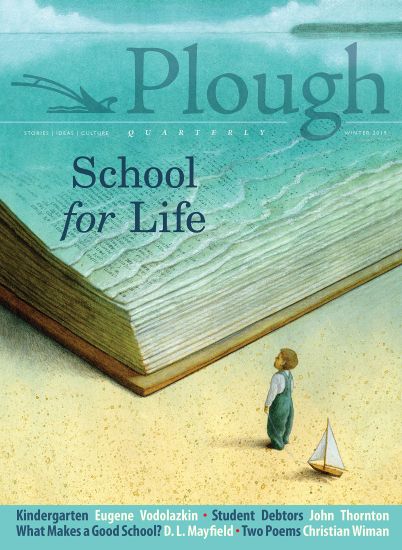
Plough Quarterly No. 19 - School for Life

Plough Quarterly No. 19 - School for Life

Eugene Vodolazkin; Karen Swallow Prior; Christian Wiman; John Thornton; D. L. Mayfield; Andrew Balio; Julian Peters; Denise Uwimana; Alfred Delp; Martin Luther; Michael St. Thomas; Sally Thomas

Plough Publishing House
2019
pokkari
What we want for schools reveals what we value as a society. “What’s the point of school?” Parents have a stock set of responses, but the question remains unsettled, even two centuries after the Prussians invented compulsory education. The Prussian idea of what a school is for – to mold the populace to serve the state – seems unacceptable today. In vogue, instead, are slogans like “acquiring marketable skills” and “realizing your full potential.” These ideas powerfully shape our culture. Ultimately, they boil down to pursuing one supreme value: individual success in a competitive world. Schools are a mirror of our society as a whole; what we want for schools makes plain what and whom we value in our common life. In the Christian tradition, the life of discipleship is also a school. In this educational community, under the instruction of our one Teacher, we learn not to seek empowerment, but to find strength in weakness; not to out-achieve others, but to serve them; not to pursue our passion, but to obey a call. Also in this issue: poetry by Christian Wiman; reviews of new books by Robert Macfarlane, Jackie Morris, Francisco Cantú, Leif Enger, Carol Anderson, Stephanie Land, and Susan Wise Bauer; and art by Margaret McWethy, Albrecht Dürer, Raphael, Gérard David, Jackie Morris, Gustaf Tenggren, Sergey Dushkin, Anja Percival, Dmitry Samofalov, Christoph Wetzel, Sherrie York, Cathleen Rehfield, Pawel Kuczynski, and Jason Landsel. Plough Quarterly features stories, ideas, and culture for people eager to put their faith into action. Each issue brings you in-depth articles, interviews, poetry, book reviews, and art to help you put Jesus’ message into practice and find common cause with others.
Assimilate Or Go Home

Assimilate Or Go Home

D. L. Mayfield

HarperOne
2016
nidottu
From childhood, D.L. Mayfield longed to be a missionary, so she was thrilled when the opportunity arose to work with a group of Somali Bantu refugees in her hometown of Portland, OR. As the days, months, and years went by, her hopeful enthusiasm began to wear off, her faith became challenged, and the real work of learning to love and serve her neighbors grew harder, deeper, and more complex. She writes: "The more I failed to communicate the love of God to my refugee friends, the more I experienced it for myself. The more overwhelmed I felt as I became involved in the myriads of problems facing my friends who experience poverty in America, the less pressure I felt to attain success or wealth or prestige. And the more my world started to expand at the edges of my periphery, the more it became clear that life was more beautiful and more terrible than I had been told."In this collection of stunning and surprising essays, Mayfield invites readers to reconsider their concepts of justice, love, and reimagine being a citizen of this world and the upside-down kingdom of God.