Kirjojen hintavertailu. Mukana 12 390 323 kirjaa ja 12 kauppaa.

Kirjailija

D. Marc Kilgour

Kirjat ja teokset yhdessä paikassa: 6 kirjaa, julkaisuja vuosilta 1988-2018, suosituimpien joukossa Conflict Resolution Using the Graph Model: Strategic Interactions in Competition and Cooperation. Vertaile teosten hintoja ja tarkista saatavuus suomalaisista kirjakaupoista.

6 kirjaa

Kirjojen julkaisuhaarukka 1988-2018.

Conflict Resolution Using the Graph Model: Strategic Interactions in Competition and Cooperation

Conflict Resolution Using the Graph Model: Strategic Interactions in Competition and Cooperation

Haiyan Xu; Keith W. Hipel; D. Marc Kilgour; Liping Fang

Springer Nature Switzerland AG
2018
nidottu
This cutting-edge book presents the theory and practice of the Graph Model for Conflict Resolution (GMCR), which is used for strategically investigating disputes in any field to enable informed decision making. It clearly explains how GMCR can determine what is the best a particular decision maker (DM) can independently achieve in dynamic interaction with others. Moves and counter-moves follow various stability definitions reflecting human behavior under conflict. The book defines a wide range of preference structures to represent a DM’s comparisons of states or scenarios: equally preferred, more or less preferred; unknown; degrees of strength of preference; and hybrid. It vividly describes how GMCR can ascertain whether a DM can fare even better by cooperating with others in a coalition. The book portrays how a conflict can evolve from the status quo to a desirable resolution, and provides a universal design for a decision support system to implement the innovative decision technologies using the matrix formulation of GMCR. Further, it illustrates the key ideas using real-world conflicts and supplies problems at the end of each chapter. As such, this highly instructive book benefits teachers, mentors, students and practitioners in any area where conflict arises.
Conflict Resolution Using the Graph Model: Strategic Interactions in Competition and Cooperation

Conflict Resolution Using the Graph Model: Strategic Interactions in Competition and Cooperation

Haiyan Xu; Keith W. Hipel; D. Marc Kilgour; Liping Fang

Springer International Publishing AG
2018
sidottu
This cutting-edge book presents the theory and practice of the Graph Model for Conflict Resolution (GMCR), which is used for strategically investigating disputes in any field to enable informed decision making. It clearly explains how GMCR can determine what is the best a particular decision maker (DM) can independently achieve in dynamic interaction with others. Moves and counter-moves follow various stability definitions reflecting human behavior under conflict. The book defines a wide range of preference structures to represent a DM’s comparisons of states or scenarios: equally preferred, more or less preferred; unknown; degrees of strength of preference; and hybrid. It vividly describes how GMCR can ascertain whether a DM can fare even better by cooperating with others in a coalition. The book portrays how a conflict can evolve from the status quo to a desirable resolution, and provides a universal design for a decision support system to implement the innovative decision technologies using the matrix formulation of GMCR. Further, it illustrates the key ideas using real-world conflicts and supplies problems at the end of each chapter. As such, this highly instructive book benefits teachers, mentors, students and practitioners in any area where conflict arises.
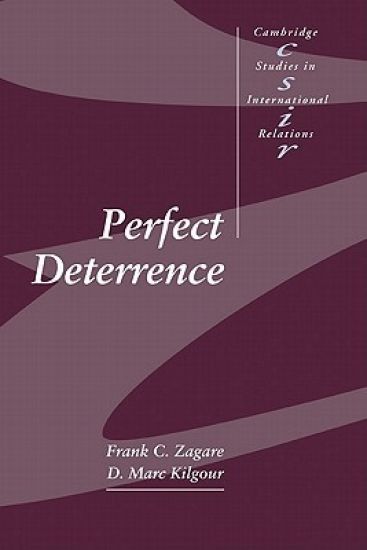
Perfect Deterrence

Perfect Deterrence

Frank C. Zagare; D. Marc Kilgour

Cambridge University Press
2000
sidottu
An important and timely contribution to International Relations and political science, this is the first general analysis of deterrence since the end of the Cold War. Using non-cooperative game theory, the authors develop a new approach to deterrence (Perfect Deterrence Theory), which they apply to unilateral and mutual direct-deterrence relationships, and to extended-deterrence relationships supported by deployment policies such as Massive Retaliation and Flexible Response. The authors focus on the relationship among capabilities, preferences, credibility, and outcomes to achieve a new understanding of threats and responses. Some surprising conclusions emerge, indicating that credible threats to respond to attack can sometimes make an attack more likely, and that incredible response threats can sometimes promote peace. With the application of deterrence theory in diverse social settings, and historical examples from before, during, and after the Cold War, this book provides a welcome new examination of the subject.
Perfect Deterrence

Perfect Deterrence

Frank C. Zagare; D. Marc Kilgour

Cambridge University Press
2000
pokkari
An important and timely contribution to International Relations and political science, this is the first general analysis of deterrence since the end of the Cold War. Using non-cooperative game theory, the authors develop a new approach to deterrence (Perfect Deterrence Theory), which they apply to unilateral and mutual direct-deterrence relationships, and to extended-deterrence relationships supported by deployment policies such as Massive Retaliation and Flexible Response. The authors focus on the relationship among capabilities, preferences, credibility, and outcomes to achieve a new understanding of threats and responses. Some surprising conclusions emerge, indicating that credible threats to respond to attack can sometimes make an attack more likely, and that incredible response threats can sometimes promote peace. With the application of deterrence theory in diverse social settings, and historical examples from before, during, and after the Cold War, this book provides a welcome new examination of the subject.
Interactive Decision Making

Interactive Decision Making

Liping Fang; Keith W. Hipel; D. Marc Kilgour

John Wiley Sons Inc
1993
muu
A comprehensive procedure for systematically examining actual disputes. Clearly explains the theory and practice of this novel approach to conflict modeling, analysis and resolution. Based upon ideas from both graph and game theories, it extends the realm of multiple objective-multiple-participant decision making in useful directions. Includes a wealth of illustrations and a computer disk.
Game Theory and National Security

Game Theory and National Security

Steven Brams; D. Marc Kilgour

Blackwell Publishers
1988
sidottu
In this path-breaking theoretical work, political scientist Steven Brams and mathematician Mark Kilgour show how game theory can be applied to the rigorous development and thoughtful analysis of several critical problems that afflict the security of nations, from the deterrence of foes who might launch attacks, to the stabilization of crises that could explode into wars. In addition, they analyze a variety of related questions, including the interlocking preferences that fuel arms races, the strategic impact that Star Wars may have on nuclear deterrence, and optimal strategies for verifying arms control treaties. Of interest to students on international relations and foreign policy as well as those concerned with the formal analysis of conflict, Game Theory and National Security provides new foundations for understanding the rational basis of international conflict.