
Kirjailija
D. Stephen Long
Kirjat ja teokset yhdessä paikassa: 28 kirjaa, julkaisuja vuosilta 2000-2024, suosituimpien joukossa Saving Karl Barth. Vertaile teosten hintoja ja tarkista saatavuus suomalaisista kirjakaupoista.
Mukana myös kirjoitusasut: D Stephen Long
28 kirjaa
Kirjojen julkaisuhaarukka 2000-2024.
Karl Barth's Christological Ecclesiology
Kimlyn J. Bender; D. Stephen Long
Wipf Stock Publishers
2013
pokkari

D. Stephen Long here addresses a key question in current theological debate: the conditions of the possibility of -God-talk, - along with attending questions about natural theology, fideism, and theological truth-claims. He engages not only the most significant contemporary theologians and philosophers on this score (Denys Turner, Bruce Marshall, John Milbank, Charles Taylor, Fergus Kerr) but also the legacy of twentieth-century theology (Barth, von Balthasar) and the analytic philosophical tradition from Wittgenstein to Davidson. Throughout, Long sustains a careful exegetical engagement with Aquinas, showing that what's at stake in contemporary theology is justhow we inherit St. Thomas. In joining all of these voices into one conversation, Long does a remarkable job of surveying the current theological scene with respect to issues of language and truth, arguing for the need to deal head-on with classical questions of metaphysics. Central to his project is averting the charge of -fideism- so often laid at the feet of -postliberal- approaches (like Long's). To that end Long argues for a (chastened) natural theology, while challenging any simple distinction between -natural- and -confessional- theology.

Stephen Long opens his erudite discussion of theology and ethics with the insistence that moral critique must emerge from a particular location, rather than from the fluid values of any ""neutral"" observer. Long sets out to put theology and ethics--as well as the church--in proper relation to one another. Ethics must be based in theology, not the other way around. Our ""finite participation in the infinite makes possible participation in a goodness beyond us."" That goodness comes to us in the flesh of Jesus Christ, and the church is indispensable in drawing all people toward God's goodness. The church, a social ethic in itself, gives purpose and order to other social institutions, including family, government, and the market. ""'The goodness of God'--such a simple phrase, such a profound (and maybe even disruptive) concept if we dare explore its implications. Not only does Steve Long lead us skillfully and smoothly through potentially difficult matters of theology and philosophy, he also brings home how our lives might be different if we really took the goodness of God to heart. ""From the matters of violence and economics to sexuality and family, Long takes his readers through a thicket of competing ideas, and leads them out the other side into greater clarity of vision, unity of purpose, and passion for God's good kingdom. Seminaries and Sunday schools alike will benefit from this scholarly but accessible volume."" --Michael Budde, DePaul University D. Stephen Long is Professor of Systematic Theology at Marquette University. He has published a number of works including The Goodness of God, The Divine Economy, John Wesley's Moral Theology, and Theology and Culture (Cascade Books, 2007).
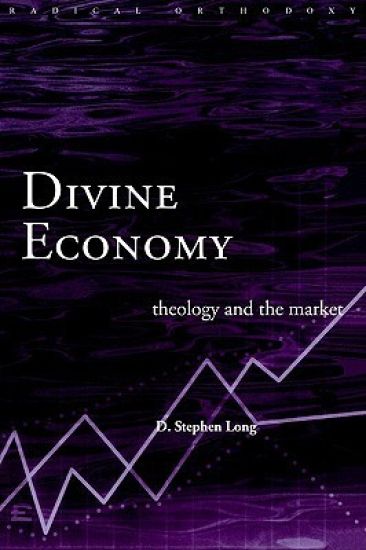
What has theology to do with economics? They are both sciences of human action, but have traditionally been treated as very separate disciplines. Divine Economy is the first book to address the need for an active dialogue between the two.D. Stephen Long traces three strategies which have been used to bring theology to bear on economic questions: the dominant twentieth-century tradition, of Weber's fact-value distinction; an emergent tradition based on Marxist social analysis; and a residual tradition that draws on an ancient understanding of a functional economy. He concludes that the latter approach shows the greatest promise because it refuses to subordinate theological knowledge to autonomous social-scientific research.Divine Economy will be welcomed by those with an interest in how theology can inform economic debate.
What has theology to do with economics? They are both sciences of human action, but have traditionally been treated as very separate disciplines. Divine Economy is the first book to address the need for an active dialogue between the two.D. Stephen Long traces three strategies which have been used to bring theology to bear on economic questions: the dominant twentieth-century tradition, of Weber's fact-value distinction; an emergent tradition based on Marxist social analysis; and a residual tradition that draws on an ancient understanding of a functional economy. He concludes that the latter approach shows the greatest promise because it refuses to subordinate theological knowledge to autonomous social-scientific research.Divine Economy will be welcomed by those with an interest in how theology can inform economic debate.