Kirjojen hintavertailu. Mukana 12 152 606 kirjaa ja 12 kauppaa.

Kirjailija

D.W. Stroock

Kirjat ja teokset yhdessä paikassa: 3 kirjaa, julkaisuja vuosilta 1983-1993, suosituimpien joukossa Dirichlet Forms. Vertaile teosten hintoja ja tarkista saatavuus suomalaisista kirjakaupoista.

Mukana myös kirjoitusasut: D. W. Stroock

3 kirjaa

Kirjojen julkaisuhaarukka 1983-1993.

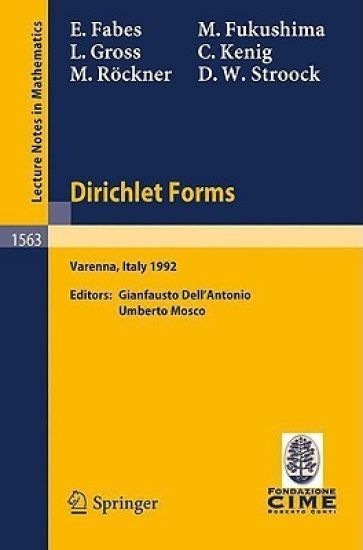
Dirichlet Forms

Dirichlet Forms

E. Fabes; M. Fukushima; L. Gross; C. Kenig; M. Röckner; D.W. Stroock

Springer-Verlag Berlin and Heidelberg GmbH Co. K
1993
nidottu
The theory of Dirichlet forms has witnessed recently some very important developments both in theoretical foundations and in applications (stochasticprocesses, quantum field theory, composite materials,...). It was therefore felt timely to have on this subject a CIME school, in which leading experts in the field would present both the basic foundations of the theory and some of the recent applications. The six courses covered the basic theory and applications to: - Stochastic processes and potential theory (M. Fukushima and M. Roeckner) - Regularity problems for solutions to elliptic equations in general domains (E. Fabes and C. Kenig) - Hypercontractivity of semigroups, logarithmic Sobolev inequalities and relation to statistical mechanics (L. Gross and D. Stroock). The School had a constant and active participation of young researchers, both from Italy and abroad.

An Introduction to the Theory of Large Deviations

An Introduction to the Theory of Large Deviations

D.W. Stroock

Springer-Verlag New York Inc.
1984
nidottu
These notes are based on a course which I gave during the academic year 1983-84 at the University of Colorado. My intention was to provide both my audience as well as myself with an introduction to the theory of 1arie deviations • The organization of sections 1) through 3) owes something to chance and a great deal to the excellent set of notes written by R. Azencott for the course which he gave in 1978 at Saint-Flour (cf. Springer Lecture Notes in Mathematics 774). To be more precise: it is chance that I was around N. Y. U. at the time'when M. Schilder wrote his thesis. and so it may be considered chance that I chose to use his result as a jumping off point; with only minor variations. everything else in these sections is taken from Azencott. In particular. section 3) is little more than a rewrite of his exoposition of the Cramer theory via the ideas of Bahadur and Zabel. Furthermore. the brief treatment which I have given to the Ventsel-Freidlin theory in section 4) is again based on Azencott's ideas. All in all. the biggest difference between his and my exposition of these topics is the language in which we have written. However. another major difference must be mentioned: his bibliography is extensive and constitutes a fine introduction to the available literature. mine shares neither of these attributes. Starting with section 5).