Kirjojen hintavertailu. Mukana 12 595 353 kirjaa ja 12 kauppaa.
Kirjailija
Dale M Coulter
Kirjat ja teokset yhdessä paikassa: 7 kirjaa, julkaisuja vuosilta 2006-2023, suosituimpien joukossa Per Visibilia Ad Invisibilia: Theological Method in Richard of St. Victor (D. 1173). Vertaile teosten hintoja ja tarkista saatavuus suomalaisista kirjakaupoista.
Christian higher education (CHE) is increasingly a transnational and global endeavor, with over one-sixth of the almost two hundred institutional members of the Council for Christian Colleges & Universities (CCCU) located in nineteen countries outside the United States. Much of this is related to the shift of the Christian center of gravity to the global South over the last half century, and in particular to the explosion of pentecostal and charismatic forms of churches across Asia, Africa, and Latin America, all of which also feeds back via migration to the so-called "browning" of the churches of North America.Networks like the CCCU have sought to bridge faith and learning through a certain form of Christ-centeredness and biblical orientation. While these theological priorities of the evangelical Protestant tradition have gained wide currency, the pneumatic spirituality of the pentecostal and charismatic movements is rarely considered when thinking about a distinctively Christian vision of higher education.When even God is showing up at secular universities, one wonders what difference considerations of the Holy Spirit might make to complement and perhaps revitalize the christocentrism renowned across CHE. The Holy Spirit and Higher Education responds along two interrelated lines: by reconsidering historic Christian education itself from this pentecostal perspective, and by formulating an approach to CHE around the charismatic, sanctifying, and missional dimensions of the Spirit's activity. Yong and Coulter show that CHE should be both Christ-centered and Pentecost-inspired, both biblically faithful and pneumatically empowered, both faith-committed and charismatically propelled.
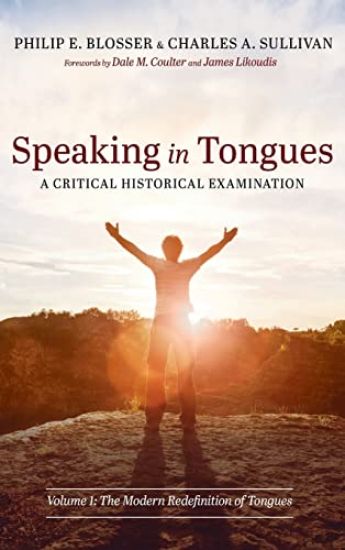
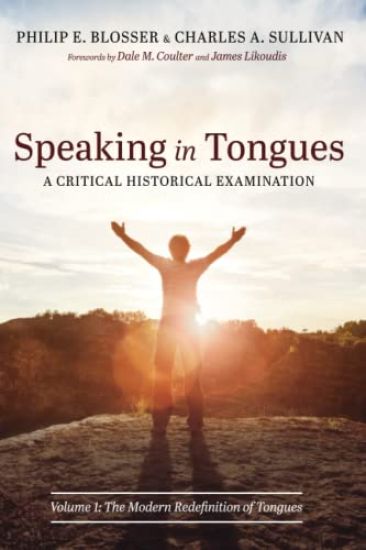
In three carefully researched volumes, this ground-breaking study examines the gift of tongues through 2,000 years of church history. Starting in the present and working back in time, these volumes consider (1) the modern redefinition of tongues as a private prayer language; (2) the church's perennial understanding of tongues as ordinary human languages; and (3) the Corinthian tongues, which, in light of Jewish liturgical tradition, turn out to have been a foreign liturgical language (Hebrew or Aramaic) requiring bilingual interpreters. In the first volume, the authors establish that modern glossolalia, far from being a supernatural gift enjoyed by certain believers since the time of Pentecost and undergoing a resurgence in modern times, has no precedent in church life prior to the nineteenth century. They discuss why German theologians, responding to the Irvingite revival, coined the term glossolalia in the 1830s; why Pentecostals between 1906-8 quietly began redefining tongues to mean a heavenly language unintelligible to human beings but pleasing to God, instead of foreign languages useful for evangelism; why Protestant cessationists believed miraculous tongues had ceased; and why interpolated idioms like unknown tongues in Protestant Bibles were aimed originally at Rome's use of Latin.
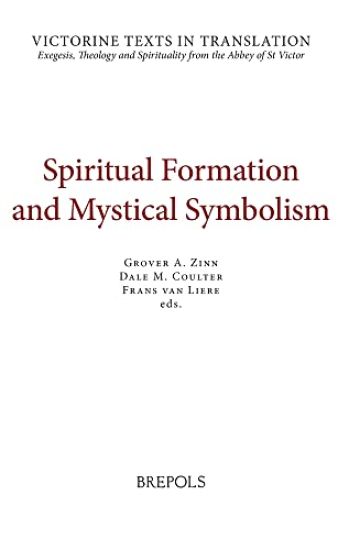
Biblical interpretation, writings on the contemplative/mystical life and a continuing deep reflection on the nature and meaning of symbols come together in powerful ways in Victorine writers, particularly Hugh and Richard, as well as the lesser-known writer, Thomas Gallus (Thomas of Vercelli), a Victorine canon who became the abbot of a house of regular canons in Vercelli, Italy. This volume contains: (1) Hugh's On the Ark of Noah and A Short Treatise on the Form of the Ark, treatises that unfold Hugh's teaching on stages and fruition of the mystical quest in relation to a complex drawing that incorporates a figure of Christ seated in majesty, embracing a map of the world on which is superimposed a diagram of Noah's Ark, representing the 12 stages of the contemplative quest; (2) Richard's On the Ark of Moses, a work that uses the symbolic (allegorical and tropological) interpretation of the Ark of the Covenant and the figures of the Cherubim that accompany the Ark in the Jerusalem Temple to convey Richard's vivid and compelling teaching on the varieties of contemplative experience as he understood them in twelfth-century Paris; and (3) Thomas Gallus' Commentary on the Song of Songs, which offers a window into a formative period of transition in the western Christian spiritual tradition, with Gallus's commentary on the Song of Songs giving voice to a more affective (versus speculative) understanding of the mystical quest and experience, drawing upon and extending earlier Victortine explorations of the interrelationship of love and knowing in the experience of contemplation. For those interested in the dynamics of the spiritual quest and symbolic understanding in the twelfth and early thirteen centuries, as well as insights that can inform the modern quest for knowledge and love of God, these are essential works for any library
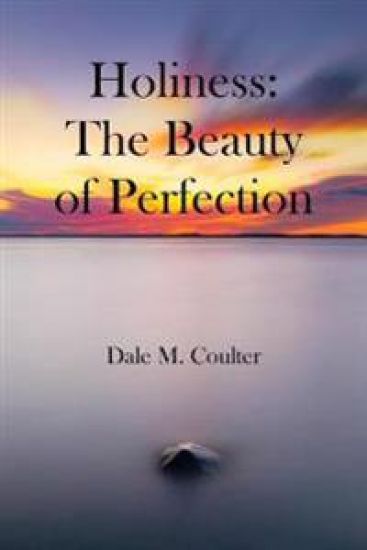
Rarely does one find a book on the topic of holiness with such depth as well as breadth. Kreider takes us on a journey deep into biblical territory and back again into the lives of nations, churches, families and individuals. In this journey the reader is convicted and drawn by the beauty of holiness. We Pentecostals need this word. --Cheryl Bridges Johns, Church of God Theological Seminary Kreider's Social Holiness surprises While holiness indeed owns the otherness of God and the call to be God's separated people, it does much more. Holiness unleashes in history a living force, a dynamism that envisions the sanctification of God's entire creation. Holiness is positive, the 'heartbeat' of Missio Dei. I highly recommend this book for its life-changing potential, both personally and for the church as God's new nation. --Willard M. Swartley, Associated Mennonite Biblical Seminary Alan Kreider writes a masterful narrative about social holiness from which Pentecostals can learn much as they reaffirm and recover this important dimension of their heritage. Its familiar terrain serves not only as a timely reminder of a way of life Pentecostals still cherish, but also as a challenge to reconsider crucial features of that way of life long forgotten. --Dale M. Coulter, Regent University Alan Kreider has gifted us with an inspiring, hopeful, and transformative invitation to follow Jesus on the journey toward personal and social holiness. His prophetic call to participate in Jesus' transnational renewal movement challenges families, congregations, students, and all Christians with practical ideas emerging from the biblical story of God's kingship and our citizenship in the holy nation. I appreciate his emphasis on moral zeal, experience, liberating action, storytelling, praise, and the risk of repentance and trust, and think] this book can be a great resource for helping the church with our public witness to Christ's shalom in a broken world. --Paul Alexander, Azusa Pacific University Kreider's Social Holiness breaks new ground and makes new connections, both in his overview of biblical history and in his application of social holiness to the contemporary church. I hope this book will help many believers today - Wesleyans, Anabaptists, and those from other traditions - become more fully and authentically a part of God's 'holy nation' in the world today. --Howard A. Snyder, Asbury Theological Seminary Ours is the age of bombast, exaggeration, hyper-activism and self-importance--all of which leaves us feeling empty. We have lost the capacity for reverence, awe, and experience of the transcendent. Alan Kreider has the audacity to call us back to the transforming presence of God so that we become God-like. This book's message can help set us free from the bondage of our self-centeredness and liberate us to participate in the mission of God. --Wilbert R. Shenk, Fuller Theological Seminary Lively, gutsy . . . Holiness is about practical social matters--such as economic relationships, making peace, working for justice . . . Kreider takes us through the Bible to show how deeply these themes are embedded in the text and how persistent has been the failure of the community of faith to be true to them . . . A must for serious-minded Christians today. --Rt. Rev. John Gladwin, Bishop of Chelmsford, in Third Way Alan Kreider is Associate Professor of Church History and Mission, Associated Mennonite Biblical Seminary, and author of English Chantries: The Road to Dissolution and The Change of Conversion and the Origin of Christendom. Dale M. Coulter is Associate Professor of Historical Theology, Regent University, and author of Per Visibilia ad Invisibilia: Theological Method in Richard of St Victor (d 1173) and Holiness: The Beauty of Perfection
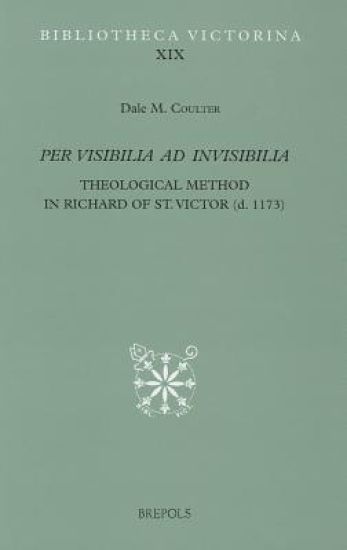
Approaching Richard of St. Victor's works through the lense of an ascent to God per visibilia ad invisibilia, the present work argues that Richard develops a consistent theological methodology that weds together an emerging academic theology with a contemplative reading of texts. This methodology begins with an attempt to understand the visible world through the medium of words, created things, and their orderly relation both in text and in creation. Coulter next discusses how Richard's investigation of the invisible world of the self, the angels, and the divine builds upon his analysis of the visible world. No longer focusing on texts, at this stage the contemplative mind must develop the appropriate intellectual skills to penetrate the mysteries of the invisible world, for which Richard offers the ark of the covenant as a rhetorical symbol. The result is a method that leads the soul to a vision of the divine per visibilia ad invisibilia.