Kirjojen hintavertailu. Mukana 12 509 365 kirjaa ja 12 kauppaa.

Kirjailija

Dale Maharidge

Kirjat ja teokset yhdessä paikassa: 10 kirjaa, julkaisuja vuosilta 1999-2021, suosituimpien joukossa Snowden's Box. Vertaile teosten hintoja ja tarkista saatavuus suomalaisista kirjakaupoista.

10 kirjaa

Kirjojen julkaisuhaarukka 1999-2021.

Fucked at Birth

Fucked at Birth

Dale Maharidge

Unnamed Press
2021
pokkari
"This is a book ripped from the headlines, from Black Lives Matter to recently thriving downtowns stripped of office workers and service workers. Those catching the brunt of it all, those with the steepest hills to climb, may have been fucked at birth. But for everyone, as Maharidge observes, the feeling of safety is folly. A sharp wake-up call to heed the new Depression and to recognize the humanity of those hit hardest." —Kirkus Reviews, STARRED REVIEW “Dale Maharidge takes us coast to coast in 2020, down highways along which he first reported decades ago. His honed class awareness—unrivaled among contemporary journalists—reveals that today's confluent health, economic and social crises are the logical conclusion to generations of unvalidated, untreated despair in a wealthy nation. Forget hollow commentary from detached television news studios in New York City. Fucked at Birth is the truth.” —Sarah Smarsh, Heartland: A Memoir of Working Hard and Being Broke in the Richest Country on Earth Pulitzer prize-winning journalist Dale Maharidge has spent his career documenting the downward spiral of the American working class. Poverty is both reality and destiny for increasing numbers of people in the 2020s and, as Maharidge discovers spray-painted inside an abandoned gas station in the California desert, it is a fate often handed down from birth. Motivated by this haunting phrase—“Fucked at Birth”—Maharidge explores the realities of being poor in America in the coming decade, as pandemic, economic crisis and social revolution up-end the country. Part raw memoir, part dogged, investigative journalism, Fucked At Birth channels the history of poverty in America to help inform the voices Maharidge encounters daily. In an unprecedented time of social activism amid economic crisis, when voices everywhere are rising up for change, Maharidge’s journey channels the spirits of George Orwell and James Agee, raising questions about class, privilege, and the very concept of “upward mobility,” while serving as a final call to action. From Sacramento to Denver, Youngstown to New York City, Fucked At Birth dares readers to see themselves in those suffering most, and to finally—after decades of refusal—recalibrate what we are going to do about it.

Snowden's Box

Snowden's Box

Jessica Bruder; Dale Maharidge

Verso Books
2021
nidottu
One day in the spring of 2013, a box appeared outside a fourth-floor apartment door in Brooklyn, New York. The recipient, who didn't know the sender, only knew she was supposed to bring this box to a friend, who would ferry it to another friend. This was Edward Snowden's box-printouts of documents proving that the US government had built a massive surveillance apparatus and used it to spy on its own people-and the friend on the end of this chain was filmmaker Laura Poitras.Thus the biggest national security leak of the digital era was launched via a remarkably analog network, the US Postal Service. This is just one of the odd, ironic details that emerges from the story of how Jessica Bruder and Dale Maharidge, two experienced journalists but security novices (and the friends who received and ferried the box) got drawn into the Snowden story as behind-the-scenes players. Their initially stumbling, increasingly paranoid, and sometimes comic efforts to help bring Snowden's leaks to light, and ultimately, to understand their significance, unfold in an engrossing narrative that includes emails and diary entries from Poitras. This is an illuminating essay on the status of transparency, privacy, and trust in the age of surveillance.
And Their Children After Them

And Their Children After Them

Dale Maharidge

Seven Stories Press,U.S.
2020
nidottu
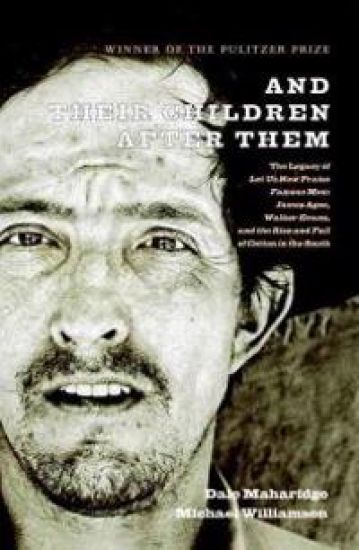
Winner of the Pulitzer Prize for Nonfiction in 1990In And Their Children After Them, the writer/photographer team Dale Maharidge and Michael Williamson return to the land and families captured in James Agee and Walker Evans's inimitable Let Us Now Praise Famous Men, extending the project of conscience and chronicling the traumatic decline of King Cotton. With this continuation of Agee and Evans's project, Maharidge and Williamson not only uncover some surprising historical secrets relating to the families and to Agee himself, but also effectively lay to rest Agee's fear that his work, from lack of reverence or resilience, would be but another offense to the humanity of its subjects. Williamson's ninety-part photo essay includes updates alongside Evans's classic originals. Maharidge and Williamson's work in And Their Children After Them was honored with the Pulitzer Prize for nonfiction when it was first published in 1990.
Snowden's Box

Snowden's Box

Jessica Bruder; Dale Maharidge

Verso Books
2020
sidottu
One day in the spring of 2013, a box appeared outside a fourth-floor apartment door in Brooklyn, New York. The recipient, who didn't know the sender, only knew she was supposed to bring this box to a friend, who would ferry it to another friend. This was Edward Snowden's box-printouts of documents proving that the US government had built a massive surveillance apparatus and used it to spy on its own people-and the friend on the end of this chain was filmmaker Laura Poitras.Thus the biggest national security leak of the digital era was launched via a remarkably analog network, the US Postal Service. This is just one of the odd, ironic details that emerges from the story of how Jessica Bruder and Dale Maharidge, two experienced journalists but security novices (and the friends who received and ferried the box) got drawn into the Snowden story as behind-the-scenes players. Their initially stumbling, increasingly paranoid, and sometimes comic efforts to help bring Snowden's leaks to light, and ultimately, to understand their significance, unfold in an engrossing narrative that includes emails and diary entries from Poitras. This is an illuminating essay on the status of transparency, privacy, and trust in the age of surveillance.
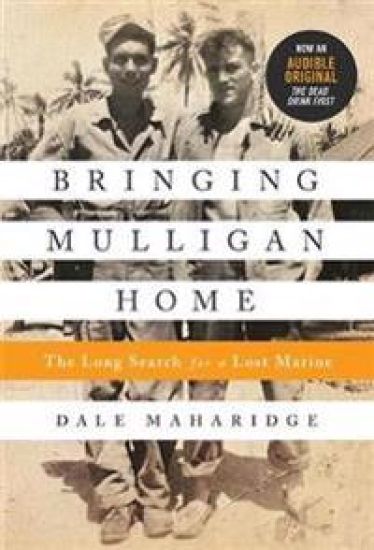
Bringing Mulligan Home (Reissue)

Bringing Mulligan Home (Reissue)

Dale Maharidge

PublicAffairs,U.S.
2019
pokkari
Sgt. Steve Maharidge, like many of his generation, hardly ever talked about the war. The only sign of it was a single black and white photograph that he pinned to the wall of his basement, where, in his spare time, he would grind steel. The picture showed Maharidge with one of his comrades---he never said who. In front of his son, Maharidge once yelled over the sound of his steel grinders at the photograph: "They said I killed him, and it wasn't my fault!" After Steve Maharidge's death, his son Dale, an adult now, began a quest to understand his father's outburst: What had happened during the battle for Okinawa, and why his father had remained haunted and all but silent about his experience and the unnamed man. In his quest for the soldier, Maharidge sought out the survivors of Love Company, men in their late 70s and 80s, many of whom had never before spoken so openly and emotionally about what they saw and experienced on Okinawa.The Battle of Okinawa of World War II began in April 1945---in the following four months, an estimated 250,000 Japanese soldiers and native Okinawans would perish, as would 12,000 American soldiers. Americans called the battle Operation Iceberg, while the Japanese called it tetsu no ame, or the rain of steel. In Bringing Mulligan Home, Maharidge delivers an affecting narrative of war and its aftermath, of fathers and sons, of the generation that survives the shell-shocked men who fought on Okinawa. In a small way, Bringing Mulligan Home fills the silence that has haunted the post-war generation. An established scholar of the American working class, Maharidge also masterfully paints a picture of the industrial working-class landscape that drove men to enlist, and the United States that awaited them upon return.
Someplace Like America

Someplace Like America

Dale Maharidge; Bruce Springsteen

University of California Press
2013
pokkari
In Someplace Like America, writer Dale Maharidge and photographer Michael S. Williamson take us to the working-class heart of America, bringing to life--through shoe leather reporting, memoir, vivid stories, stunning photographs, and thoughtful analysis--the deepening crises of poverty and homelessness. The story begins in 1980, when the authors joined forces to cover the America being ignored by the mainstream media--people living on the margins and losing their jobs as a result of deindustrialization. Since then, Maharidge and Williamson have traveled more than half a million miles to investigate the state of the working class (winning a Pulitzer Prize in the process). In Someplace Like America, they follow the lives of several families over the thirty-year span to present an intimate and devastating portrait of workers going jobless. This brilliant and essential study--begun in the trickle-down Reagan years and culminating with the recent banking catastrophe--puts a human face on today's grim economic numbers. It also illuminates the courage and resolve with which the next generation faces the future.
And Their Children After Them

And Their Children After Them

Dale Maharidge

Seven Stories Press,U.S.
2008
nidottu
In this reissue, an author/photographer team returns to the land of families captured in the inimitable masterwork "Let Us Now Praise Famous Men," extending the project of conscience and chronicling the traumatic decline of King Cotton.
Denison, Iowa

Denison, Iowa

Dale Maharidge

The Free Press
2008
pokkari
Denison, Iowa, is as close to the heart of Middle America as it gets. The hometown of Donna Reed, Denison has adopted "It's a wonderful life" as its slogan and painted the phrase on the water tower that hovers over everything in town. And in many respects, life is pretty good here: it's a quiet town, a great place to raise children; the crime rate is low, the schools strong. It's home to the county's only Wal-Mart and a factory that does a booming business in antiterrorism barriers. For outsiders looking in, there is something familiar and comforting about Denison -- it conforms to the picture of the wholesome, corn-fed heartland which we as a nation cherish and which we think we know so well. But something new and unfamiliar is happening in Denison, and traditional viewpoints and partisan labels don't quite capture it. The change goes beyond the post-9/11 loss of innocence; the sense of unease and, in some cases, of rebirth began well before 2001. Relations between the growing Latino population and the established Anglo citizenry are not always smooth. The industries that still predominate have become a mixed blessing for many people -- in the 1980s the meat-processing plant, for instance, froze wages, and they have remained basically static to this day. For many years, Dale Maharidge and Michael Williamson have made it their business to document interior America. In 1990 they won the Pulitzer Prize for their book And Their Children After Them, a conscious homage to the 1941 classic Let Us Now Praise Famous Men by James Agee and Walker Evans. To gather their observations and insights on Denison, Maharidge and Williamson lived there for a year, spending time among the 8,000 people who live, love, work, run for office, go to school, and sometimes struggle to get by there. From the Lutheran woman who singlehandedly teaches English to Latino immigrants seeking grueling work in meatpacking plants to the leaders who struggle to rescue the community from economic ruin to the Latino businessman whose career is saved by two white men risking the wrath of small-town politics, the author and photographer trace the intersections of lives, the successes and failures, the real stories beneath Denison's mom-and-apple-pie surface. Through Maharidge's gorgeous, plainspoken prose and Williamson's stunning photography, we are privy to a sweeping perspective layered with a microscopic depth of observation, and a searingly honest portrait tempered by heartfelt compassion. Denison, Iowa is a big, beautiful book about a small town at a critical time in our history -- and it's the crowning work of a brilliant, quarter-century partnership.
Homeland

Homeland

Dale Maharidge

Seven Stories Press,U.S.
2005
nidottu
"In "Homeland," Maharidge breaks new ground in the genre of 9/11 journalism by heading into heartland America . . . . The tales Maharidge relates expose the synergy between economics and racism in Rust Belt communities, whose residents are the victims of post-industrial collapse and what he describes as a '30-year war against the working class.'"--"In These Times""This book emerges as a sensitive, heartfelt examination of a wounded America whose wounds existed long before the terrorist attacks."--"Publishers Weekly""A unique and insightful look at how America changed after the terrorist attack of Sept. 11, 2001, and what it means for the future."--"The Sacramento Bee""Homeland" is the fourth book from the Pulitzer Prize-winning team of Dale Maharidge and photographer Michael Williamson. Maharidge offers an original and provocative thesis: 9/11 was not a genesis, but an amplifier of unease that had long been building in the United States. A complete picture of post-9/11 America, Maharidge argues, is not simply a picture of post-9/11 America, but a complicated portrayal taking into account deep-seated tensions, some going back three decades and more.Dale Maharidge and Michael Williamson's "Journey To Nowhere" (1985) was the inspiration for two songs on Bruce Springsteen's album "The Ghost of Tom Joad." Their second book, "And Their Children After Them," won the 1990 Pulitzer Prize for nonfiction. The two also co-authored "The Last Great American Hobo" (1993), a biographical snapshot of the last Depression-era hobo in the final years of his life and times. Williamson, a staff photographer at "The Washington Post," won a second Pulitzer Prize in 2000 for his work in Kosovo. Maharidge teaches at the Graduate School of Journalism at Columbia University, previously taught journalism at Stanford University and was a 1988 Nieman Fellow at Harvard University.