Kirjojen hintavertailu. Mukana 12 226 366 kirjaa ja 12 kauppaa.

Kirjailija

Dalia Dassa Kaye

Kirjat ja teokset yhdessä paikassa: 18 kirjaa, julkaisuja vuosilta 2001-2025, suosituimpien joukossa Future U.S. Security Relationship with Iraq and Afghanistan. Vertaile teosten hintoja ja tarkista saatavuus suomalaisista kirjakaupoista.

18 kirjaa

Kirjojen julkaisuhaarukka 2001-2025.

Withdrawing from Iraq

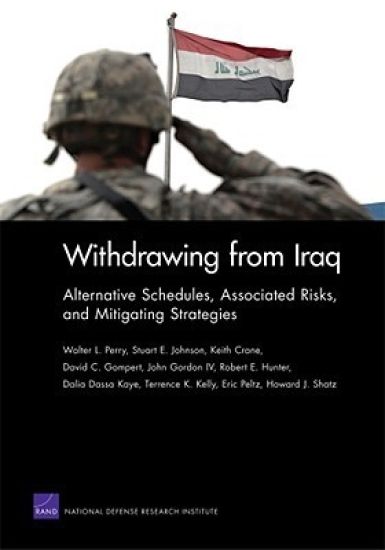
Withdrawing from Iraq

Walter L. Perry; Stuart E. Johnson; Keith Crane; David C. Gompert; John Gordon; Robert E. Hunter; Dalia Dassa Kaye; Terrence K. Kelly; Eric Peltz; Howard J. Shatz

RAND
2009
pokkari
Since 2007, security has improved dramatically in Iraq. The U.S. and Iraqi governments - and most Iraqis - want to see both the U.S. presence there reduced and the Iraqi government and security forces assuming a greater role in providing for public security. The challenge is to effect this drawdown while preserving security and stability in the country and in the region. In response to tasking from the U.S. Congress, RAND researchers conducted an independent study to examine drawdown schedules, risks, and mitigating strategies. They identified logistical constraints on moving equipment out of the country, assessed trends in insurgent activity and the ability of Iraqi security forces to counter it, and examined the implications for the size of the residual U.S. force and for security in Iraq and the region. This book presents alternative drawdown schedules - one consistent with the Obama administration's stated intentions and two others, one somewhat slower and another faster - that are responsive to these factors.It also recommends steps that the United States can take to alleviate anticipated constraints, overcome likely resistance, and reduce the potential risks associated with a drawdown. For more than 60 years, decisionmakers in the public and private sectors have turned to the RAND Corporation for objective analysis and effective solutions that address the challenges facing the nation and the world.
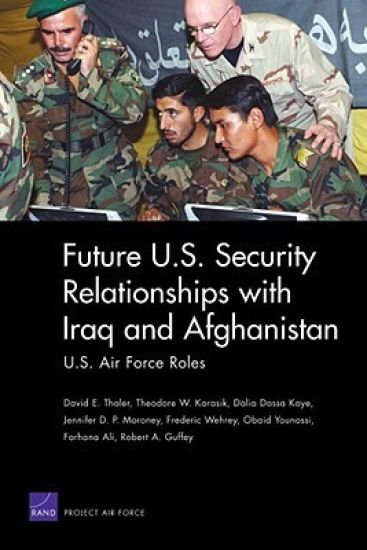
Future U.S. Security Relationship with Iraq and Afghanistan

Future U.S. Security Relationship with Iraq and Afghanistan

David E. Thaler; Theodore W. Karasik; Dalia Dassa Kaye; Jennifer D. P. Moroney; Frederic M. Wehrey; Obaid Younossi; Farhana Ali; Robert A. Guffey

RAND
2008
pokkari
The authors describe possible regional security structures and bilateral U.S. relationships with Iraq and Afghanistan. They recommend that the United States offer a wide range of security cooperation activities to compatible future governments in Kabul and Baghdad and should also plan to hedge against less-favorable contingencies. They emphasize that the U.S. Air Force should expect to remain heavily tasked for the foreseeable future.This book frames potential long-term U.S. security relationships with Iraq and Afghanistan in a regional context and posits roles of U.S. forces, especially the Air Force, in supporting these relationships under a variety of contingencies.
Enduring Hostility

Enduring Hostility

Dalia Dassa Kaye

STANFORD UNIVERSITY PRESS
2025
pokkari
American policy toward Iran has remained remarkably consistent since the earliest years of the Reagan administration. US–Iran hostility has endured for longer than the Cold War. Momentous geopolitical shifts, changing leaderships, and evolving domestic priorities have not fundamentally altered this antagonistic relationship. Standard explanations pin the blame for this enduring hostility on Iran and its leaders' revolutionary ideology and policies at odds with the United States and the West. While Iran bears significant blame for a deeply adversarial relationship—the country often engages in dangerous and repressive activities—this book demonstrates that "it's them, not us" accounts cannot alone explain America's posture toward this complicated but critically important country. Drawing on original interviews with former government officials, oral histories, memoirs, congressional hearings, archival material, and the author's own participation in dozens of Iran-related track two meetings, Dalia Dassa Kaye deftly explores how America's Iran policy is made, the people who make it, and the underlying ideas and perceptions that inform it. Dassa Kaye looks back at US policy toward Iran over the past four decades to help us look ahead, offering wider lessons for understanding American foreign policymaking.
Enduring Hostility

Enduring Hostility

Dalia Dassa Kaye

STANFORD UNIVERSITY PRESS
2025
sidottu
American policy toward Iran has remained remarkably consistent since the earliest years of the Reagan administration. US–Iran hostility has endured for longer than the Cold War. Momentous geopolitical shifts, changing leaderships, and evolving domestic priorities have not fundamentally altered this antagonistic relationship. Standard explanations pin the blame for this enduring hostility on Iran and its leaders' revolutionary ideology and policies at odds with the United States and the West. While Iran bears significant blame for a deeply adversarial relationship—the country often engages in dangerous and repressive activities—this book demonstrates that "it's them, not us" accounts cannot alone explain America's posture toward this complicated but critically important country. Drawing on original interviews with former government officials, oral histories, memoirs, congressional hearings, archival material, and the author's own participation in dozens of Iran-related track two meetings, Dalia Dassa Kaye deftly explores how America's Iran policy is made, the people who make it, and the underlying ideas and perceptions that inform it. Dassa Kaye looks back at US policy toward Iran over the past four decades to help us look ahead, offering wider lessons for understanding American foreign policymaking.
Countering Sectarianism in the Middle East

Countering Sectarianism in the Middle East

Jeffrey Martini; Dalia Dassa Kaye; Becca Wasser

RAND
2019
nidottu
Scholars and policymakers have sought to understand what drives sectarianism in the Middle East and its relationship to multiple conflicts, but far less attention has been focused on the factors that make a community more resilient to sectarianism. This report provides a better understanding of how communities inoculate themselves from sectarianism or recover from it and draws lessons on how to promote resilience and cross-sectarian cooperation.
The Outlook for Arab Gulf Cooperation

The Outlook for Arab Gulf Cooperation

Jeffrey Martini; Becca Wasser; Dalia Dassa Kaye; Daniel Egel; Cordaye Ogletree

RAND
2016
pokkari
This report examines what binds and divides the six Gulf Cooperation Council (GCC) states Bahrain, Kuwait, Oman, Qatar, Saudi Arabia, and the United Arab Emirates and presents the outlook for the GCC s evolution over the next ten years. The study aims to help policymakers better understand intra-GCC dynamics and prepare for future trends in a region with high stakes for U.S. strategic interests."
The Muslim Brotherhood, its Youth, and Implications for U.S. Engagement

The Muslim Brotherhood, its Youth, and Implications for U.S. Engagement

Jeffrey Martini; Dalia Dassa Kaye; Erin York

RAND
2012
pokkari
Since the 2011 revolution in Egypt, the Muslim Brotherhood has emerged as a key political player. Although individuals under the age of 35 make up a large share of the membership, the group's strict hierarchy has led to disaffection among its youth. These members merit attention not only as a challenge to the Brotherhood's organizational cohesion, but as a potential conduit for expanding U.S. engagement with the group.
Israel and Iran

Israel and Iran

Dalia Dassa Kaye; Alireza Nader; Parisa Roshan

RAND
2012
pokkari
Israel and Iran have come to view each other as direct regional rivals. The two countries are not natural rivals; they have shared geopolitical interests, which led to years of cooperation both before and after the 1979 Islamic revolution. But their rivalry has intensified recently, particularly with the rise of fundamentalist leaders in Iran and the prospect of a nuclear-armed Iran posing grave strategic and ideological challenges to Israel.
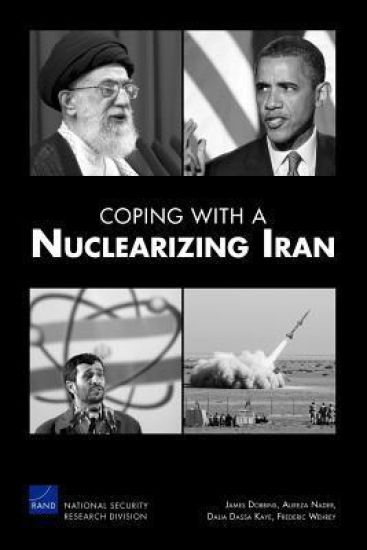
Coping with a Nuclearizing Iran

Coping with a Nuclearizing Iran

James Dobbins; Alireza Nader; Dalia Dassa Kaye; Frederic M. Wehrey

RAND
2011
pokkari
It is not inevitable that Iran will acquire nuclear weapons or even that it will gain the capacity to quickly produce them. U.S. and even Israeli analysts continually push their estimates for such an event further into the future. Nevertheless, absent a change in Iranian policy, it is reasonable to assume that, some time in the coming decade, Iran will acquire such a capability. Most recent scholarly studies have also focused on how to prevent Iran from acquiring nuclear weapons. Other, less voluminous writing looks at what to do after Iran becomes a nuclear power. What has so far been lacking is a policy framework for dealing with Iran before, after, and, indeed, during its crossing of the nuclear threshold. This monograph attempts to fill that gap by providing a midterm strategy for dealing with Iran that neither begins nor ends at the point at which Tehran acquires a nuclear weapon capability. It proposes an approach that neither acquiesces to a nuclear-armed Iran nor refuses to admit the possibility - indeed, the likelihood - of this occurring.
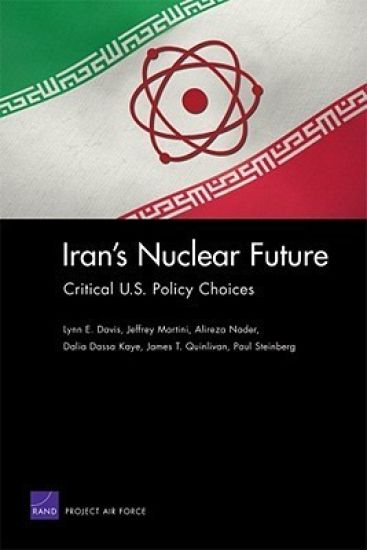
Iran's Nuclear Future: Critical U.S. Policy Choices

Iran's Nuclear Future: Critical U.S. Policy Choices

Lynn E. Davis; Jeffrey Martini; Alireza Nader; Dalia Dassa Kaye; James T. Quinlivan; Paul Steinberg

RAND
2011
pokkari
As Iran's nuclear program evolves, U.S. decisionmakers will confront a series of critical policy choices involving complex considerations and policy trade-offs. These policy choices could involve dissuading Iran from developing nuclear weapons; deterring Iran from using its nuclear weapons, if it were to acquire them; and, reassuring U.S. regional partners. The U.S. Air Force will need to prepare to carry out whatever policies are chosen.
The Iraq Effect

The Iraq Effect

Frederic M. Wehrey; Dalia Dassa Kaye; Jessica Watkins; Jeffrey Martini; Robert A. Guffey

RAND
2010
pokkari
Regardless of its outcome, the Iraq War has had a transformative effect on the Middle East. To equip U.S. policymakers to better manage the war's long-term consequences, the authors analyzed its effects on the regional balance of power, local perceptions of U.S. credibility, the domestic stability of neighboring states, and trends in terrorism after conducting extensive interviews in the region and drawing from an array of local media sources.
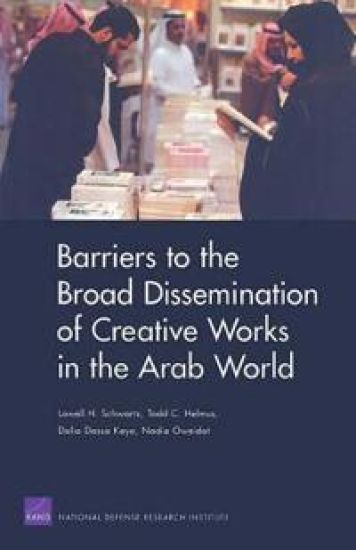
Barriers to the Broad Dissemination of Creative Works in the Arab World

Barriers to the Broad Dissemination of Creative Works in the Arab World

Lowell H Schwartz; Todd C Helmus; Dalia Dassa Kaye; Nadia Oweidat

RAND
2009
pokkari
A growing body of creative works by Arab authors and artists counters the intellectual and ideological underpinnings of violent extremism. Unfortunately, many of these works are not widely disseminated, marginalizing the influence of these alternative voices. This monograph examines the barriers to the broad dissemination of such works, with a focus on Arabic literature, and suggests ways to overcome these barriers.
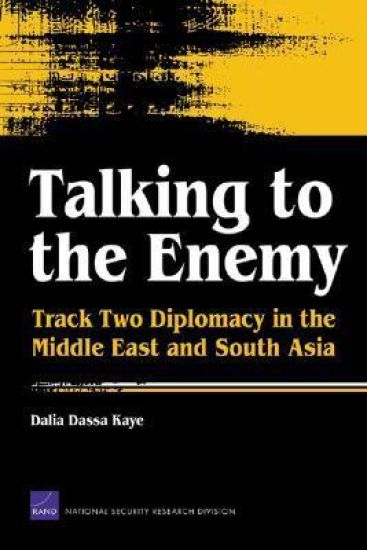
Talking to the Enemy

Talking to the Enemy

Dalia Dassa Kaye

RAND
2007
pokkari
This monograph examines security-related track two diplomacy efforts in the Middle East and South Asia, including how such efforts have socialized participants into thinking about security in more cooperative terms, and whether the ideas generated in track two forums have been acknowledged at the societal level or influenced official policy. Kaye concludes with suggestions on how to improve future track two efforts.
Beyond the Handshake

Beyond the Handshake

Dalia Dassa Kaye

Columbia University Press
2001
pokkari
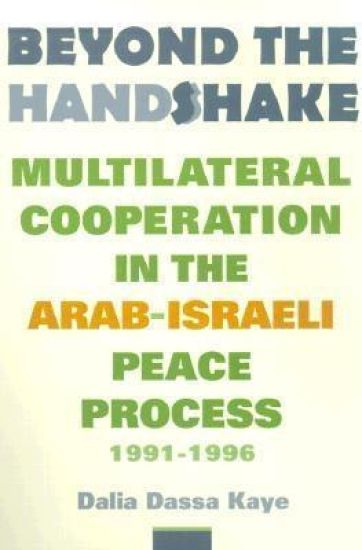
Arabs and Israelis have battled one another in political and military arenas, seemingly continuously, for some fifty years. The 1991 Madrid Peace Conference sought to change this pattern, launching bilateral and multilateral tracks in the Arab-Israeli peace process. As a result, a broad group of Arab states sat down with Israel and began to cooperate on a wide range of regional issues in what became known as the Middle East multilaterals. Yet why did enemies reluctant even to recognize one another choose to cooperate on regional problems? And once this process began, what drove the parties to continue such cooperation or, in some cases, halt their cooperative efforts? Beyond the Handshake addresses these fundamental questions, exploring the origins of the multilaterals and the development of multilateral cooperation in the areas of arms control and regional security, economic development, water management, and the environment. Dalia Dassa Kaye, challenging conventional concepts of cooperation, argues that multilateral cooperation in the Middle East must be appreciated as a process of interaction rather than solely as a set of outcomes. Presenting theoretical insights of value to students of regional and international relations, Beyond the Handshake provides a unique look at the evolving nature of Arab-Israeli relations and exposes the foundation the multilateral peace process laid for future regional cooperation in the Middle East.
Beyond the Handshake

Beyond the Handshake

Dalia Dassa Kaye

Columbia University Press
2001
sidottu
Arabs and Israelis have battled one another in political and military arenas, seemingly continuously, for some fifty years. The 1991 Madrid Peace Conference sought to change this pattern, launching bilateral and multilateral tracks in the Arab-Israeli peace process. As a result, a broad group of Arab states sat down with Israel and began to cooperate on a wide range of regional issues in what became known as the Middle East multilaterals. Yet why did enemies reluctant even to recognize one another choose to cooperate on regional problems? And once this process began, what drove the parties to continue such cooperation or, in some cases, halt their cooperative efforts? Beyond the Handshake addresses these fundamental questions, exploring the origins of the multilaterals and the development of multilateral cooperation in the areas of arms control and regional security, economic development, water management, and the environment. Dalia Dassa Kaye, challenging conventional concepts of cooperation, argues that multilateral cooperation in the Middle East must be appreciated as a process of interaction rather than solely as a set of outcomes. Presenting theoretical insights of value to students of regional and international relations, Beyond the Handshake provides a unique look at the evolving nature of Arab-Israeli relations and exposes the foundation the multilateral peace process laid for future regional cooperation in the Middle East.