Kirjojen hintavertailu. Mukana 12 127 085 kirjaa ja 12 kauppaa.

Kirjailija

Damir D. Dzhafarov

Kirjat ja teokset yhdessä paikassa: 3 kirjaa, julkaisuja vuosilta 2022-2024, suosituimpien joukossa Reverse Mathematics. Vertaile teosten hintoja ja tarkista saatavuus suomalaisista kirjakaupoista.

3 kirjaa

Kirjojen julkaisuhaarukka 2022-2024.

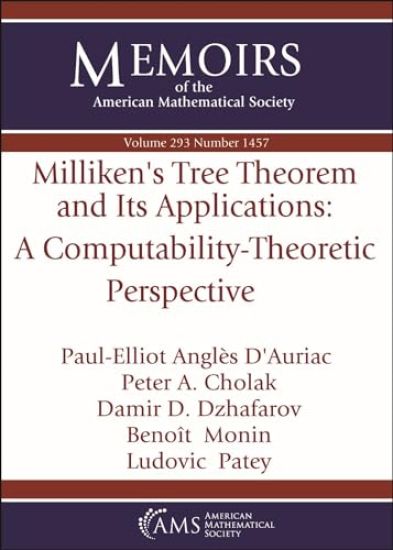
Milliken's Tree Theorem and Its Applications: A Computability-Theoretic Perspective

Milliken's Tree Theorem and Its Applications: A Computability-Theoretic Perspective

Paul-Elliot Angles D'Auriac; Peter A. Cholak; Damir D. Dzhafarov; Benoit Monin; Ludovic Patey

AMERICAN MATHEMATICAL SOCIETY
2024
nidottu
Milliken's tree theorem is a deep result in combinatorics that generalizes a vast number of other results in the subject, most notably Ramsey's theorem and its many variants and consequences. In this sense, Milliken's tree theorem is paradigmatic of structural Ramsey theory, which seeks to identify the common combinatorial and logical features of partition results in general. Its investigation in this area has consequently been extensive.Motivated by a question of Dobrinen, we initiate the study of Milliken's tree theorem from the point of view of computability theory. The goal is to understand how close it is to being algorithmically solvable, and how computationally complex are the constructions needed to prove it. This kind of examination enjoys a long and rich history, and continues to be a highly active endeavor. Applied to combinatorial principles, particularly Ramsey's theorem, it constitutes one of the most fruitful research programs in computability theory as a whole. The challenge to studying Milliken's tree theorem using this framework is its unusually intricate proof, and more specifically, the proof of the Halpern-La¨uchli theorem, which is a key ingredient.Our advance here stems from a careful analysis of the Halpern–Läuchli theorem which shows that it can be carried out effectively (i.e., that it is computably true). We use this as the basis of a new inductive proof of Milliken's tree theorem that permits us to gauge its effectivity in turn. The key combinatorial tool we develop for the inductive step is a fast-growing computable function that can be used to obtain a finitary, or localized, version of Milliken's tree theorem. This enables us to build solutions to the full Milliken's tree theorem using effective forcing. The principal result of this is a full classification of the computable content of Milliken's tree theorem in terms of the jump hierarchy, stratified by the size of instance. As usual, this also translates into the parlance of reverse mathematics, yielding a complete understanding of the fragment of second-order arithmetic required to prove Milliken's tree theorem.We apply our analysis also to several well-known applications of Milliken's tree theorem, namely Devlin's theorem, a partition theorem for Rado graphs, and a generalized version of the so-called tree theorem of Chubb, Hirst, and McNicholl. These are all certain kinds of extensions of Ramsey's theorem for different structures, namely the rational numbers, the Rado graph, and perfect binary trees, respectively. We obtain a number of new results about how these principles relate to Milliken's tree theorem and to each other, in terms of both their computability-theoretic and combinatorial aspects. In particular, we establish new structural Ramsey-theoretic properties of the Rado graph theorem and the generalized Chubb-Hirst-McNicholl tree theorem using Zucker's notion of big Ramsey structure.
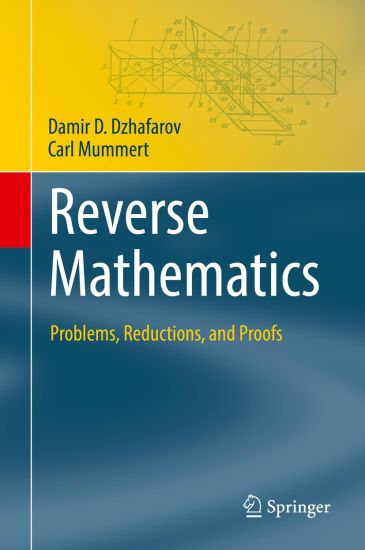
Reverse Mathematics

Reverse Mathematics

Damir D. Dzhafarov; Carl Mummert

Springer International Publishing AG
2023
nidottu
Reverse mathematics studies the complexity of proving mathematical theorems and solving mathematical problems. Typical questions include: Can we prove this result without first proving that one? Can a computer solve this problem? A highly active part of mathematical logic and computability theory, the subject offers beautiful results as well as significant foundational insights.This text provides a modern treatment of reverse mathematics that combines computability theoretic reductions and proofs in formal arithmetic to measure the complexity of theorems and problems from all areas of mathematics. It includes detailed introductions to techniques from computable mathematics, Weihrauch style analysis, and other parts of computability that have become integral to research in the field. Topics and features:Provides a complete introduction to reverse mathematics, including necessary background from computability theory, second order arithmetic, forcing, induction, and model constructionOffers a comprehensive treatment of the reverse mathematics of combinatorics, including Ramsey's theorem, Hindman's theorem, and many other resultsProvides central results and methods from the past two decades, appearing in book form for the first time and including preservation techniques and applications of probabilistic argumentsIncludes a large number of exercises of varying levels of difficulty, supplementing each chapterThe text will be accessible to students with a standard first year course in mathematical logic. It will also be a useful reference for researchers in reverse mathematics, computability theory, proof theory, and related areas.Damir D. Dzhafarov is an Associate Professor of Mathematics at the University of Connecticut, CT, USA. Carl Mummert is a Professor of Computer and Information Technology at Marshall University, WV, USA.
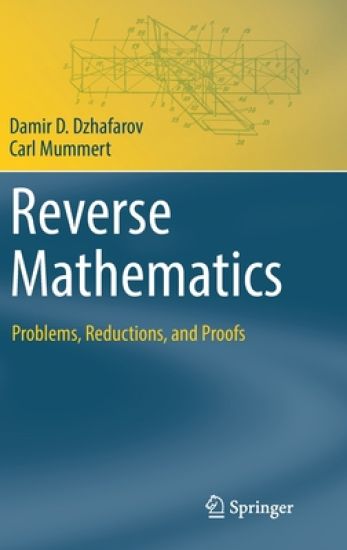
Reverse Mathematics

Reverse Mathematics

Damir D. Dzhafarov; Carl Mummert

Springer International Publishing AG
2022
sidottu
Reverse mathematics studies the complexity of proving mathematical theorems and solving mathematical problems. Typical questions include: Can we prove this result without first proving that one? Can a computer solve this problem? A highly active part of mathematical logic and computability theory, the subject offers beautiful results as well as significant foundational insights.This text provides a modern treatment of reverse mathematics that combines computability theoretic reductions and proofs in formal arithmetic to measure the complexity of theorems and problems from all areas of mathematics. It includes detailed introductions to techniques from computable mathematics, Weihrauch style analysis, and other parts of computability that have become integral to research in the field. Topics and features:Provides a complete introduction to reverse mathematics, including necessary background from computability theory, second order arithmetic, forcing, induction, and model constructionOffers a comprehensive treatment of the reverse mathematics of combinatorics, including Ramsey's theorem, Hindman's theorem, and many other resultsProvides central results and methods from the past two decades, appearing in book form for the first time and including preservation techniques and applications of probabilistic argumentsIncludes a large number of exercises of varying levels of difficulty, supplementing each chapterThe text will be accessible to students with a standard first year course in mathematical logic. It will also be a useful reference for researchers in reverse mathematics, computability theory, proof theory, and related areas.Damir D. Dzhafarov is an Associate Professor of Mathematics at the University of Connecticut, CT, USA. Carl Mummert is a Professor of Computer and Information Technology at Marshall University, WV, USA.