Kirjojen hintavertailu. Mukana 12 595 353 kirjaa ja 12 kauppaa.

Kirjailija

Daniel Bar-Tal

Kirjat ja teokset yhdessä paikassa: 8 kirjaa, julkaisuja vuosilta 1999-2023, suosituimpien joukossa Sinking into the Honey Trap. Vertaile teosten hintoja ja tarkista saatavuus suomalaisista kirjakaupoista.

8 kirjaa

Kirjojen julkaisuhaarukka 1999-2023.

Sinking into the Honey Trap

Sinking into the Honey Trap

Daniel Bar-Tal

Westphalia Press
2023
pokkari
Sinking into the Honey Trap: The Case of the Israeli-Palestinian Conflict describes how Israeli society has positioned itself in the comfort zone, ignoring the reality in which it exists. It is about the story they tell us, and most of the people accept it. This story shapes the consciousness of the Israeli Jewish society, by explaining the half truth about the past, hiding the present and describing a deceptive vision for the future. It explains the mechanisms that make it possible to ignore the reality and live in a situation that prolongs the conflict with the Palestinians and push the solution to an unseen future with ongoing violence. It tells what and how political forces pushed Israel to the advancing occupation and settling with Jews the West Bank. The society is paying high prices for the continuation of the situation - not only in life, mental health and economic price, but also in the deterioration of democracy and morality that accelerates the growth of an authoritarian regime with nationalism and religiosity. This process occurs also in other places engulfed in intractable conflict like Turkey, Russia, India, or Rwanda. That is, the societies are sinking in the honey trap. Daniel Bar-Tal is Professor Emeritus at the School of Education, Tel Aviv University. His research interest is in political and social psychology studying socio-psychological foundations of intractable conflicts and peace building. His most influential theoretical contribution is the development of a systematic and holistic theory of the dynamics of interethnic bloody and lasting conflicts: how they erupt, escalate and possibly de-escalate, are resolved peacefully and even reconciled. In addition, he is an authority on the Israeli-Arab/Palestinian conflict, suggesting a comprehensive interdisciplinary analysis of its foundation, continuation and maintenance. He has published over twenty-five books and over two hundred and fifty articles and chapters in major social and political psychological journals, books and encyclopedias. He served as a President of the International Society of Political Psychology and received numerous awards for his academic achievements.

Intractable Conflicts

Intractable Conflicts

Daniel Bar-Tal

Cambridge University Press
2015
pokkari
This book provides a comprehensive, interdisciplinary and holistic analysis of the socio-psychological dynamics of intractable conflicts. Daniel Bar-Tal's original conceptual framework is supported by evidence drawn from different disciplines, including empirical data and illustrative case studies. His analysis rests on the premise that intractable conflicts share certain socio-psychological foundations, despite differences in context and other characteristics. He describes a full cycle of intractable conflicts - their outbreak, escalation and reconciliation through peace building. Bar-Tal's framework provides a broad theoretical view of the of the socio-psychological repertoire that develops in the course of long-term and violent conflicts, outlines the factors affecting its formation, demonstrates how it is maintained, points out its functions and describes its consequences. The book also elaborates on the contents, processes and other factors involved in the peace building process.
Intractable Conflicts

Intractable Conflicts

Daniel Bar-Tal

Cambridge University Press
2013
sidottu
This book provides a comprehensive, interdisciplinary and holistic analysis of the socio-psychological dynamics of intractable conflicts. Daniel Bar-Tal's original conceptual framework is supported by evidence drawn from different disciplines, including empirical data and illustrative case studies. His analysis rests on the premise that intractable conflicts share certain socio-psychological foundations, despite differences in context and other characteristics. He describes a full cycle of intractable conflicts - their outbreak, escalation and reconciliation through peace building. Bar-Tal's framework provides a broad theoretical view of the of the socio-psychological repertoire that develops in the course of long-term and violent conflicts, outlines the factors affecting its formation, demonstrates how it is maintained, points out its functions and describes its consequences. The book also elaborates on the contents, processes and other factors involved in the peace building process.
Group Beliefs

Group Beliefs

Daniel Bar-Tal

Springer-Verlag New York Inc.
2011
nidottu
"Individuals who live in groups hold common beliefs which define their reality, not only as persons, but also as group members. This reality becomes especially important when group members become aware that they share beliefs and are convinced that these beliefs characterize them as a group. In this case common beliefs become group beliefs." With this statement, Dr. Bar-Tal begins his far-reaching analysis of beliefs as a group phenomenon. Group beliefs are shown to have important behavioral, cognitive, and affective implications for group members and the group as a whole. They may contribute to the behavioral direction a group takes, coordinate group activities, determine the intensity and involvement of group members, and influence the way group members affect the leaders. This book introduces and articulates the implications of a new concept of group beliefs, shedding new light on the structure and processes of groups, focusing on such phenomena as group formation, subgrouping, splits, mergence and group disintegration. By taking an interdisciplinary approach, this integrative conception opens new avenues to the study and understanding of group behavior.
Stereotypes and Prejudice in Conflict

Stereotypes and Prejudice in Conflict

Daniel Bar-Tal; Yona Teichman

Cambridge University Press
2009
pokkari
In the last two decades, the study of social stereotypes and prejudice has become one of the central interests in social psychology in particular. One reflection of this growing interest is the focus on shared stereotypes and prejudices. The primary reason for this development is the recognition that stereotypes and prejudice play a determinative role in shaping intergroup relations. In situations of conflict, they are simultaneously outcomes of the accumulated animosity between the involved groups and also feed on the continuation of the conflict by furnishing the cognitive-affective basis for the experienced mistrust by the parties. In spite of this recognition, no systematic analysis of the stereotypes and prejudice was carried out in real situations. This book tries to rectify this by applying a general and universal conceptual framework to the study of the acquisition and development of stereotypes and prejudice in a society involved in an intractable conflict.
Shared Beliefs in a Society

Shared Beliefs in a Society

Daniel Bar-Tal

SAGE Publications Inc
2000
sidottu
...carefully argued, this book will have special appeal to graduate students, faculty, social psychologists (notably those yearning for Lewinian Approaches), and group-oriented sociologists. —Choice What kind of shared beliefs in a society are of importance to social systems? What functions do they fulfill? How are they informed and disseminated? What are the societal consequences of shared beliefs? All of these questions are addressed in this book in which Daniel Bar-Tal develops the notion of societal psychology, which he states can contribute a social-psychological perspective to the study of a wide range of social problems in a society. He shows how societal psychology can fulfill the promise of early social psychologists by directing attention to the societal and cultural contexts in which individuals live and by examining the reciprocal influence between these contexts and individuals. In this comprehensive volume, four themes of societal belief: patriotism, security, siege mentality, and deligitimization, are examined through well-defined examples and systematic analysis. Researchers, students and practitioners in social psychology, sociology, political science and anthropology will be stimulated and engaged by this important contribution to the field.
Shared Beliefs in a Society

Shared Beliefs in a Society

Daniel Bar-Tal

SAGE Publications Inc
2000
nidottu
...carefully argued, this book will have special appeal to graduate students, faculty, social psychologists (notably those yearning for Lewinian Approaches), and group-oriented sociologists. —Choice What kind of shared beliefs in a society are of importance to social systems? What functions do they fulfill? How are they informed and disseminated? What are the societal consequences of shared beliefs? All of these questions are addressed in this book in which Daniel Bar-Tal develops the notion of societal psychology, which he states can contribute a social-psychological perspective to the study of a wide range of social problems in a society. He shows how societal psychology can fulfill the promise of early social psychologists by directing attention to the societal and cultural contexts in which individuals live and by examining the reciprocal influence between these contexts and individuals. In this comprehensive volume, four themes of societal belief: patriotism, security, siege mentality, and deligitimization, are examined through well-defined examples and systematic analysis. Researchers, students and practitioners in social psychology, sociology, political science and anthropology will be stimulated and engaged by this important contribution to the field.
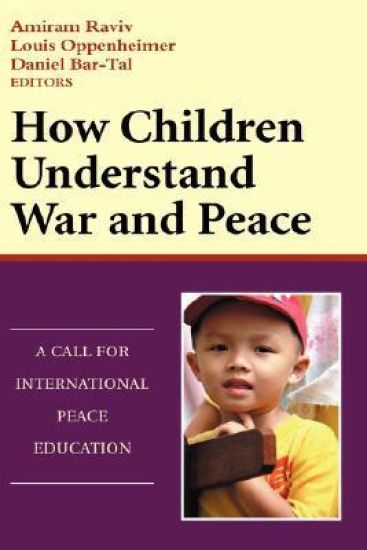
How Children Understand War and Peace

How Children Understand War and Peace

Amiram Raviv; Louis Oppenheimer; Daniel Bar-Tal

Jossey-Bass Inc.,U.S.
1999
sidottu
How Children Understand War and Peace is a landmark book that examines these two vital questions and provides a solid framework on which to build answers. Written by an international panel of experts in the fields of developmental, social, and educational psychology, How Children Understand War and Peace presents a collection of the most current thoughts and insights into how children and adolescents develop an understanding of war, conflict, and peace.Based on research studies done in Australia, Canada, Finland, Holland, Israel, Portugal, Northern Ireland, Sweden, and the United States, this comprehensive volume presents evidence that perceptions of war and peace formed during childhood relate directly to adult perspectives on these critical issues. The contributors present persuasive evidence that our knowledge about how youngsters from around the globe develop and form worldviews can be used to create educational programs that teach children peace education, conflict management, and conflict resolution.