Kirjojen hintavertailu. Mukana 12 302 702 kirjaa ja 12 kauppaa.

Kirjailija

Daniel Gonzales

Kirjat ja teokset yhdessä paikassa: 15 kirjaa, julkaisuja vuosilta 2000-2024, suosituimpien joukossa An Assessment of the U.S. and Chinese Industrial Bases in Quantum Technology. Vertaile teosten hintoja ja tarkista saatavuus suomalaisista kirjakaupoista.

15 kirjaa

Kirjojen julkaisuhaarukka 2000-2024.

Alternative Futures for Digital Infrastructure

Alternative Futures for Digital Infrastructure

Julia Brackup; Sarah Harting; Daniel Gonzales; Brandon Corbin

RAND Corporation
2024
pokkari
A competition for digital infrastructure (DI) is underway between the United States and China, which has implications for military forces and operations that rely on this infrastructure in competition and conflict. This report summarizes an alternative futures analysis of how the global DI could evolve out to 2050 and the military implications of those futures for the United States and China.
An Assessment of U.S.-Allied Nations' Industrial Bases in Quantum Technology

An Assessment of U.S.-Allied Nations' Industrial Bases in Quantum Technology

Edward Parker; Richard Silberglitt; Daniel Gonzales

RAND Corporation
2023
nidottu
This report presents an assessment of the quantum technology industrial bases of several U.S.-allied nations that are major players in the development of quantum technology, beginning with a global look and then focusing on the quantum industrial bases of Australia, the UK, Germany, and Japan. It gives recommendations for how the United States can promote strong ties with its allies in quantum technology research and development
Securing 5g

Securing 5g

Daniel Gonzales; Julia Brackup; Spencer Pfeifer; Timothy M Bonds

RAND Corporation
2022
pokkari
This report describes fifth-generation (5G) network security, the 5G supply chain, competition in 5G equipment and mobile device markets, where the United States has security advantages over China, and how to preserve those advantages in the 5G competition between the United States and China. The report provides recommendations for securing 5G networks and mobile devices of the United States, its allies, and foreign partners.
Unclassified and Secure

Unclassified and Secure

Daniel Gonzales; Sarah Harting; Mary Kate Adgie; Julia Brackup; Lindsey Polley; Karlyn D Stanley

RAND
2020
nidottu
The unclassified networks of defense industrial base firms have become an attractive entrance for adversaries seeking access to cutting-edge technologies and research and development efforts. This report describes a way for the U.S. Department of Defense to better secure such networks through the establishment of a cybersecurity program designed to strengthen their protections.
Designing Unmanned Systems with Greater Autonomy

Designing Unmanned Systems with Greater Autonomy

Daniel Gonzales; Sarah Harting

RAND
2014
pokkari
Current unmanned systems (UxSs) use different communication systems and have limited autonomy, which limit their ability to share information they collect with warfighters and other UxSs operating in the same area. UxSs may also face survivability and mission effectiveness challenges when they operate in contested environments. This report identifies an architectural approach that can improve system interoperability and autonomy.
DOD and Commercial Advanced Waveform Developments and Programs with Nunn-Mccurdy Breaches

DOD and Commercial Advanced Waveform Developments and Programs with Nunn-Mccurdy Breaches

Mark V. Arena; Irv Blickstein; Daniel Gonzales; Sarah Harting; Jennifer Lamping Lewis; Michael McGee; Megan McKErnan; Charles Nemfakos; Jan Osburg; Rena Rudavsky; Jerry M. Sollinger

RAND
2014
pokkari
The report presents the results of two studies: The first compares the capabilities and development approaches used in the Joint Tactical Radio System wideband networking waveform and the commercial long-term evolution waveform, and the second analyzes military acquisition programs that have exceeded certain cost thresholds more than once.
Improving Interagency Information Sharing Using Technology Demonstrations

Improving Interagency Information Sharing Using Technology Demonstrations

Daniel Gonzales; Sarah Harting; Jason Mastbaum; Carolyn Wong

RAND
2014
pokkari
The Department of Defense (DoD) has developed new sensor technologies to support U.S. forces in Iraq and Afghanistan; these technologies are potentially useful for counterdrug operations along the southern U.S. border, but there are legal questions regarding how they may be used and how sensor information may be shared between federal agencies in domestic operations. This report examines federal law and DoD policy to answer these questions.
Authority to Issue Interoperability Policy

Authority to Issue Interoperability Policy

Carolyn Wong; Daniel Gonzales

RAND
2014
pokkari
This report presents an approach and framework for determining what parties have authority to issue interoperability policy, the legal and policy origins and implementation paths of the authority, and the extent of the authority. The approach includes rigorous analysis by researchers to identify pertinent authorities in federal law and a means to facilitate discovery of roles and responsibilities in Department of Defense and Service policies.
Using Epic to Find Conflicts, Inconsistencies, and Gaps in Department of Defense Policies

Using Epic to Find Conflicts, Inconsistencies, and Gaps in Department of Defense Policies

Carolyn Wong; Daniel Gonzales; Chad J. R. Ohlandt; Eric Landree; John Hollywood

RAND
2013
pokkari
The authors present a framework and methodology to identify the roles and responsibilities of those implementing Department of Defense policies and also potential conflicts, ambiguities, gaps, inconsistencies, and redundancies in those policies. They introduce a new software tool that automates one step of the methodology--EPIC--and demonstrate its use with three case studies to illustrate the technique and also the tool's flexibility.
Are Law and Policy Clear and Consistent?

Are Law and Policy Clear and Consistent?

Daniel Gonzales; Carolyn Wong; Eric Landree; Leland Joe

RAND
2010
pokkari
The roles and responsibilities of defense acquisition officers and chief information officers are governed both by U.S. laws and by Department of Defense (DoD) policy. The authors identify policy governing the design, acquisition, and integration of information technology (IT) and national security systems (NSS) that could lead to potential conflicts among these executives when they exercise their duties in the defense acquisition system, and suggest changes to DoD policy that can resolve these conflicts.
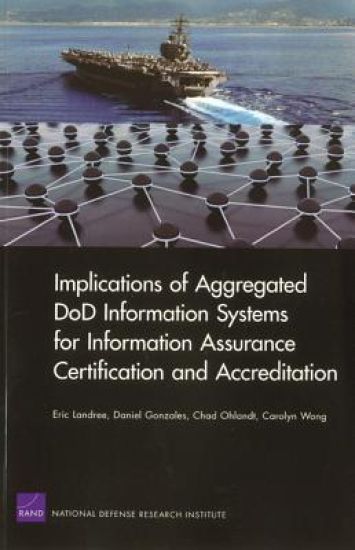
Implications of Aggregated DOD Information Systems for Information Assurance Certification and Accreditation
The challenge of securing U.S. Department of Defense (DoD) information systems has grown significantly. A new approach to information assurance certification and accreditation (IA C&A) is needed to effectively extend the IA C&A process to aggregations of systems and improve their security. An examination of current policy shows that a number of changes could enable the IA C&A of aggregations of DoD information systems on a common platform.
Networked Forces in Stability Operations

Networked Forces in Stability Operations

Daniel Gonzales; John Hollywood; Jerry M Sollinger; James McFadden; John Dejarnette

RAND
2007
pokkari
Compares three units that conducted stability operations in the same area in northern Iraq-the 101st Airborne Division (which had only limited digital communications), the 3/2 Stryker brigade combat team (SBCT), and the 1/25 SBCT (both equipped with digital networks) and finds that leadership, training, and tactics and procedures are just as important as networking capabilities for improving mission effectiveness in stability operations.