Kirjojen hintavertailu. Mukana 12 595 353 kirjaa ja 12 kauppaa.

Kirjailija

Daniel J. Duffy

Kirjat ja teokset yhdessä paikassa: 9 kirjaa, julkaisuja vuosilta 2004-2022, suosituimpien joukossa C# for Financial Markets. Vertaile teosten hintoja ja tarkista saatavuus suomalaisista kirjakaupoista.

Mukana myös kirjoitusasut: Daniel J Duffy

9 kirjaa

Kirjojen julkaisuhaarukka 2004-2022.

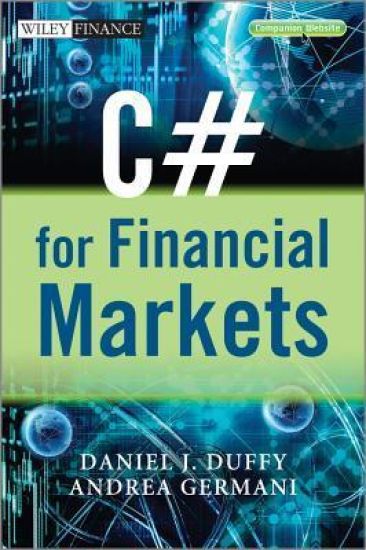
C# for Financial Markets

C# for Financial Markets

Daniel J. Duffy; Andrea Germani

John Wiley Sons Inc
2013
muu
A practice-oriented guide to using C# to design and program pricing and trading models In this step-by-step guide to software development for financial analysts, traders, developers and quants, the authors show both novice and experienced practitioners how to develop robust and accurate pricing models and employ them in real environments. Traders will learn how to design and implement applications for curve and surface modeling, fixed income products, hedging strategies, plain and exotic option modeling, interest rate options, structured bonds, unfunded structured products, and more. A unique mix of modern software technology and quantitative finance, this book is both timely and practical. The approach is thorough and comprehensive and the authors use a combination of C# language features, design patterns, mathematics and finance to produce efficient and maintainable software. Designed for quant developers, traders and MSc/MFE students, each chapter has numerous exercises and the book is accompanied by a dedicated companion website, www.datasimfinancial.com/forum/viewforum.php?f=196&sid=f30022095850dee48c7db5ff62192b34, providing all source code, alongside audio, support and discussion forums for readers to comment on the code and obtain new versions of the software.
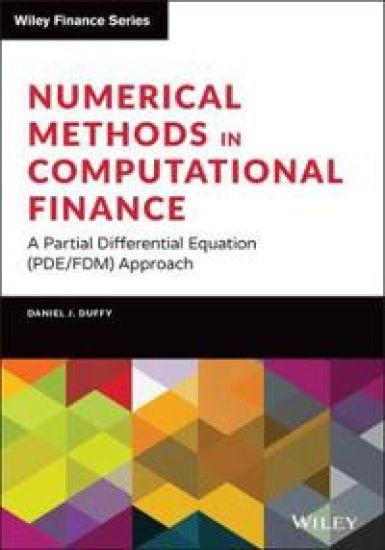
Numerical Methods in Computational Finance

Numerical Methods in Computational Finance

Daniel J. Duffy

JOHN WILEY SONS INC
2022
sidottu
This book is a detailed and step-by-step introduction to the mathematical foundations of ordinary and partial differential equations, their approximation by the finite difference method and applications to computational finance. The book is structured so that it can be read by beginners, novices and expert users. Part A Mathematical Foundation for One-Factor Problems Chapters 1 to 7 introduce the mathematical and numerical analysis concepts that are needed to understand the finite difference method and its application to computational finance. Part B Mathematical Foundation for Two-Factor Problems Chapters 8 to 13 discuss a number of rigorous mathematical techniques relating to elliptic and parabolic partial differential equations in two space variables. In particular, we develop strategies to preprocess and modify a PDE before we approximate it by the finite difference method, thus avoiding ad-hoc and heuristic tricks. Part C The Foundations of the Finite Difference Method (FDM) Chapters 14 to 17 introduce the mathematical background to the finite difference method for initial boundary value problems for parabolic PDEs. It encapsulates all the background information to construct stable and accurate finite difference schemes. Part D Advanced Finite Difference Schemes for Two-Factor Problems Chapters 18 to 22 introduce a number of modern finite difference methods to approximate the solution of two factor partial differential equations. This is the only book we know of that discusses these methods in any detail. Part E Test Cases in Computational Finance Chapters 23 to 26 are concerned with applications based on previous chapters. We discuss finite difference schemes for a wide range of one-factor and two-factor problems. This book is suitable as an entry-level introduction as well as a detailed treatment of modern methods as used by industry quants and MSc/MFE students in finance. The topics have applications to numerical analysis, science and engineering. More on computational finance and the author’s online courses, see www.datasim.nl.
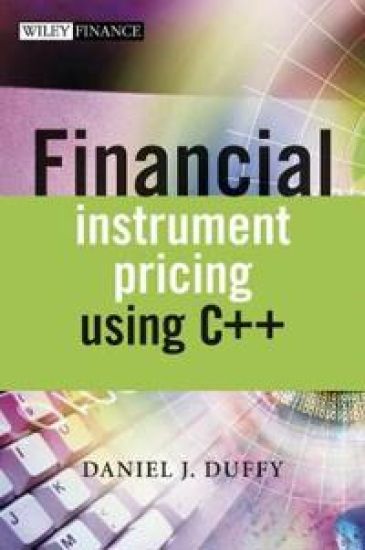
Financial Instrument Pricing Using C++

Financial Instrument Pricing Using C++

Daniel J. Duffy

John Wiley Sons Inc
2018
sidottu
An integrated guide to C++ and computational finance This complete guide to C++ and computational finance is a follow-up and major extension to Daniel J. Duffy's 2004 edition of Financial Instrument Pricing Using C++. Both C++ and computational finance have evolved and changed dramatically in the last ten years and this book documents these improvements. Duffy focuses on these developments and the advantages for the quant developer by: Delving into a detailed account of the new C++11 standard and its applicability to computational finance.Using de-facto standard libraries, such as Boost and Eigen to improve developer productivity.Developing multiparadigm software using the object-oriented, generic, and functional programming styles.Designing flexible numerical algorithms: modern numerical methods and multiparadigm design patterns.Providing a detailed explanation of the Finite Difference Methods through six chapters, including new developments such as ADE, Method of Lines (MOL), and Uncertain Volatility Models.Developing applications, from financial model to algorithmic design and code, through a coherent approach.Generating interoperability with Excel add-ins, C#, and C++/CLI.Using random number generation in C++11 and Monte Carlo simulation. Duffy adopted a spiral model approach while writing each chapter of Financial Instrument Pricing Using C++ 2e: analyse a little, design a little, and code a little. Each cycle ends with a working prototype in C++ and shows how a given algorithm or numerical method works. Additionally, each chapter contains non-trivial exercises and projects that discuss improvements and extensions to the material. This book is for designers and application developers in computational finance, and assumes the reader has some fundamental experience of C++ and derivatives pricing. HOW TO RECEIVE THE SOURCE CODE Once you have purchased a copy of the book please send an email to the author dduffyATdatasim.nl requesting your personal and non-transferable copy of the source code. Proof of purchase is needed. The subject of the mail should be “C++ Book Source Code Request”. You will receive a reply with a zip file attachment.
Monte Carlo Frameworks

Monte Carlo Frameworks

Daniel J. Duffy; Joerg Kienitz

John Wiley Sons Inc
2009
muu
This is one of the first books that describe all the steps that are needed in order to analyze, design and implement Monte Carlo applications. It discusses the financial theory as well as the mathematical and numerical background that is needed to write flexible and efficient C++ code using state-of-the art design and system patterns, object-oriented and generic programming models in combination with standard libraries and tools. Includes a CD containing the source code for all examples. It is strongly advised that you experiment with the code by compiling it and extending it to suit your needs. Support is offered via a user forum on www.datasimfinancial.com where you can post queries and communicate with other purchasers of the book. This book is for those professionals who design and develop models in computational finance. This book assumes that you have a working knowledge of C ++.
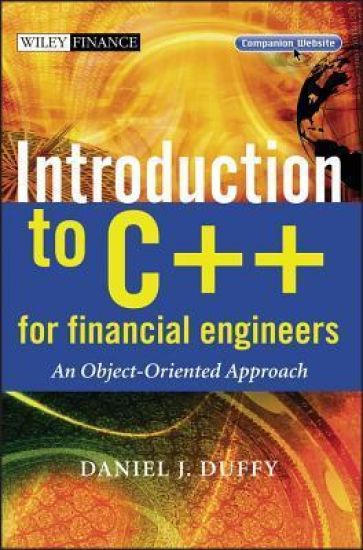
Introduction to C++ for Financial Engineers

Introduction to C++ for Financial Engineers

Daniel J. Duffy

John Wiley Sons Inc
2006
sidottu
This book introduces the reader to the C++ programming language and how to use it to write applications in quantitative finance (QF) and related areas. No previous knowledge of C or C++ is required -- experience with VBA, Matlab or other programming language is sufficient. The book adopts an incremental approach; starting from basic principles then moving on to advanced complex techniques and then to real-life applications in financial engineering. There are five major parts in the book: C++ fundamentals and object-oriented thinking in QFAdvanced object-oriented features such as inheritance and polymorphismTemplate programming and the Standard Template Library (STL)An introduction to GOF design patterns and their applications in QF Applications The kinds of applications include binomial and trinomial methods, Monte Carlo simulation, advanced trees, partial differential equations and finite difference methods. This book includes a companion website with all source code and many useful C++ classes that you can use in your own applications. Examples, test cases and applications are directly relevant to QF. This book is the perfect companion to Daniel J. Duffy’s book Financial Instrument Pricing using C++ (Wiley 2004, 0470855096 / 9780470021620)
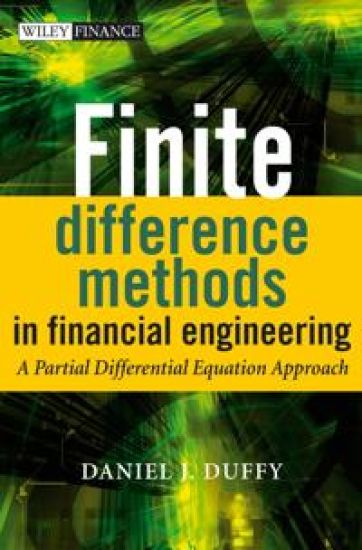
Finite Difference Methods in Financial Engineering
The world of quantitative finance (QF) is one of the fastest growing areas of research and its practical applications to derivatives pricing problem. Since the discovery of the famous Black-Scholes equation in the 1970's we have seen a surge in the number of models for a wide range of products such as plain and exotic options, interest rate derivatives, real options and many others. Gone are the days when it was possible to price these derivatives analytically. For most problems we must resort to some kind of approximate method. In this book we employ partial differential equations (PDE) to describe a range of one-factor and multi-factor derivatives products such as plain European and American options, multi-asset options, Asian options, interest rate options and real options. PDE techniques allow us to create a framework for modeling complex and interesting derivatives products. Having defined the PDE problem we then approximate it using the Finite Difference Method (FDM). This method has been used for many application areas such as fluid dynamics, heat transfer, semiconductor simulation and astrophysics, to name just a few. In this book we apply the same techniques to pricing real-life derivative products. We use both traditional (or well-known) methods as well as a number of advanced schemes that are making their way into the QF literature: Crank-Nicolson, exponentially fitted and higher-order schemes for one-factor and multi-factor optionsEarly exercise features and approximation using front-fixing, penalty and variational methodsModelling stochastic volatility models using Splitting methodsCritique of ADI and Crank-Nicolson schemes; when they work and when they don't workModelling jumps using Partial Integro Differential Equations (PIDE)Free and moving boundary value problems in QF Included with the book is a CD containing information on how to set up FDM algorithms, how to map these algorithms to C++ as well as several working programs for one-factor and two-factor models. We also provide source code so that you can customize the applications to suit your own needs.
Financial Instrument Pricing Using C++

Financial Instrument Pricing Using C++

Daniel J. Duffy

John Wiley Sons Inc
2004
muu
This book will help individuals design and implement robust and flexible software for applications (using C++) for financial instrument pricing problems. Designing and Implementing Software for Financial Instrument Pricing takes a practical approach to this topic. It has been written for those involved in designing and implementing numerical models for financial derivative products.