Kirjojen hintavertailu. Mukana 12 390 323 kirjaa ja 12 kauppaa.
Kirjailija
Daniel J. Shepard
Kirjat ja teokset yhdessä paikassa: 29 kirjaa, julkaisuja vuosilta 2011-2014, suosituimpien joukossa The Error of Boethius: Resolving the problem of free will. Vertaile teosten hintoja ja tarkista saatavuus suomalaisista kirjakaupoista.
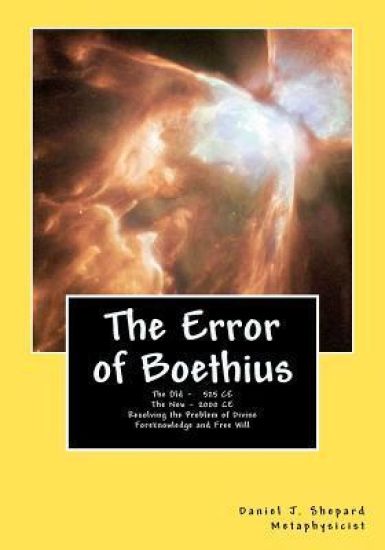
Panentheism is a model of reality capable of resolving the conflicting concepts of free will and divine foreknowledge. Free will confined within the boundaries of determinism is simply an illusion of free will. 'There can be little question that Boethius, more than any other philosophical author, helped the great Schoolmen to retain a general comprehensive view of the world as a whole, in spite of the distractions of their minute inquiries. ' Boethius presented humanity with a model of a metaphysical system, which led to an understanding regarding how it is men retain free will within the parameters of an all-knowing entity. Boethius' metaphysical system describes an omniscient God and It's interrelationship to free will. Examination of Boethius' metaphysical system becomes the point of the first part of this tractate. The second part of this tractate is an examination of a means by which we can embrace such a system while freeing ourselves of the contradiction divine foreknowledge, determinism, pre-destination, or predestination impose upon the very concept of 'free' will. Paradoxically, the process of freeing ourselves of the confines of determinism is accomplished through a process of removing free will from the realm of determinism and then reinserting free will back into determinism through a process of 'separation through inclusion' versus 'separation through exclusion'. The exploration of 'separation through inclusion' versus 'separation through exclusion' is itself fully explored in Tractate 8: Russell. Although the in depth understanding regarding the concept of 'separation through inclusion' must wait for the Russell Tractate, we will initiate the understanding regarding such a concept within this tractate. Boethius argued we must accept free will as being recessive, submissive to divine foreknowledge, determinism, pre-destination, and predestination. Now if submissive independence is not an error, what is? Is Boethius to blame for our having been unable to resolve the paradox regarding free will and divine foreknowledge? The answer is no. We are now the ones responsible for not resolving the issue regarding the paradox of the simultaneous independent existence of free will and determinism. Philosophers have expanded our understanding of abstraction and scientists have expanded our understanding of the physical. Now it is up to us to merge the two sets of knowledge. We have the knowledge. Therefore, it is up to present day metaphysicians to assemble these pieces of the puzzle and create a new metaphysical model. An alternative metaphysical perception, metaphysical model, to Boethius' metaphysical perception exists and is presented within this tractate. The problem is to gain the attention of religion, philosophy, and science, all of whom have rejected the very validity of metaphysics itself. With this in mind, let's examine what it was Boethius laid out for us as a metaphysical perception. Let us then proceed to examine why this metaphysical system was accepted as a logical argument. We will then examine why such a metaphysical model advanced intact through history followed by an examination as to why it is we have not yet discarded this metaphysical system. Finally, let us examine why it is we can now file Boethius' system away as an interesting perception found within the annals of philosophical history as opposed to its status of being an unresolved perplexing paradox of philosophical perception.
It is panentheism which provides the hope of developing a universal ethic which stretches from one end of our galaxy to the other. Universal ethics are ethics which apply to more than just an individual, a nation, a planet, a solar system or a galaxy. Universal ethics apply throughout the whole of a universe. What then are we to examine within this Volume 10: Kant and the Void of Space and Time? We are to examine space and time, the void of space and time, passive observation, active observation. It is this exploration which will lead us the the ever elusive development of what Kant calls his Categorical Imperatives or more generically, Universal Ethics. In spite of the pronouncements of philosophers to follow Kant, meta-physics, is not dead. Meta-physics has just been set aside while we await a new metaphysical system. Kant said we have no choice but to establish a more comprehensive metaphysical system before we relegate his system to the archives of ancient history. Such then becomes the task of this dialectic for it is the very purpose of this work, The War and Peace of a New Metaphysical Perception, to establish the rationality regarding a new metaphysical model. As we shall see, however, the task of 'replacing' Kant's system is not to be attempted through the process of destroying Kant metaphysical model but rather the new model is established through the process of fusing Aristotle's, Kant's, and Hegel's model all into one metaphysical model. Kant's metaphysical system presented many contradictions. Before we can replace Kant's system we must first examine Kant's system to, as Wittgenstein said: '... get a clear view of the state of ... affairs before the contradiction is resolved It is both aspects, examination and replacement, which is the focus of this volume. Kant embraced the concept of an Aristotelian Cartesian system. A Cartesian system is one built upon 'a' 'foundation'. Kant, therefore, believed a metaphysical system must have 'a' first principle. b The brief description of Kant's system, leads us to Kant's dilemma. Before we delve into the substance of this volume however, a few additional words would be appropriate regarding the direction this volume is to take. This volume is not to be a critique of Kant's work; rather this volume is an examination followed by an expansion of two of Kant's positions. First: The universe evolves as our thoughts evolve. Second: The concept of a system is critical to metaphysics. Regarding the first concept: The perception, the universe evolves as our thoughts evolve, provides the rationale as to why our understanding of the 'Greater' picture is so important. The concept that the universe evolves as our thoughts evolve implies we actively 'form' what 'will be' as opposed to the past Aristotelian perception that we are merely observers of 'what is'. Regarding the second concept: Kant was the first to propose such an upside down concept as the universe itself evolving as our thoughts evolved. Kant turned metaphysics and thus philosophy on its head just as Copernicus turned cosmology and thus science on its head. Kant was the first metaphysician to step beyond the perceptual metaphysical perception of the day. Kant was able to step beyond the perception of the day regarding the observer passively observing. Kant, however, was unable to step beyond the perception of the day regarding the existence of an Aristotelian closed system. Such conflicting positions generated unwieldy metaphysical contradictions. Kant innovated a perception incapable of being 'confined' within an Aristotelian closed system and thus found himself incapable of finding both first truth and his dearly sought categorical imperative. It is these two concepts, first truth and categorical imperatives, that this volume will examine and with the help of Hegelian concepts attempt to resolve.
Hegel's Theory... is a philosophical summit So it is 'a' summit appears to have been reached only for us to find, having attained such a summit, a new summit awaits beyond the one we just laboriously conquered. The climb towards Hegel's summit began with 'nothingness' and revealed stunning paradoxes great metaphysical thinkers such as Zeno, Aristotle, Boethius, Copernicus, Leibniz, Kant, and Hegel himself attempted but failed to resolve. The gallant attempts put forward by these great thinkers led to metaphysical perceptions which temporarily satisfied segments of our species but never rose to the level of consensus required of a universal metaphysical model. A universal metaphysical model answers, at a minimum, three metaphysical questions: Where am I? What am I? And, Why do I exist? From such a model the term 'I' finds itself, naturally and with an ease of complete continuity, capable of being rationally replaceable with the terms: 'you', 'we', 'you and I together', 'humanity', 'life', 'the earth', 'the solar system', 'the galaxy', 'other life forms within the universe', 'all life forms within the universe', 'the universe', 'all universes'. Thinkers such as Zeno, Aristotle, Boethius, Copernicus, Leibniz, and Kant demonstrated the problems broad forms of substitution create when applied to the limited metaphysical systems these thinkers left in place. Hegel is no different just because we come to 'a' summit. There is always a summit to follow each summit we conquer. To state: 'Hegel's Theory... is a philosophical summit.' is not to imply there are no other summits awaiting us. Before we can begin our climb to the next summit, we need to understand the new perception Hegel displayed for us. It is Hegel's metaphysical system, which raises the question regarding the need of 'a creator of the universe', the need of' 'a primal cause', the need of 'a first Cause'. Kant's metaphysical system left us with an understanding regarding a perception of a second location existing: a location for the universe and a second location for 'God'. Such a perception did not emerge because Kant stated the need for a second location but rather such a perception emerged naturally as a means of resolving issues Kant's system brought to the surface of reason. It is panentheism which provides the answers to the questions raised by both Hegel and Kant and it is these answers which are fully explored within this volume.
Panentheism is an ontological system capable of compassionately resolving the issue of theodicy or what generically is termed as omni-benevolence. Leibniz and Theodicy, appears relatively unimportant when compared to the voluminous material found within the previous tractates. One must not forget, however, that we are dealing with abstractual concepts within the complete work of The War and Peace of a New Metaphysical Perception of which this tractate is an element. Abstractual concepts are not measured in terms of physical dimensions and thus cannot be compared one to another in our customary fashion. Abstractual concepts just are and as such abstractual concepts have not only no relative value of physical size one to the other but have no relative value of importance one to the other. Why then examine the concept of Theodicy which was introduced so eloquently by Leibniz rather than other 'more important' aspects of Leibniz' work? There it is again, the almost inescapable desire to place relative value upon one idea as opposed to another. So again we will ask the question but remove the concept of 'relative value' from the question: Why then examine the concept of Theodicy? The concept of theodicy, as introduced by Leibniz, created a beacon which metaphysicians felt obliged to follow as they worked throughout the following centuries. Metaphysicians, by embracing the concept that 'perfection' as defined by ontologists, in truth lost their way and simply perceived themselves to be metaphysicians when in actuality they became ontologists masquerading as metaphysicians. Such 'metaphysicians' examined the personality of 'God' versus the fundamental characteristics of 'the whole' system 'within' which we, elements of perceptual knowing, find ourselves to exist. Metaphysics does not deal with the personality of the whole but rather metaphysics deals with the basics, with what is. Ontology deals with the abstractual personality of the whole, which emerges from the existence of the whole itself. So for a third time: Why then examine the concept of Theodicy? ...
Panentheism is the only cosmological and ontological system capable of demonstrating the interrelationship between the physical an the nonphysical. Zeno is where the perception of physical distance split from abstract distance, where the physical split from the Eternal. Zeno, and for that matter philosophers throughout the past two thousand five hundred years, were not aware of what it was they were on the verge of understanding. The understanding eluding philosophers was not to reveal itself until after Einstein and his concept of 'relative' time was verbalized. Even then, even with the concept of 'relative' time being verbalized, the potential understanding regarding the relationship of the individual, God, and 'acting within' was not to be immediately understood. And why would understanding the relationship of the individual, God, and 'acting within' not be understood when Einstein revealed the concept of relative time? It was not understood because philosophers had proclaimed the demise of Metaphysics and having done so, buried Metaphysics deep within the most inaccessible realms of the philosophical subconscious. As such, the tool needed to understand the concept of individuality/the individual, the whole/God, and action, process/reality/being (vb) was to languish until the time when Metaphysics was once again brought forth from the dark sub-sub conscious realm of philosophy. After all Metaphysics is by its most primal definition, the understanding of fundamental, universal, truths and their interrelationship in the active sense of their coexisting as opposed to the previously perceived passive sense of their coexisting. And where does all this 'the individual', God, the universe, the demise of Metaphysics, Metaphysics resurrection, incrementalism, abstract functionality, concrete functionality, ad infinitum begin? It begins with Zeno because Zeno expressed a good point from which we can begin the discussion. Zeno verbalized the long and arduous task of understanding the development regarding the technicality of a radically new metaphysical perception. Zeno initiated a discussion regarding the multiplicity of distance vs. the seamlessness of distance, which, after twenty-five hundred years of philosophical debate, has lead us to the development of a new metaphysical perception. It was Zeno who established an excellent beginning point from which the most primal understanding of the universe, our home, could begin. It is through the paradoxes of Zeno that we were to learn the difference between the abstract and the physical, the concrete. So who is this solitary man standing at this point we call a beginning rather than the beginning of the journey traveled by this thing we call humanity, this thing we call 'a' human? There were many Zeno's in Greek history. This Zeno is Zeno of Elea. This man is like you and I, a simple human with a simple idea which when added to ideas, perceptions, emerging over the next twenty-five hundred years would create a metaphysical picture capable of answering three questions which were to trouble our species since time began: 'Where am I' 'What am I' And, 'Why do I exist'
It is time we as a species examine our true purpose for existing in earnest. Panentheism is an understanding of the whole of reality capable of providing us as individuals and as a species with the means of understanding our role within the whole of reality. Establishing the understanding and simply stating a belief, the belief that our inalienable rights were endowed by the Creator, are two entirely different things. What is different is the approach. For hundreds of years, perhaps thousands of years, isolated pockets of humanity have professed the altruistic belief that individual rights are endowed by our Creator. The idea was always based upon an intuitive sense. The esoteric means by which a few select individual could understand the rationale for such an altruistic belief was little understood by the masses. As a species we have never focused upon building a rational model supporting the idea Society has not recognized the means of establishing the rationale for such rights. Building a simple model of reality, building a cross sectional two-dimensional drawing of the whole of reality begins with the use of four perceptual tools available to our species, namely: observation/science, rational dialectics/philosophy, universal teachings/religion and a universal language/mathematics. We, humans, are visual creatures and as such a drawing, a picture, of reality helps us understand the composition of reality, understand reality itself. As they say: A picture is worth a thousand words. A model of reality gives us a picture demonstrating where we as individuals stand in reality, which in turn leads us to understand our true essence. It is the understanding of our true nature, which then leads us to understand why we exist which in turn leads to the rational understanding regarding the significance of individual and regarding who or what granted us our individual rights. If our rights were endowed to us by other physical beings, be they human or otherwise, then said rights can rationally be ungifted by those that gifted them. If, however, The Creator of the physical universe endowed our individual rights, then only the Creator can rationally remove them. So it is the war between the secularists and the theists rages and the secularists, at this point in time, are winning. We are a species, which is losing its way. We are standing at the crossroads of humanity's journey into the third millennium and the beginning of our becoming space travelers, and we as a species have yet to make a decision as to which road to take. Are we spiritual beings or are we physical beings? This road is becoming less and less traveled by our species. This road says we are spiritual beings located within a physical universe which in turn is located within a non-physical 'location', located within a larger spiritual reality. Down this road, in the far distance lies potential, huge potential for the individual, huge potential for the human species and huge potential for other life forms we may encounter as we journey through space. ... The greatest philosophical minds throughout the East and the West have over the last two thousand years debated the validity of this esoteric knowledge within the arena of metaphysics (the branch of philosophy that deals with first principles and seeks to explain the nature of being or reality and the origin and structure of the universe - Webster New World Dictionary 3rd College Edition). As the debate began to unfold within the eyes of the public, secularists recognized the potential threat of metaphysics to their positions. Secularists sought and found the means, for all intents and purposes, to banish metaphysics to the far fringes of philosophy.
The concept of a true void, nothingness, simply existing took thousands of years to be accepted in the West as well as the East. Strangely enough, the void is still not understood as being 'something' as opposed to existing as nothing. Paradoxically the void is 'nothing' and for that very reason it is, it exists, it is 'something'. Nothing is nothing. The void is the lack of matter, the lack of energy, the lack of space-time, the lack of God, the lack of any 'thing' as well as the lack of any 'abstraction'. ... Understanding the concept of 'nothingness', a perfect void being 'something' while simultaneously being what it is, nothingness, is a fairly new concept and as such the discussion of such a topic will seem alien at first glance. The void, nothingness, is a concept of our perceptions and as such nothingness is abstract in nature. Existence of abstraction is not an uncommon occurrence. There are many abstractions, which are purely abstract versus abstractions, which are abstract perceptions of the physical. An example of a pure abstraction is a 'point'. A geometric point is a location of no size and incorporating no time. Although a point technically does not exist, the whole field of geometry is built upon this elusive abstraction. Without the concept of a point, geometry would not exist. In fact, without the concept of the abstract, non-existent point, physics itself would not exist. The metaphysician deals with what comes before zero and after infinity. The physicists and mathematicians deal with what lies between zero and infinity. ...The movement 'towards' and understanding of the 'limit' zero in turn leads us 'towards' understanding what happens to the physical when the physical becomes 'zero'. In addition to not having examined zero-ness itself, Western mathematics has not looked in the other direction and examined infinite-ness itself. Western mathematics has not examined what happens as we move 'out' infinitely far beyond the endlessness of expansion. Western mathematics has not examined the totality of time and timelessness, has not examined the summation of time and timelessness. This volume leads to an understanding of 'nothingness', an understanding of how it is nothingness, something which does not exist, not only exists but exists dramatically in a dynamic active state upon which both the individual - individuality and God - the Whole, depend for their very existence. The process of understanding 'nothingness' existing in the 'active' state versus a 'passive' state requires an understanding of the actual limit of zero-ness/nothingness itself. ...It is Metaphysics, a subset of philosophy, which will lead the way towards understanding the functionality of zero, infinity, and nothingness. The demise of metaphysics has become starkly apparent beginning with the nineteenth century and culminating in the twentieth centuries. The shambles of metaphysics is so apparent its absence was noted by one of the great cosmologists of the twentieth century when he stated: "However, in the nineteenth and twentieth centuries, science became too technical and mathematical for the philosophers, or anyone else except a few specialists. Philosophers reduced the scope of their inquiries so much that Wittgenstein, the most famous philosopher of the century, said, "The sole remaining task for philosophy is the analysis of language. What a come down from the tradition of philosophy from Aristotle to Kant " Steven Hawking - A Brief History of Time But it is not the technicality of science, which has caused philosophy to draw up short of its objective and hesitate. It is the understanding of the concept of the existence and functionality of nothingness which this volume addresses in detail.
Panentheism A Model of a Universal Philosophy The Guide and Reference provides a tool for exploring the trilogy. It includes over 1,000 questions addressed, 100 flow charts, 750 thematic ideas and a complete glossary. Volume 1: Panentheism Addressing Humanity's Purpose In Reality outlines the basic model of creating a universal philosophy as well as its potential impact upon society and the individual. Volume 2: Panentheism Addressing Man Made In The Image of God explores twenty futuristic and ten present societal dilemmas and their possible consequences with - as well as without - a universal philosophy in place. Volume 3: Panentheism Addressing Validation By Science, Religion, Philosophy and Prophecy verify the benefits of a universal philosophy through the examination of science, religion, philosophy and prophecy. Welcome to the Cross Reference Guide & Index. This volume is intended as a companion to the trilogy; Volume 1: Panentheism Addressing Humanity's Purpose In Reality, Volume 2: Panentheism Addressing Man Made In The Image of God, and Volume 3: Panentheism Addressing Validation By Science, Religion, Philosophy and Prophecy This fourth volume has been included in order to assist the reader in exploring the trilogy. It contains five distinct sections; Flowcharts, Questions Addressed, Thematic Index and Index. These allow the reader to locate, through different means, particular points of interest within the volumes 1, 2 and 3 of the Panentheistic series. The subject of volumes 1, 2 and 3 of the Panentheistic seriec is the development of a universal philosophy. Particular emphasis is placed on symbiotic panentheism as one such philosophy, and how it could provide a perceptual shift for humankind. This perceptual shift could have enormous benefits for us as individuals, as members of society, and as an entity within the universe. Social dilemmas, both present and future, are addressed and the consequences of not resolving these dilemmas are explored. Many fields of enquiry are included within the discussion, including; religion, science, philosophy, and prophecy. The merits of each are examined and their historical conflicts with each other are addressed. Using the Cross With the aide of this guide and reference volume the reader is able to explore the benefits and disadvantages of these various belief systems. Consideration is given to a unification of these diverse beliefs in order to attain a particular goal - that of achieving a universal and constructive philosophy for humankind. Because volumes 1, 2 and 3 cover such a broad range of topics, volume 4 should be an invaluable tool in gaining the most from the series.
This volume examines the very relationship of time and distance whether it is in a form of direct proportionality, a form of inverse proportionality, a form of time multiplied by time, or a form of space multiplied by space. This is a process of stepping onto a surface of quicksand whose depth is indeterminable. The only tangible aspect of this volume is an intuitive sense that the depth of this 'quicksand' will go well beyond Einstein and his concepts of relativity as it applies to metaphysical thought. To avoid such a journey, however, is to turn away from the true nature of metaphysics, which is to explore regions yet to be theoretically examined by science itself. To avoid addressing potentially hypothetical challenges, which a new metaphysical system may 'encounter', to avoid addressing potentially hypothetical dilemmas, which a new metaphysical system may 'suggest', is to show no confidence in the new system itself. To avoid the inevitable is in essence to shut down the very concept of what a new metaphysical system is required by its very nature to address. So how are we to delve into such an immense project as attempting to understand the concept regarding: 1. Metaphysically understanding the direct proportional interrelationship of time and distance. 2. Metaphysically understanding the interrelationship of inverse time being directly proportional to inverse of distance. 3. Metaphysically understanding the concept regarding the square of the interrelationships expressed in #1 and #2. To understand the complexity of direct, inverse, and square relationships of time and distance, we will focus upon mathematics and mathematics' fundamental explanation regarding the relationship between time and distance. If I were a mathematician, the following concepts could be seriously considered for their mathematical soundness. Since I am not a mathematician, rather than the mathematical soundness of the arguments being the points to consider, one might better focus upon the metaphysical implications of what bits and pieces may emerge from the following examination of mathematics and what clues mathematics might conceivably provide metaphysics regarding an understanding of what lies outside the physical. Having established a defense for any irrationality which may emerge from the remainder of this volume, let's explore where reason, fused with mathematics, might take us in regards to metaphysics as we attempt to resolve the puzzling state existing between Zeno's 'i', Newton's 'i', and Einstein's 'i'. The new metaphysical perception which the individual acting within God creates regarding Zeno, Newton, Einstein, relativity, and the modern physics of quantum mechanics is an unusual one to say the least. Modern physics is immersed in the realm of the physical universe. This is as it should be. What should not be the case however is the perplexing abstractual state of existence within which modern mathematics (the language of physics) and physics find themselves existing. Mathematics and modern physics find themselves immersed within the realm of physicality with no sense of understanding the abstractual significance of the very physical reality they are examining. Mathematics and physics are in a state of abstractual confusion. This state of abstractual confusion was not 'created' by mathematics and physics but rather was created by the inability of metaphysics to break out of its state of uncertainty regarding the most fundamental of first truths: 'I am.' 'The universe is.' '1st cause is.' Until a theoretical goal is established by metaphysical ingenuity, mathematics and physics will have no beacon towards which they can advance. Without such a beacon, mathematics and physics will have no choice but to visualize each new advance as a step into the blackness of the unknowable which they find surrounding their reality of the physical.