Kirjojen hintavertailu. Mukana 12 595 353 kirjaa ja 12 kauppaa.

Kirjailija

Daniel J. Velleman

Kirjat ja teokset yhdessä paikassa: 4 kirjaa, julkaisuja vuosilta 2018-2020, suosituimpien joukossa Zur Philosophie der Mathematik. Vertaile teosten hintoja ja tarkista saatavuus suomalaisista kirjakaupoista.

4 kirjaa

Kirjojen julkaisuhaarukka 2018-2020.

Bicycle or Unicycle?

Bicycle or Unicycle?

Daniel J. Velleman; Stan Wagon

American Mathematical Society
2020
nidottu
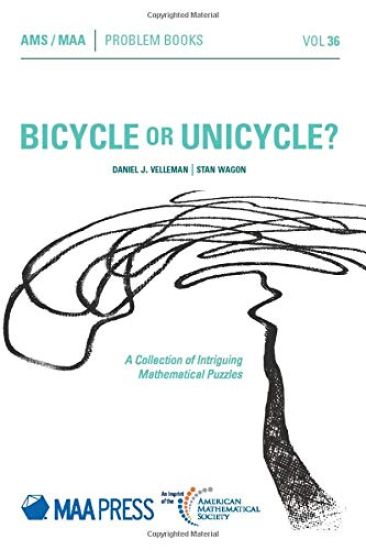
Bicycle or Unicycle? is a collection of 105 mathematical puzzles whose defining characteristic is the surprise encountered in their solutions. Solvers will be surprised, even occasionally shocked, at those solutions. The problems unfold into levels of depth and generality very unusual in the types of problems seen in contests. In contrast to contest problems, these are problems meant to be savored; many solutions, all beautifully explained, lead to unanswered research questions. At the same time, the mathematics necessary to understand the problems and their solutions is all at the undergraduate level. The puzzles will, nonetheless, appeal to professionals as well as to students and, in fact, to anyone who finds delight in an unexpected discovery.These problems were selected from the Macalester College Problem of the Week archive. The Macalester tradition of a weekly problem was started by Joseph Konhauser in 1968. In 1993 Stan Wagon assumed problem-generating duties. A previous book written by Wagon, Konhauser, and Dan Velleman, Which Way Did the Bicycle Go?, gathered problems from the first twenty-five years of the archive. The title problem in that collection was inspired by an error in logic made by Sherlock Holmes, who attempted to determine the direction of a bicycle from the tracks of its wheels. Here the title problem asks whether a bicycle track can always be distinguished from a unicycle track. You'll be surprised by the answer.
How to Prove It

How to Prove It

Daniel J. Velleman

Cambridge University Press
2019
sidottu
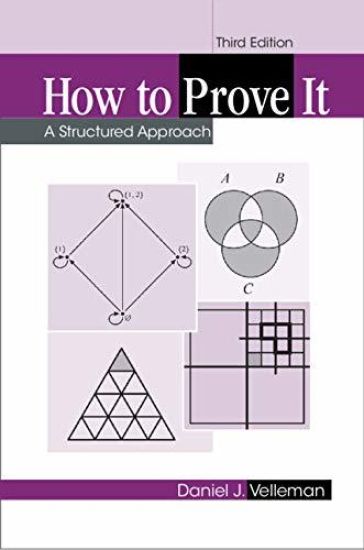
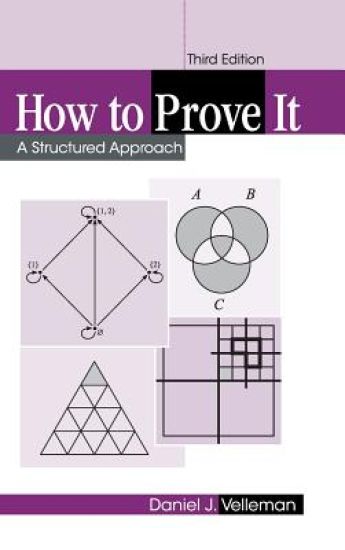
Proofs play a central role in advanced mathematics and theoretical computer science, yet many students struggle the first time they take a course in which proofs play a significant role. This bestselling text's third edition helps students transition from solving problems to proving theorems by teaching them the techniques needed to read and write proofs. Featuring over 150 new exercises and a new chapter on number theory, this new edition introduces students to the world of advanced mathematics through the mastery of proofs. The book begins with the basic concepts of logic and set theory to familiarize students with the language of mathematics and how it is interpreted. These concepts are used as the basis for an analysis of techniques that can be used to build up complex proofs step by step, using detailed 'scratch work' sections to expose the machinery of proofs about numbers, sets, relations, and functions. Assuming no background beyond standard high school mathematics, this book will be useful to anyone interested in logic and proofs: computer scientists, philosophers, linguists, and, of course, mathematicians.
How to Prove It

How to Prove It

Daniel J. Velleman

Cambridge University Press
2019
pokkari
Proofs play a central role in advanced mathematics and theoretical computer science, yet many students struggle the first time they take a course in which proofs play a significant role. This bestselling text's third edition helps students transition from solving problems to proving theorems by teaching them the techniques needed to read and write proofs. Featuring over 150 new exercises and a new chapter on number theory, this new edition introduces students to the world of advanced mathematics through the mastery of proofs. The book begins with the basic concepts of logic and set theory to familiarize students with the language of mathematics and how it is interpreted. These concepts are used as the basis for an analysis of techniques that can be used to build up complex proofs step by step, using detailed 'scratch work' sections to expose the machinery of proofs about numbers, sets, relations, and functions. Assuming no background beyond standard high school mathematics, this book will be useful to anyone interested in logic and proofs: computer scientists, philosophers, linguists, and, of course, mathematicians.
Zur Philosophie der Mathematik

Zur Philosophie der Mathematik

Alexander George; Daniel J. Velleman

Springer-Verlag Berlin and Heidelberg GmbH Co. K
2018
nidottu
Dieses Buch blickt in eine bedeutende Epoche der Philosophie der Mathematik zurück, deren Strömungen die heutige Gestalt der Mathematik prägten. In der Wende vom 19. zum 20. Jahrhundert befand sich die Mathematik in einem fundamentalen Umbruch, der die Mathematiker dieser Zeit herausforderte. Sie mussten Stellung beziehen. Die Grundsätze und Wege der philosophischen Richtungen, die dieses Buch verständlich, kritisch und anerkennend beschreibt, wurden von Mathematikern formuliert. Eine Zeit gravierender Disharmonien begann, die bis in Streit und Feindschaften mündeten und zugleich faszinierende und fruchtbare Ergebnisse hervorbrachten, mathematisch wie philosophisch. Es war ein aufregendes, intellektuelles Abenteuer zu Beginn des 20. Jahrhunderts auf einem außergewöhnlich scharfsinnigen und kreativen Niveau. Die Debatte über die unversöhnlichen Ansichten versiegte allmählich und inzwischen ist wieder relative Ruhe in die Gemeinde der Mathematiker eingekehrt. Zentrale philosophische Fragen aber, die damals die Protagonisten spalteten, sind nach wie vor unbeantwortet. Die Suche nach dem Wesen der Mathematik geht weiter und greift auf die Ideen dieser Kontroversen zurück.