Kirjojen hintavertailu. Mukana 12 595 353 kirjaa ja 12 kauppaa.

Kirjailija

Daniel Kroening

Kirjat ja teokset yhdessä paikassa: 4 kirjaa, julkaisuja vuosilta 2008-2018, suosituimpien joukossa Decision Procedures. Vertaile teosten hintoja ja tarkista saatavuus suomalaisista kirjakaupoista.

4 kirjaa

Kirjojen julkaisuhaarukka 2008-2018.

Decision Procedures

Decision Procedures

Daniel Kroening; R.E. Bryant; Ofer Strichman

Springer-Verlag Berlin and Heidelberg GmbH Co. K
2008
sidottu
A decision procedure is an algorithm that, given a decision problem, terminates with a correct yes/no answer. Here, the authors focus on theories that are expressive enough to model real problems, but are still decidable. Specifically, the book concentrates on decision procedures for first-order theories that are commonly used in automated verification and reasoning, theorem-proving, compiler optimization and operations research. The techniques described in the book draw from fields such as graph theory and logic, and are routinely used in industry. The authors introduce the basic terminology of satisfiability modulo theories and then, in separate chapters, study decision procedures for each of the following theories: propositional logic; equalities and uninterpreted functions; linear arithmetic; bit vectors; arrays; pointer logic; and quantified formulas. They also study the problem of deciding combined theories and dedicate a chapter to modern techniques based on an interplay between a SAT solver and a decision procedure for the investigated theory. This textbook has been used to teach undergraduate and graduate courses at ETH Zurich, at the Technion, Haifa, and at the University of Oxford. Each chapter includes a detailed bibliography and exercises. Lecturers' slides and a C++ library for rapid prototyping of decision procedures are available from the authors' website.
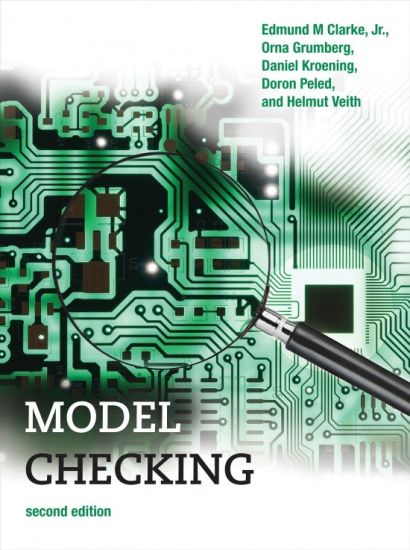
Model Checking

Model Checking

Edmund M. Clarke Jr.; Orna Grumberg; Daniel Kroening; Doron Peled; Helmut Veith

MIT Press
2018
sidottu
An expanded and updated edition of a comprehensive presentation of the theory and practice of model checking, a technology that automates the analysis of complex systems.Model checking is a verification technology that provides an algorithmic means of determining whether an abstract model-representing, for example, a hardware or software design-satisfies a formal specification expressed as a temporal logic formula. If the specification is not satisfied, the method identifies a counterexample execution that shows the source of the problem. Today, many major hardware and software companies use model checking in practice, for verification of VLSI circuits, communication protocols, software device drivers, real-time embedded systems, and security algorithms. This book offers a comprehensive presentation of the theory and practice of model checking, covering the foundations of the key algorithms in depth. The field of model checking has grown dramatically since the publication of the first edition in 1999, and this second edition reflects the advances in the field. Reorganized, expanded, and updated, the new edition retains the focus on the foundations of temporal logic model while offering new chapters that cover topics that did not exist in 1999: propositional satisfiability, SAT-based model checking, counterexample-guided abstraction refinement, and software model checking. The book serves as an introduction to the field suitable for classroom use and as an essential guide for researchers.
Decision Procedures

Decision Procedures

Daniel Kroening; Ofer Strichman

Springer-Verlag Berlin and Heidelberg GmbH Co. K
2018
nidottu
A decision procedure is an algorithm that, given a decision problem, terminates with a correct yes/no answer. Here, the authors focus on theories that are expressive enough to model real problems, but are still decidable. Specifically, the book concentrates on decision procedures for first-order theories that are commonly used in automated verification and reasoning, theorem-proving, compiler optimization and operations research. The techniques described in the book draw from fields such as graph theory and logic, and are routinely used in industry. The authors introduce the basic terminology of SAT, Satisfiability Modulo Theories (SMT) and the DPLL(T) framework. Then, in separate chapters, they study decision procedures for propositional logic; equalities and uninterpreted functions; linear arithmetic; bit vectors; arrays; pointer logic; and quantified formulas. They also study the problem of deciding combined theories based on the Nelson-Oppen procedure. Thefirst edition of this book was adopted as a textbook in courses worldwide. It was published in 2008 and the field now called SMT was then in its infancy, without the standard terminology and canonic algorithms it has now; this second edition reflects these changes. It brings forward the DPLL(T) framework. It also expands the SAT chapter with modern SAT heuristics, and includes a new section about incremental satisfiability, and the related Constraints Satisfaction Problem (CSP). The chapter about quantifiers was expanded with a new section about general quantification using E-matching and a section about Effectively Propositional Reasoning (EPR). The book also includes a new chapter on the application of SMT in industrial software engineering and in computational biology, coauthored by Nikolaj Bjørner and Leonardo de Moura, and Hillel Kugler, respectively. Each chapter includes a detailed bibliography and exercises. Lecturers’ slides and a C++ library for rapid prototyping of decision procedures are available from the authors’ website.
Decision Procedures

Decision Procedures

Daniel Kroening; Ofer Strichman

Springer-Verlag Berlin and Heidelberg GmbH Co. K
2017
sidottu
A decision procedure is an algorithm that, given a decision problem, terminates with a correct yes/no answer. Here, the authors focus on theories that are expressive enough to model real problems, but are still decidable. Specifically, the book concentrates on decision procedures for first-order theories that are commonly used in automated verification and reasoning, theorem-proving, compiler optimization and operations research. The techniques described in the book draw from fields such as graph theory and logic, and are routinely used in industry. The authors introduce the basic terminology of SAT, Satisfiability Modulo Theories (SMT) and the DPLL(T) framework. Then, in separate chapters, they study decision procedures for propositional logic; equalities and uninterpreted functions; linear arithmetic; bit vectors; arrays; pointer logic; and quantified formulas. They also study the problem of deciding combined theories based on the Nelson-Oppen procedure. Thefirst edition of this book was adopted as a textbook in courses worldwide. It was published in 2008 and the field now called SMT was then in its infancy, without the standard terminology and canonic algorithms it has now; this second edition reflects these changes. It brings forward the DPLL(T) framework. It also expands the SAT chapter with modern SAT heuristics, and includes a new section about incremental satisfiability, and the related Constraints Satisfaction Problem (CSP). The chapter about quantifiers was expanded with a new section about general quantification using E-matching and a section about Effectively Propositional Reasoning (EPR). The book also includes a new chapter on the application of SMT in industrial software engineering and in computational biology, coauthored by Nikolaj Bjørner and Leonardo de Moura, and Hillel Kugler, respectively. Each chapter includes a detailed bibliography and exercises. Lecturers’ slides and a C++ library for rapid prototyping of decision procedures are available from the authors’ website.