Kirjojen hintavertailu. Mukana 12 595 353 kirjaa ja 12 kauppaa.

Kirjailija

Daniel M. Kliman

Kirjat ja teokset yhdessä paikassa: 3 kirjaa, julkaisuja vuosilta 2006-2014, suosituimpien joukossa Japan's Security Strategy in the Post-9/11 World. Vertaile teosten hintoja ja tarkista saatavuus suomalaisista kirjakaupoista.

3 kirjaa

Kirjojen julkaisuhaarukka 2006-2014.

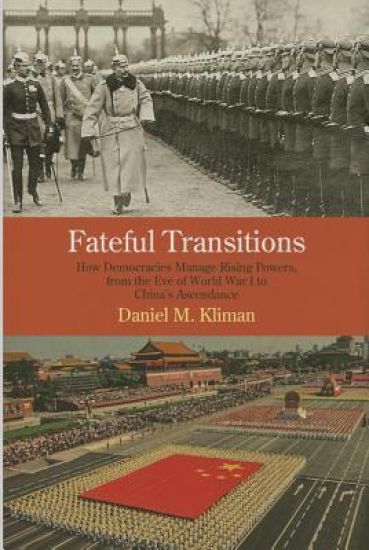
Fateful Transitions

Fateful Transitions

Daniel M. Kliman

University of Pennsylvania Press
2014
sidottu
As China emerges as a global force in the twenty-first century, questions of how existing great powers will navigate the geopolitical transition loom large. In Fateful Transitions, Daniel M. Kliman revisits historic power shifts to shed light on enduring patterns in international relations, demonstrating that the regime type of ascendant powers greatly influences global interactions. Since the late nineteenth century, the world's major democracies have tended to accommodate or conciliate ascendant democratic states. Certain attributes of democracy, such as a free press and domestic checks and balances, encourage trust during power shifts, whereas closed and autocratic regimes on the ascent tend to produce a cycle of suspicion, competition, and confrontation. Drawing on democratic peace theory and power transition theory, Kliman compares Great Britain's embrace of U.S. ascendancy in the early twentieth century to its confrontational stance toward autocratic Germany and later U.S. mistrust of the Soviet Union. Within this geopolitical context, he evaluates the interactions between China and current great powers, the United States and Japan. Building on this analysis, Kliman offers new insights into the dynamics of power shifts and explores their implications for how today's established and emerging powers can successfully navigate fateful transitions.

Japan's Security Strategy in the Post-9/11 World

Japan's Security Strategy in the Post-9/11 World

Daniel M. Kliman

Praeger Publishers Inc
2006
sidottu
In this book, Daniel Kliman argues that the years following September 11, 2001, have marked a turning point in Japan's defense strategy. Utilizing poll data from Japanese newspapers as well as extensive interview material, Kliman chronicles the erosion of normative and legal restraints on Tokyo's security policy. In particular, he notes that both Japanese elites and the general public increasingly view national security from a realpolitik perspective. Japan's more realpolitik orientation has coincided with a series of precedent-breaking defense initiatives. Tokyo deployed the Maritime Self-Defense Force to the Indian Ocean, decided to introduce missile defense, and contributed troops to Iraq's post-conflict reconstruction.Kliman explains these initiatives as the product of four mutually interactive factors. In the period after September 11, the impact of foreign threats on Tokyo's security calculus became ever more pronounced; internalized U.S. expectations exerted a profound influence over Japanese defense behavior; prime ministerial leadership played an instrumental role in deciding high profile security debates; and public opinion appeared to overtake generational change as a motivator of realpolitik defense policies.This book rebuts those who exaggerate the nature of Japan's strategic transition. By evaluating potential amendments to Article 9, Kliman demonstrates that Tokyo's defense posture will remain constrained even after constitutional revision.
Japan's Security Strategy in the Post-9/11 World

Japan's Security Strategy in the Post-9/11 World

Daniel M. Kliman

Praeger Publishers Inc
2006
nidottu
In this book, Daniel Kliman argues that the years following September 11, 2001, have marked a turning point in Japan's defense strategy. Utilizing poll data from Japanese newspapers as well as extensive interview material, Kliman chronicles the erosion of normative and legal restraints on Tokyo's security policy. In particular, he notes that both Japanese elites and the general public increasingly view national security from a realpolitik perspective. Japan's more realpolitik orientation has coincided with a series of precedent-breaking defense initiatives. Tokyo deployed the Maritime Self-Defense Force to the Indian Ocean, decided to introduce missile defense, and contributed troops to Iraq's post-conflict reconstruction.Kliman explains these initiatives as the product of four mutually interactive factors. In the period after September 11, the impact of foreign threats on Tokyo's security calculus became ever more pronounced; internalized U.S. expectations exerted a profound influence over Japanese defense behavior; prime ministerial leadership played an instrumental role in deciding high profile security debates; and public opinion appeared to overtake generational change as a motivator of realpolitik defense policies.This book rebuts those who exaggerate the nature of Japan's strategic transition. By evaluating potential amendments to Article 9, Kliman demonstrates that Tokyo's defense posture will remain constrained even after constitutional revision.