Kirjailija
Daniel Ness
Kirjat ja teokset yhdessä paikassa: 12 kirjaa, julkaisuja vuosilta 2005-2024, suosituimpien joukossa Writing Critically in STEAM. Vertaile teosten hintoja ja tarkista saatavuus suomalaisista kirjakaupoista.
12 kirjaa
Kirjojen julkaisuhaarukka 2005-2024.
Writing can be a tortuous process in any discipline. However, it can be particularly daunting in science, technology, engineering, the arts or architecture, and mathematics (henceforth, STEAM). In fact, it is not uncommon for most STEAM professionals to say things like, "As an engineer, I write only when I have to…" or "engaging in science is easy for me but sitting down and writing my manuscripts are so painful" or "I’m really good at math but I’m a terrible writer…" However, writing can become an easier process in STEAM especially when one’s ideas are fleshed out and organized in a systematic manner. While there are a number of books or articles on reading and writing in specific STEM disciplines, at present, there are no books or supplementary materials that serve to support STEAM learners, practitioners, and even researchers in becoming better critical writers. Writing Critically in STEAM will be the first book of its kind to focus primarily on what the scientist, technology specialist, engineer, artist, art historian, or architect, and mathematician needs to know in order to become a finer writer in one’s field. In addition, given the current post-truth zeitgeist, Writing Critically in STEAM addresses the essential issue of evidence as a means of supporting scientific and scientifically related claims.

Block Parties examines young children’s spatial development through the lens of emergent STEAM thinking. This book explores the physical and psychological tools that children use when they engage in constructive free play, and how these tools contribute to and shape the constructions they produce. Providing readers with the tools and understanding necessary to develop children’s spatial sense through the domains of mapping and architecture, this cutting-edge volume lays the groundwork for both cognitive development and early childhood specialists and educators to develop more robust models of STEAM-related curriculum that span the early years through to adolescence.
Spatial Intelligence examines public and professional conceptions of the relationships between thinking about spatial attributes and active engagement in spatially related constructions and designs. Even though children’s and adolescents’ spatial propensities in constructive activities parallel the skills needed by professionals in both established and emerging fields, spatial education is often missing from K–12 curricula and is easily impeded by teachers, parents, or other individuals who do not provide contexts in formalized settings, such as schools, to nurture its potential. This book bridges the gap by linking the natural spatial inclinations, interests, and proclivities of individuals from a variety of cultures with professional training and expertise in engineering, architecture, science, and mathematics. Educators will be better able to achieve the skills and awareness necessary to provide children and young adults with the vital opportunities inherent in spatial education.
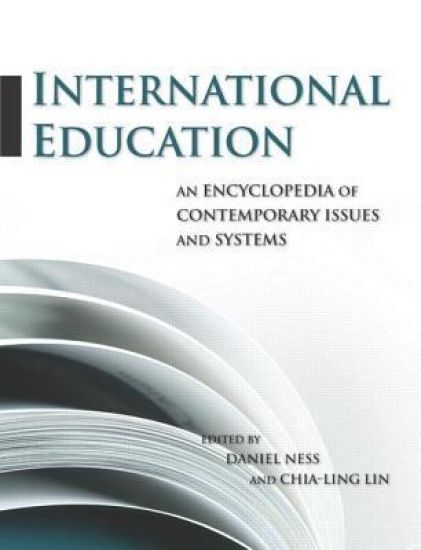
This encyclopedia is the most current and exhaustive reference available on international education. It provides thorough, up-to-date coverage of key topics, concepts, and issues, as well as in-depth studies of approximately 180 national educational systems throughout the world. Articles examine education broadly and at all levels--from primary grades through higher education, formal to informal education, country studies to global organizations.
The Importance of Average
Stephen Farenga; Daniel Ness; Dale D. Johnson; Bonnie Johnson
Rowman Littlefield Publishers
2011
nidottu
The Importance of Average calls attention to the policies and practices that discriminate against the silent majority of students in the American educational system. Arguments presented emphasize the collateral damage caused to average students by legislative mandates, administrative policies, teaching practices, parenting beliefs, and adherence to strict psychological constructs. Each of these factors has created a pervasive psycho-educational belief of average ability. The authors challenge what they consider as a pseudo-definition of 'average' that was brought about as an attempt by policymakers to test their way out of addressing the true inequities found in society. Further, the authors identify how educational policymakers have sacrificed the education of an entire class of students by creating the illusion that underachievement can be eliminated simply through lowering standards and examination pass rates. In chronicling the plight of average students, the authors capture the emotions and attitudes of teachers, parents, and students whose frustrations have been set aside in order to meet other special interests. The authors explore methods that provide students of average knowledge in any given area with the appropriate tools necessary for succeeding in school. Finally, the authors argue that there is no such thing as 'average' intelligence.
The Importance of Average
Stephen Farenga; Daniel Ness; Dale D. Johnson; Bonnie Johnson
Rowman Littlefield Publishers
2010
sidottu
The Importance of Average calls attention to the policies and practices that discriminate against the silent majority of students in the American educational system. Arguments presented emphasize the collateral damage caused to average students by legislative mandates, administrative policies, teaching practices, parenting beliefs, and adherence to strict psychological constructs. Each of these factors has created a pervasive psycho-educational belief of average ability. The authors challenge what they consider as a pseudo-definition of 'average' that was brought about as an attempt by policymakers to test their way out of addressing the true inequities found in society. Further, the authors identify how educational policymakers have sacrificed the education of an entire class of students by creating the illusion that underachievement can be eliminated simply through lowering standards and examination pass rates. In chronicling the plight of average students, the authors capture the emotions and attitudes of teachers, parents, and students whose frustrations have been set aside in order to meet other special interests. The authors explore methods that provide students of average knowledge in any given area with the appropriate tools necessary for succeeding in school. Finally, the authors argue that there is no such thing as 'average' intelligence.
Knowledge under Construction
Daniel Ness; Stephen J. Farenga
Rowman Littlefield Publishers
2007
sidottu
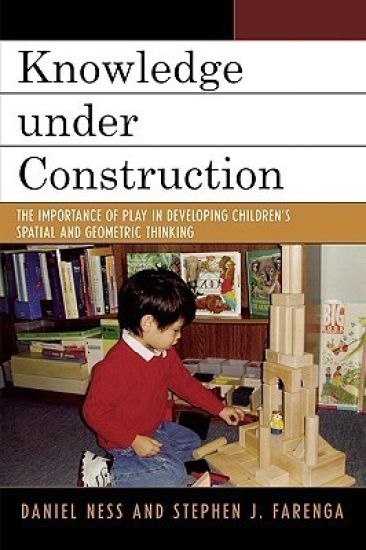
Knowledge under Construction investigates how young children develop spatial, geometric, and scientific thinking skills-particularly those associated with architecture. Based on original research and analysis of videotapes of children's play with blocks, the authors' findings suggest that such play is anything but pointless. Their conclusions fill in gaps in our current understanding of how children learn to think spatially and scientifically even while challenging portions of that understanding, including some of Piaget's thesis about the primacy of topological space in children's learning. A system of measurement developed to identify and categorize children's spontaneous behavior at play allows adults to observe patterns of behavior as children play and record the development of process skills and cognitive abilities, enhancing our understanding of how children begin to learn about space and architectural relationships. The book also examines the educational implications of our enhanced understanding. One possible development is a new, alternative way to measure cognitive abilities and development in children based on their work with blocks.
Knowledge under Construction
Daniel Ness; Stephen J. Farenga
Rowman Littlefield Publishers
2007
nidottu
Knowledge under Construction investigates how young children develop spatial, geometric, and scientific thinking skills-particularly those associated with architecture. Based on original research and analysis of videotapes of children's play with blocks, the authors' findings suggest that such play is anything but pointless. Their conclusions fill in gaps in our current understanding of how children learn to think spatially and scientifically even while challenging portions of that understanding, including some of Piaget's thesis about the primacy of topological space in children's learning. A system of measurement developed to identify and categorize children's spontaneous behavior at play allows adults to observe patterns of behavior as children play and record the development of process skills and cognitive abilities, enhancing our understanding of how children begin to learn about space and architectural relationships. The book also examines the educational implications of our enhanced understanding. One possible development is a new, alternative way to measure cognitive abilities and development in children based on their work with blocks.
This comprehensive and exhaustive reference work on the subject of education from the primary grades through higher education combines educational theory with practice, making it a unique contribution to the educational reference market. Issues related to human development and learning are examined by individuals whose specializations are in diverse areas including education, psychology, sociology, philosophy, law, and medicine. The book focuses on important themes in education and human development. Authors consider each entry from the perspective of its social and political conditions as well as historical underpinnings. The book also explores the people whose contributions have played a seminal role in the shaping of educational ideas, institutions, and organizations, and includes entries on these institutions and organizations. This work integrates numerous theoretical frameworks with field based applications from many areas in educational research.
Trivializing Teacher Education
Dale D. Johnson; Bonnie Johnson; Stephen J. Farenga; Daniel Ness
Rowman Littlefield Publishers
2005
nidottu
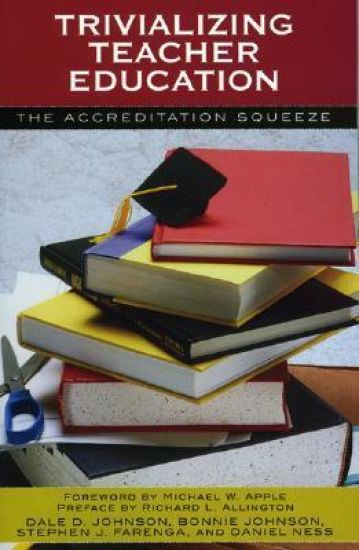
Trivializing Teacher Education: The Accreditation Squeeze presents a critical analysis of the National Council for Accreditation of Teacher Education (NCATE). This accreditation organization has been in existence for 50 years and claims to accredit approximately 700 teacher education programs that prepare two-thirds of the nation's teachers. There is no convincing research, however, that NCATE's 'stamp of approval' makes a difference in teacher preparation programs or in beginning teachers' competencies. There is evidence that NCATE is masterful at self-promotion, marketing, and aligning itself with policy-makers and politicians. This book illustrates the questionable NCATE processes and requirements and exposes the exorbitant costs accrued by universities seeking NCATE accreditation. It points out that the NCATE standards do not address the major issues that impact teaching and learning. The book highlights NCATE's support of teacher testing in the face of evidence that such tests lack predictive validity. It shows how NCATE is reaching out to accredit for-profit organizations and how it sends its evaluators to review international programs in the Middle East. The book calls on NCATE to make the professional backgrounds of its examiners, reviewers, board members, and staff transparent. It addresses the attention teacher educators must devote to mindless, trivial NCATE demands that usurp time that should be spent on their students and their research. This book urges teacher educators, college faculties and administrators, state education officials and legislators, parents of school-age children, and concerned citizens to open their eyes to this powerful organization, NCATE, and to examine what it has done to teacher education in the last half century.