Kirjojen hintavertailu. Mukana 12 585 057 kirjaa ja 12 kauppaa.

Kirjailija

Daniel P. Palomar

Kirjat ja teokset yhdessä paikassa: 4 kirjaa, julkaisuja vuosilta 2007-2025, suosituimpien joukossa MIMO Transceiver Design via Majorization Theory. Vertaile teosten hintoja ja tarkista saatavuus suomalaisista kirjakaupoista.

4 kirjaa

Kirjojen julkaisuhaarukka 2007-2025.

MIMO Transceiver Design via Majorization Theory

MIMO Transceiver Design via Majorization Theory

Daniel P. Palomar; Yi Jiang

now publishers Inc
2007
nidottu
Multiple-input multiple-output (MIMO) channels provide an abstract and unified representation of different physical communication systems, ranging from multi-antenna wireless channels to wireless digital subscriber line (DSL) systems. They have the key property that several data streams can be simultaneously established.MIMO Transceiver Design via Majorization Theory presents an up-to-date unified mathematical framework for the design of point-to-point MIMO transceivers with channel state information (CSI) at both sides of the link according to an arbitrary cost function as a measure of the system performance. In addition, the framework embraces the design of systems with given individual performance on the data streams.This is an invaluable resource for researchers and practitioners involved in the state-of-the-art design of MIMO-based communication systems.
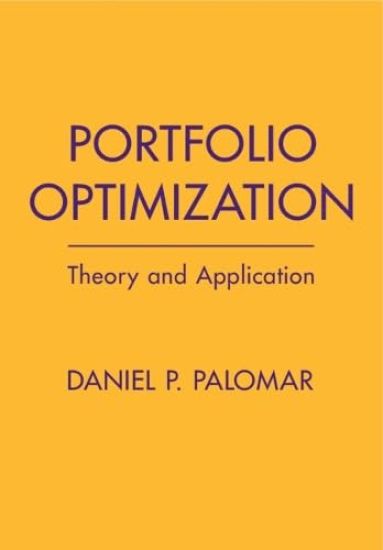
Portfolio Optimization

Portfolio Optimization

Daniel P. Palomar

Cambridge University Press
2025
sidottu
This comprehensive guide to the world of financial data modeling and portfolio design is a must-read for anyone looking to understand and apply portfolio optimization in a practical context. It bridges the gap between mathematical formulations and the design of practical numerical algorithms. It explores a range of methods, from basic time series models to cutting-edge financial graph estimation approaches. The portfolio formulations span from Markowitz's original 1952 mean–variance portfolio to more advanced formulations, including downside risk portfolios, drawdown portfolios, risk parity portfolios, robust portfolios, bootstrapped portfolios, index tracking, pairs trading, and deep-learning portfolios. Enriched with a remarkable collection of numerical experiments and more than 200 figures, this is a valuable resource for researchers and finance industry practitioners. With slides, R and Python code examples, and exercise solutions available online, it serves as a textbook for portfolio optimization and financial data modeling courses, at advanced undergraduate and graduate level.
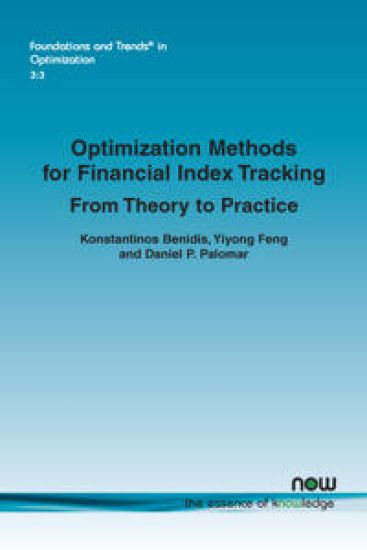
Optimization Methods for Financial Index Tracking

Optimization Methods for Financial Index Tracking

Konstantinos Benidis; Yiyong Feng; Daniel P. Palomar

now publishers Inc
2018
nidottu
Index tracking is a very popular passive investment strategy. Since an index cannot be traded directly, index tracking refers to the process of creating a portfolio that approximates its performance. A straightforward way to do that is to purchase all the assets that compose an index in appropriate quantities. However, to simplify the execution, avoid small and illiquid positions and large transaction costs, it is desired that the tracking portfolio consists of a small number of assets.Although index tracking is driven from the financial industry, it is in fact a pure signal processing problem: a regression of the financial historical data subject to some portfolio constraints with some caveats and particularities. Furthermore, the sparse index tracking problem is similar to many sparsity formulations in the signal processing area in the sense that it is a regression problem with some sparsity requirements. In its original form, sparse index tracking can be formulated as a combinatorial optimization problem. A commonly used approach is to use mixed-integer programming (MIP) to solve small sized problems. Nevertheless, MIP solvers are not applicable for high-dimensional problems since the running time can be prohibiting for practical use.This monograph provides an in-depth overview of the index tracking problem and analyzes all the caveats and practical issues an investor might have. Furthermore, it provides a unified framework for a large variety of sparse index tracking formulations. The derived algorithms are very attractive for practical use since they provide efficient tracking portfolios orders of magnitude faster than MIP solvers.
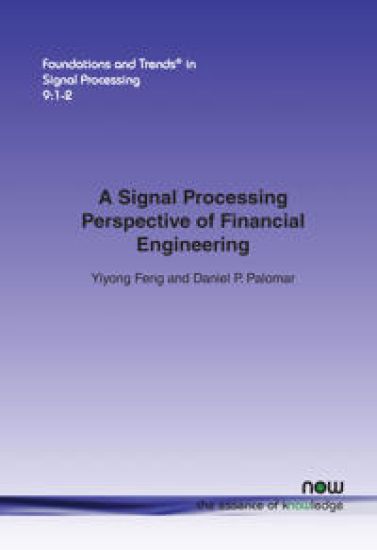
A Signal Processing Perspective of Financial Engineering

A Signal Processing Perspective of Financial Engineering

Yiyong Feng; Daniel P. Palomar

now publishers Inc
2016
nidottu
Despite the different nature of financial engineering and electrical engineering, both areas are intimately connected on a mathematical level. The foundations of financial engineering lie on the statistical analysis of numerical time series and the modeling of the behavior of the financial markets in order to perform predictions and systematically optimize investment strategies. Similarly, the foundations of electrical engineering, for instance, wireless communication systems, lie on statistical signal processing and the modeling of communication channels in order to perform predictions and systematically optimize transmission strategies. Both foundations are the same in disguise. It is often the case in science that the same or very similar methodologies are developed and applied independently in different areas.A Signal Processing Perspective of Financial Engineering is about investment in financial assets treated as a signal processing and optimization problem. It explores such connections and capitalizes on the existing mathematical tools developed in wireless communications and signal processing to solve real-life problems arising in the financial markets in an unprecedented way. It provides straightforward and systematic access to financial engineering for researchers in signal processing and communications so that they can understand problems in financial engineering more easily and may even apply signal processing techniques to handle some financial problems.