Kirjojen hintavertailu. Mukana 12 390 323 kirjaa ja 12 kauppaa.

Kirjailija

Daniel Seymour

Kirjat ja teokset yhdessä paikassa: 8 kirjaa, julkaisuja vuosilta 1995-2024, suosituimpien joukossa From Auschwitz with Love. Vertaile teosten hintoja ja tarkista saatavuus suomalaisista kirjakaupoista.

8 kirjaa

Kirjojen julkaisuhaarukka 1995-2024.

Liebesgrüße aus Auschwitz

Liebesgrüße aus Auschwitz

Daniel Seymour

Amsterdam Publishers
2024
pokkari
Mukačevo in der Tschechoslowakei. Zwei junge M dchen, Manci und Ruth Grunberger, wachsen zusammen mit ihren sechs Geschwistern in einer liebevollen, j dischen Familie am Fu e der Karpaten auf, eine friedliche Region, bis sie von Ungarn im Jahr 1938 annektiert wird.Sowie der Zweite Weltkrieg ber Europa hinwegfegt, r ckt das Territorium immer mehr in den Fokus der Nazi-Endl sung. Familie Grunberger wird nach Auschwitz deportiert, wo Josef Mengele dar ber entscheidet, wer lebt und wer stirbt. Manci und Ruth verlieren ihren Vater, ihre Mutter und alle sechs Geschwister an die Gaskammern.Die beiden Schwestern berleben sieben Monate in Auschwitz und einen f nfmonatigen Todesmarsch durch die Sudeten unter der Aufsicht von brutalen SS-Wachen, bevor sie nahe der d nischen Grenze gerettet werden. Verwandte aus Philadelphia h ren von ihrem berleben und kurz darauf sind Manci und Ruth unter den ersten Fl chtenden des Holocaust, die in die Vereinigten Staaten auswandern.Aus diesen traumatischen Anf ngen erbl hen zwei erf llte Leben. Die Schwestern haben unterschiedliche Werte, Interessen und Bew ltigungsmethoden und doch wird das pers nliche Band zwischen den beiden-die selbstlose, bedingungslose Liebe zueinander- ber die Jahre hinweg nur noch st rker.Ihre einzelnen Memoiren-erz hlt in der ersten Person und begleitet von historischem Kontext-kommen zusammen, um ein erstaunliches Bild von Widerstandsf higkeit und berlebenswillen zu erschaffen. Ein Triumph des menschlichen Geistes, der sich ber neun Jahrzehnte erstreckt.
From Auschwitz with Love

From Auschwitz with Love

Daniel Seymour

Amsterdam Publishers
2022
nidottu
Mukacevo, Czechoslovakia. Two young girls, Manci and Ruth Grunberger, are growing up in a loving Jewish family with their six siblings at the base of Carpathian Mountains, a peaceful region until Hungary annexes the territory in 1938.As WWII engulfs Europe, the area gradually becomes the focus of the Nazi's Final Solution. The Grunberger family is sent to Auschwitz where Josef Mengele chooses who lives and who dies. Their father, mother, and six siblings are murdered in the gas chambers.The two sisters survive seven months in Auschwitz and another five months marching through the Sudeten Mountains at the mercy of brutal SS guards before being rescued near the Danish border. The sisters are found by family in Philadelphia and become some of the first Jewish refugees brought to the United States.From these traumatic beginnings, what emerges are two fulfilling life stories. The sisters have different beliefs, interests, and coping methods, and yet, their personal bond - the selfless, unconditional love between them - only grows stronger throughout the years.Captured in two first-person memoirs-and presented along with added historical references-this is a remarkable story of resilience and survival that describes a resounding triumph of the human spirit spanning nine decades.
From Auschwitz with Love

From Auschwitz with Love

Daniel Seymour

Amsterdam Publishers
2022
sidottu
Mukacevo, Czechoslovakia. Two young girls, Manci and Ruth Grunberger, are growing up in a loving Jewish family with their six siblings at the base of Carpathian Mountains, a peaceful region until Hungary annexes the territory in 1938.As WWII engulfs Europe, the area gradually becomes the focus of the Nazi's Final Solution. The Grunberger family is sent to Auschwitz where Josef Mengele chooses who lives and who dies. Their father, mother, and six siblings are murdered in the gas chambers.The two sisters survive seven months in Auschwitz and another five months marching through the Sudeten Mountains at the mercy of brutal SS guards before being rescued near the Danish border. The sisters are found by family in Philadelphia and become some of the first Jewish refugees brought to the United States.From these traumatic beginnings, what emerges are two fulfilling life stories. The sisters have different beliefs, interests, and coping methods, and yet, their personal bond - the selfless, unconditional love between them - only grows stronger throughout the years.Captured in two first-person memoirs - and presented along with added historical references - this is a remarkable story of resilience and survival that describes a resounding triumph of the human spirit spanning nine decades.
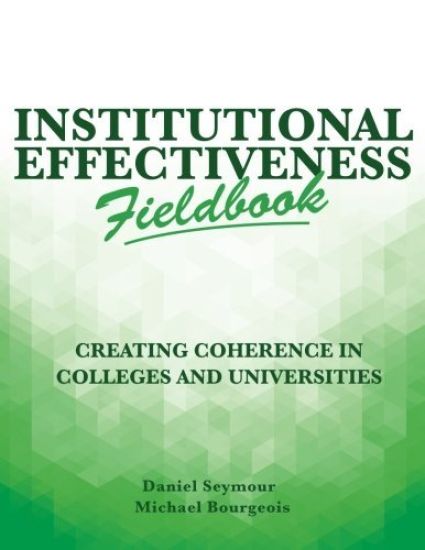
Institutional Effectiveness Fieldbook: Creating Coherence in Colleges and Universities

Institutional Effectiveness Fieldbook: Creating Coherence in Colleges and Universities

Michael Bourgeois; Daniel Seymour

Createspace Independent Publishing Platform
2018
nidottu
Institutional effectiveness (IE) is an emerging structural design in colleges and universities that is the antidote to its traditional loose-coupling where independence and autonomy lead to a lack of strategic intent. The focus is on "creating coherence" or developing an approach that leads to greater interdependency, greater coordination, and more information flow. The book begins with an explanation of IE and the environmental imperatives that suggest why it is critical to higher education. Systems thinking, organizational design, and model building are the core chapters followed by an extensive chapter on challenges to the IE imperative. Extensive case studies are used in each chapter as well as "Questions to Ask" sections. An expanded "Resources" appendix is useful for those who need to explore the cross-functional nature of institutional effectiveness at their institutions. This is the second book in a Fieldbook series. The first-Future College Fieldbook: Mission, Vision, and Values in Higher Education (2016)-is being used in strategic planning sessions and retreats to help institutions with the difficult job of direction-setting. The general approach to the series is to use strong research and disciplinary bases for the work and to also include a large number of current examples from different institutional types.
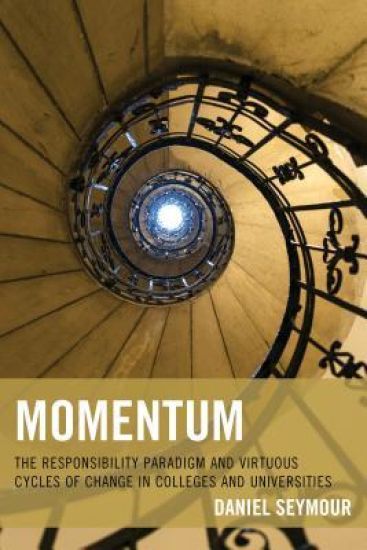
Momentum

Momentum

Daniel Seymour

Rowman Littlefield
2015
sidottu
An era of accountability has swept over the higher education landscape. Everyone it seems—legislatures, think tanks, newspapers, magazines, books, and bloggers—wants to “hold colleges and universities accountable.” They are attaching strings to budgets; producing reports that read like exposés; developing clever systems to rank and sort us; and writing books and articles that describe the end of college as we know it. According to them, we need to be reformed, reimagined, and rebooted. Momentum changes the conversation from how others are holding higher education accountable to why colleges and universities need to embrace the need to demonstrate their own responsibility. The responsibility paradigm that emerges fundamentally shifts the dialogue from fixing to preventing, from reacting to creating, from surviving to thriving. To implement this new paradigm, the dynamics of virtuous cycles are introduced and described. These upward spirals build on their own successes and result in growing confidence—a sense of vitality and resilience. The future of these institutions isn’t the result of outside pressure or reformers. The future is something that can and should be created by those who take responsibility for it.
Momentum

Momentum

Daniel Seymour

Rowman Littlefield
2015
nidottu
An era of accountability has swept over the higher education landscape. Everyone it seems—legislatures, think tanks, newspapers, magazines, books, and bloggers—wants to “hold colleges and universities accountable.” They are attaching strings to budgets; producing reports that read like exposés; developing clever systems to rank and sort us; and writing books and articles that describe the end of college as we know it. According to them, we need to be reformed, reimagined, and rebooted. Momentum changes the conversation from how others are holding higher education accountable to why colleges and universities need to embrace the need to demonstrate their own responsibility. The responsibility paradigm that emerges fundamentally shifts the dialogue from fixing to preventing, from reacting to creating, from surviving to thriving. To implement this new paradigm, the dynamics of virtuous cycles are introduced and described. These upward spirals build on their own successes and result in growing confidence—a sense of vitality and resilience. The future of these institutions isn’t the result of outside pressure or reformers. The future is something that can and should be created by those who take responsibility for it.