Kirjojen hintavertailu. Mukana 12 657 676 kirjaa ja 12 kauppaa.

Kirjailija

Daniel Wakelin

Kirjat ja teokset yhdessä paikassa: 7 kirjaa, julkaisuja vuosilta 2007-2025, suosituimpien joukossa Designing English. Vertaile teosten hintoja ja tarkista saatavuus suomalaisista kirjakaupoista.

7 kirjaa

Kirjojen julkaisuhaarukka 2007-2025.

Unprinted

Unprinted

Daria Kohler; Daniel Wakelin; Natascha Domeisen; Daniel Haywood; Edward Jones; Micah Mackay; Rosie Maxton; Brian M. Moore; Katie Noble; Felix M. Simon; Daniel Wojahn

Cambridge University Press
2025
pokkari
This Element explores the idea of publication in media used before, alongside, and after print. It contrasts multiple traditions of unprinted communication in their diversity and particularity. This decentres print as the means for understanding publication; instead, publication is seen as an heuristic term which identifies activities these traditions share, but which also differ in ways not reducible to comparisons with printing. The Element engages with texts written on papyrus, chiselled in stone, and created digitally; sung, proclaimed, and put on stage; banned, hidden and rediscovered. The authors move between Greek inscriptions and Tibetan edicts, early modern manuscripts and AI-assisted composition, monasteries and courts, constantly questioning the term 'publication' and considering the agency of people publishing and the publics they address. The picture that transpires is that of a colourful variety of contexts of production and dissemination, underlining the value of studying 'unprinted' publication in its own right.
Immaterial Texts in Late Medieval England

Immaterial Texts in Late Medieval England

Daniel Wakelin

Cambridge University Press
2024
pokkari
Daniel Wakelin introduces and reinterprets the misunderstood and overlooked craft practices, cultural conventions and literary attitudes involved in making some of the most important manuscripts in late medieval English literature. In doing so he overturns how we view the role of scribes, showing how they ignored or concealed irregular and damaged parchment; ruled pages from habit and convention more than necessity; decorated the division of the text into pages or worried that it would harm reading; abandoned annotations to poetry, focusing on the poem itself; and copied English poems meticulously, in reverence for an abstract idea of the text. Scribes' interest in immaterial ideas and texts suggests their subtle thinking as craftspeople, in ways that contrast and extend current interpretations of late medieval literary culture, 'material texts' and the power of materials. For students, researchers and librarians, this book offers revelatory perspectives on the activities of late medieval scribes.
Immaterial Texts in Late Medieval England

Immaterial Texts in Late Medieval England

Daniel Wakelin

Cambridge University Press
2022
sidottu
Daniel Wakelin introduces and reinterprets the misunderstood and overlooked craft practices, cultural conventions and literary attitudes involved in making some of the most important manuscripts in late medieval English literature. In doing so he overturns how we view the role of scribes, showing how they ignored or concealed irregular and damaged parchment; ruled pages from habit and convention more than necessity; decorated the division of the text into pages or worried that it would harm reading; abandoned annotations to poetry, focusing on the poem itself; and copied English poems meticulously, in reverence for an abstract idea of the text. Scribes' interest in immaterial ideas and texts suggests their subtle thinking as craftspeople, in ways that contrast and extend current interpretations of late medieval literary culture, 'material texts' and the power of materials. For students, researchers and librarians, this book offers revelatory perspectives on the activities of late medieval scribes.
Designing English

Designing English

Daniel Wakelin

Bodleian Library
2017
sidottu
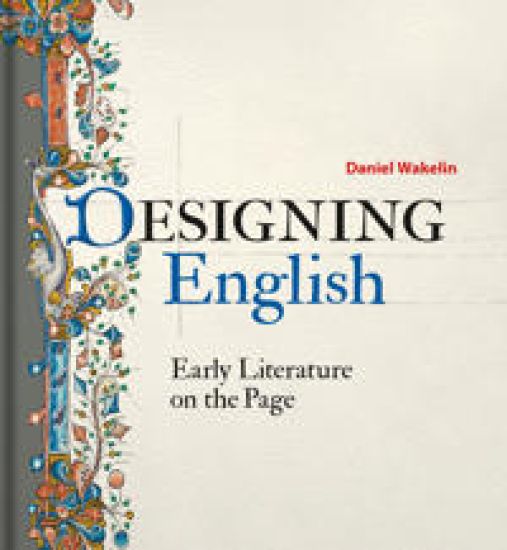
Early manuscripts in the English language include religious works, plays, romances, poetry and songs, as well as charms, notebooks, science and medieval medicine. How did scribes choose to arrange the words and images on the page in each manuscript? How did they preserve, clarify and illustrate writing in English? What visual guides were given to early readers of English in how to understand or use their books? 'Designing English' is an overview of eight centuries of graphic design in manuscripts and inscriptions from the Anglo-Saxon to the early Tudor periods. Working beyond the traditions established for Latin, scribes of English needed to be more inventive, so that each book was an opportunity for redesigning. 'Designing English' focuses on the craft, agency and intentions of scribes, painters and engravers in the practical processes of making pages and artefacts. It weighs up the balance of ingenuity and copying, practicality and imagination in their work. It surveys bilingual books, format, ordinatio, decoration and reading aloud, as well as inscriptions on objects, monuments and buildings. With over ninety illustrations, drawn especially from the holdings of the Bodleian Library in Old English and Middle English, 'Designing English' gives a comprehensive overview of English books and other material texts across the Middle Ages.
Scribal Correction and Literary Craft

Scribal Correction and Literary Craft

Daniel Wakelin

Cambridge University Press
2017
pokkari
This extensive survey of scribal correction in English manuscripts explores what correcting reveals about attitudes to books, language and literature in late medieval England. Daniel Wakelin surveys a range of manuscripts and genres, but focuses especially on poems by Chaucer, Hoccleve and Lydgate, and on prose works such as chronicles, religious instruction and practical lore. His materials are the variants and corrections found in manuscripts, phenomena usually studied only by editors or palaeographers, but his method is the close reading and interpretation typical of literary criticism. From the corrections emerge often overlooked aspects of English literary thinking in the late Middle Ages: scribes, readers and authors seek, though often fail to achieve, invariant copying, orderly spelling, precise diction, regular verse and textual completeness. Correcting reveals their impressive attention to scribal and literary craft - its rigour, subtlety, formalism and imaginativeness - in an age with little other literary criticism in English.
Scribal Correction and Literary Craft

Scribal Correction and Literary Craft

Daniel Wakelin

Cambridge University Press
2014
sidottu
This extensive survey of scribal correction in English manuscripts explores what correcting reveals about attitudes to books, language and literature in late medieval England. Daniel Wakelin surveys a range of manuscripts and genres, but focuses especially on poems by Chaucer, Hoccleve and Lydgate, and on prose works such as chronicles, religious instruction and practical lore. His materials are the variants and corrections found in manuscripts, phenomena usually studied only by editors or palaeographers, but his method is the close reading and interpretation typical of literary criticism. From the corrections emerge often overlooked aspects of English literary thinking in the late Middle Ages: scribes, readers and authors seek, though often fail to achieve, invariant copying, orderly spelling, precise diction, regular verse and textual completeness. Correcting reveals their impressive attention to scribal and literary craft - its rigour, subtlety, formalism and imaginativeness - in an age with little other literary criticism in English.
Humanism, Reading, & English Literature 1430-1530

Humanism, Reading, & English Literature 1430-1530

Daniel Wakelin

Oxford University Press
2007
sidottu
Humanism is usually thought to come to England in the early sixteenth century. In this book, however, Daniel Wakelin uncovers the almost unknown influences of humanism on English literature in the preceding hundred years. He considers the humanist influences on the reception of some of Chaucer's work and on the work of important authors such as Lydgate, Bokenham, Caxton, and Medwall, and in many anonymous or forgotten translations, political treatises, and documents from the fifteenth and early sixteenth centuries. At the heart of his study is a consideration of William Worcester, the fifteenth-century scholar. Wakelin can trace the influence of humanism much earlier than was thought, because he examines evidence in manuscripts and early printed books of the English study and imitation of antiquity, in polemical marginalia on classical works, and in the ways in which people copied and shared classical works and translations. He also examines how various English works were shaped by such reading habits and, in turn, how those English works reshaped the reading habits of the wider community. Humanism thus, contrary to recent strictures against it, appears not as 'top-down' dissemination, but as a practical process of give-and-take between writers and readers. Humanism thus also prompts writers to imagine their potential readerships in ways which challenge them to re-imagine the political community and the intellectual freedom of the reader. Our views both of the fifteenth century and of humanist literature in English are transformed.