Kirjailija
Daniel Wilson
Kirjat ja teokset yhdessä paikassa: 103 kirjaa, julkaisuja vuosilta 2002-2026, suosituimpien joukossa The Analogy Of Religion, Natural And Revealed, To The Constitution And Course Of Nature. Vertaile teosten hintoja ja tarkista saatavuus suomalaisista kirjakaupoista.
103 kirjaa
Kirjojen julkaisuhaarukka 2002-2026.
Reproduction of the original: The Lost Atlantis by Daniel Wilson
Reproduction of the original: The Archaeology and Prehistoric Annals of Scotland by Daniel Wilson
Seventh Report on the North-western Tribes of Canada
Franz Boas; Daniel Wilson
Palala Press
2018
pokkari
This work has been selected by scholars as being culturally important, and is part of the knowledge base of civilization as we know it. This work was reproduced from the original artifact, and remains as true to the original work as possible. Therefore, you will see the original copyright references, library stamps (as most of these works have been housed in our most important libraries around the world), and other notations in the work.This work is in the public domain in the United States of America, and possibly other nations. Within the United States, you may freely copy and distribute this work, as no entity (individual or corporate) has a copyright on the body of the work.As a reproduction of a historical artifact, this work may contain missing or blurred pages, poor pictures, errant marks, etc. Scholars believe, and we concur, that this work is important enough to be preserved, reproduced, and made generally available to the public. We appreciate your support of the preservation process, and thank you for being an important part of keeping this knowledge alive and relevant.
Reminiscences of Old Edinburgh - Vol. 1 is an unchanged, high-quality reprint of the original edition of 1878. Hansebooks is editor of the literature on different topic areas such as research and science, travel and expeditions, cooking and nutrition, medicine, and other genres. As a publisher we focus on the preservation of historical literature. Many works of historical writers and scientists are available today as antiques only. Hansebooks newly publishes these books and contributes to the preservation of literature which has become rare and historical knowledge for the future.
William Nelson - A Memoir is an unchanged, high-quality reprint of the original edition of 1889. Hansebooks is editor of the literature on different topic areas such as research and science, travel and expeditions, cooking and nutrition, medicine, and other genres. As a publisher we focus on the preservation of historical literature. Many works of historical writers and scientists are available today as antiques only. Hansebooks newly publishes these books and contributes to the preservation of literature which has become rare and historical knowledge for the future.
Burger Lab examines the elements that make up the ultimate burger: the perfect squishy bun; a pickle that has just the right amount of tang and crunch; the exact quantity of mayo and ketchup to deliver maximum flavor without over-powering the burger; and the ultimate pattie that's meaty, juicy and umami-intense. It is a science to get all the elements perfect, but in this unique cookbook Daniel Wilson shows us how to get the chemistry exactly right. The modern-day junk food is elevated to the sublime by Daniel Wilson's cheffy sensibilities; Burger Lab will change everything you thought you knew about burgers and arm you with everything you'll need to know to make cult-worthy burgers at home. Mouth-watering constructions include a Wagyu cheeseburger deluxe, a Fried chicken burger with slaw, a Reuben burger with corned beef, sauerkraut, Swiss cheese, thousand island on a rye bun, a BBQ pulled pork bun with pickles and more, plus recipes for condiments, chips and milkshakes to wash it all down. The book's unexpected and fun design, with close-up cross-sections of burgers, illustrative elements throughout and even including an amazing pop-out burger illustration on the endpapers make this the most exciting burger book ever!
Brain-Weight and Size in Relation to Relative Capacity of Races
Daniel Wilson
Hansebooks
2017
pokkari
Having acquired a Shakespeare folio for a few shillings, anthropologist Daniel Wilson (1816–92) found in The Tempest a source of scientific intrigue. Writing more than two hundred years before Darwin propounded his theory of evolution, in his final play Shakespeare had created a missing link caught between the animal and the human. In this monograph, first published in 1873, Wilson uses the strange and unfortunate character of Caliban as a means through which to explore the principles of evolution. He traces many of the play's plot devices back to real events that perhaps inspired them - from storms in Bermuda to records of semi-human creatures around the world - and brings literary commentary into science as he links the relationships set out in the play to anthropological principles. This interdisciplinary approach makes the book both an entertaining exegesis of the play and a uniquely accessible explanation of contemporary scientific theories.
Born in Edinburgh, Daniel Wilson (1816–92) initially pursued an artistic career and spent time in Turner's studio. However, in 1846 he became a fellow of the Society of Antiquaries of Scotland and devoted the rest of his life to archaeology, anthropology and university administration. He was active in the Society's attempts to save historic buildings in Edinburgh, and the city's built environment was the subject of this two-volume 1848 work, which is illustrated with engravings after his own drawings. In Volume 2, Wilson continues to cover local antiquities and traditions, with each chapter looking at a different area of the Old Town. Leith, the New Town, and ecclesiastical buildings are also discussed. The historical detail, with references, is immense, and Wilson's enthusiasm for his city is evident throughout. Wilson's second major work, the landmark Prehistoric Annals of Scotland (second edition, 1863), is also reissued in this series.
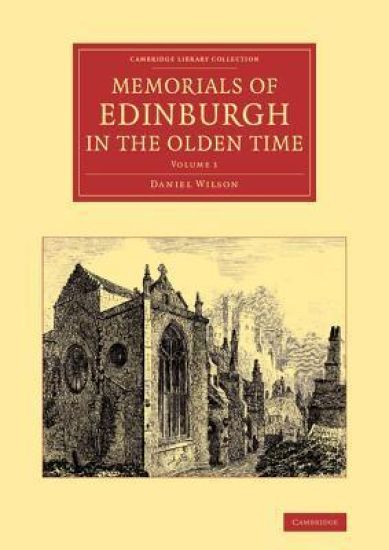
Memorials of Edinburgh in the Olden Time: Volume 1
Daniel Wilson
Cambridge University Press
2013
pokkari
Born in Edinburgh, Daniel Wilson (1816–92) initially pursued an artistic career and spent time in Turner's studio. However, in 1846 he became a fellow of the Society of Antiquaries of Scotland and devoted the rest of his life to archaeology, anthropology and university administration. He was active in the Society's attempts to save historic buildings in Edinburgh, and the city's built environment was the subject of this two-volume 1848 work, which is illustrated with engravings after his own drawings. In Volume 1, Wilson begins by tracing the city's history from earliest times. The latter part of the volume covers local antiquities and traditions, with each chapter looking at a different area of the Old Town. The historical detail, with references, is immense, and Wilson's enthusiasm for his city is evident throughout. His second major work, the landmark Prehistoric Annals of Scotland (second edition, 1863), is also reissued in this series.
Visible Learners
Mara Krechevsky; Ben Mardell; Melissa Rivard; Daniel Wilson
John Wiley Sons Inc
2013
nidottu
A progressive, research-based approach for making learning visible Based on the Reggio Emilia approach to learning, Visible Learners highlights learning through interpreting objects and artifacts, group learning, and documentation to make students' learning evident to teachers. Visible classrooms are committed to five key principles: that learning is purposeful, social, emotional, empowering, and representational. The book includes visual essays, key practices, classroom and examples. Show how to make learning happen in relation to others, spark emotional connections, give students power over their learning, and express ideas in multiple waysIllustrate Reggio-inspired principles and approaches via quotes, photos, student and teacher reflections, and examples of student workOffer a new way to enhance learning using progressive, research-based practices for increasing collaboration and critical thinking in and outside the classroom Visible Learners asks that teachers look beyond surface-level to understand who students are, what they come to know, and how they come to know it.
Born in Edinburgh, Daniel Wilson (1816–92) planned on becoming a painter and spent time working in Turner's studio. But in 1842 he became secretary of the Society of Antiquaries in Scotland and devoted the rest of his life to archaeology, anthropology and university administration. This two-volume work, first published in 1851, brought him to immediate academic attention. Carrying out pioneering work of scientific archaeology, Wilson brought the very word 'prehistoric' into use in English for the first time. And although a devout Christian, he accepted the theory of evolution, unlike many of his contemporaries. Split into four periods, the work is richly illustrated, with many of the illustrations created by the author himself. For this second edition, published in 1863, Wilson updated his work to reflect recent discoveries. Volume 2 continues through the Roman and early Christian periods.
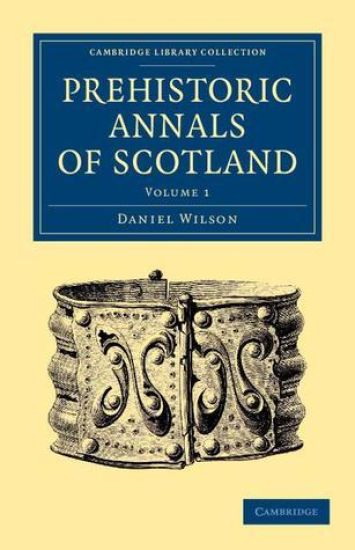
Born in Edinburgh, Daniel Wilson (1816–92) planned on becoming a painter and spent time working in Turner's studio. But in 1842 he became secretary of the Society of Antiquaries in Scotland and devoted the rest of his life to archaeology, anthropology and university administration. This two-volume work, first published in 1851, brought him to immediate academic attention. Carrying out pioneering work of scientific archaeology, Wilson brought the very word 'prehistoric' into use in English for the first time. And although a devout Christian, he accepted the theory of evolution, unlike many of his contemporaries. Split into four periods, the work is richly illustrated, with many of the illustrations created by the author himself. For this second edition, published in 1863, Wilson updated his work to reflect recent discoveries. Volume 1 looks at the earliest human settlers up to the Bronze Age.
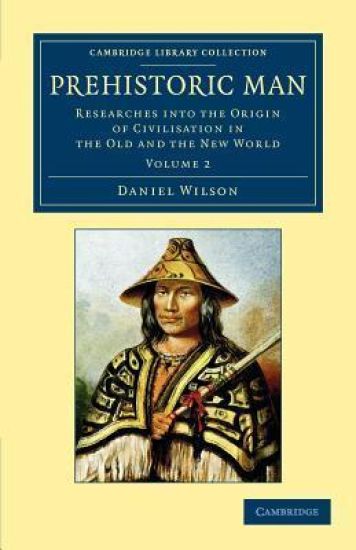
The Scottish archaeologist and anthropologist Daniel Wilson (1816–92) spent the latter part of his life in Canada. Published in 1862, this is a seminal work in the study of early man in which Wilson utilises studies of native tribes 'still seen there in a condition which seems to reproduce some of the most familiar phases ascribed to the infancy of the unhistoric world'. He believed that civilisations initially developed in mild climates and judged the Mayans to have been the most advanced civilisation in the New World. Twentieth-century anthropologist Bruce Trigger argued that Wilson 'interpreted evidence about human behaviour in a way that is far more in accord with modern thinking than are the racist views of Darwin and Lubbock', and it is in this light that this two-volume work can be judged. Volume 2 covers topics ranging from ceramic arts to the influence of interbreeding and migration upon civilisations.
The Scottish archaeologist and anthropologist Daniel Wilson (1816–92) spent the latter part of his life in Canada. Published in 1862, this is a seminal work in the study of early man in which Wilson utilises studies of native tribes 'still seen there in a condition which seems to reproduce some of the most familiar phases ascribed to the infancy of the unhistoric world'. He believed that civilisations initially developed in mild climates and judged the Mayans to have been the most advanced civilisation in the New World. Twentieth-century anthropologist Bruce Trigger argued that Wilson 'interpreted evidence about human behaviour in a way that is far more in accord with modern thinking than are the racist views of Darwin and Lubbock', and it is in this light that this two-volume work can be judged. Volume 1 covers such important areas as the development and use of metals and 'the architectural instinct'.