Kirjojen hintavertailu. Mukana 12 595 353 kirjaa ja 12 kauppaa.

Kirjailija

Dariusz Jemielniak

Kirjat ja teokset yhdessä paikassa: 15 kirjaa, julkaisuja vuosilta 2008-2026, suosituimpien joukossa Anti-Science. Vertaile teosten hintoja ja tarkista saatavuus suomalaisista kirjakaupoista.

15 kirjaa

Kirjojen julkaisuhaarukka 2008-2026.

Anti-Science

Anti-Science

Dariusz Jemielniak

TAYLOR FRANCIS LTD
2026
nidottu
Tackling the critical issue of the growing skepticism towards science, this volume explores the complex forces driving the anti-science movement. It dissects the phenomenon of increasing anti-science advocates using academic research boosted by lived experiences fighting online disinformation. The book focuses on the alarming erosion of trust in scientific authority. It highlights how misinformation, the politicization of scientific issues, an epistemic revolution of knowledge hierarchies, and a cultural shift toward prioritizing personal beliefs over facts have contributed to this trend. It explores the implications of a society increasingly skeptical of scientific expertise, driven by the rapid spread of misinformation on digital platforms and a deepening distrust in traditional institutions. Illuminating the path that led us here, the author advocates for the importance of critical thinking and digital literacy as tools to combat misinformation. This volume is not just an analysis of the current state of skepticism toward science; it is a call to action, encouraging a recommitment to the values of scientific inquiry and evidence-based decision-making in an age marked by doubt. Both theoretically informed and accessibly written, the book will appeal to students, academics, and general readers, alike.

Anti-Science

Anti-Science

Dariusz Jemielniak

TAYLOR FRANCIS LTD
2026
sidottu
Tackling the critical issue of the growing skepticism towards science, this volume explores the complex forces driving the anti-science movement. It dissects the phenomenon of increasing anti-science advocates using academic research boosted by lived experiences fighting online disinformation. The book focuses on the alarming erosion of trust in scientific authority. It highlights how misinformation, the politicization of scientific issues, an epistemic revolution of knowledge hierarchies, and a cultural shift toward prioritizing personal beliefs over facts have contributed to this trend. It explores the implications of a society increasingly skeptical of scientific expertise, driven by the rapid spread of misinformation on digital platforms and a deepening distrust in traditional institutions. Illuminating the path that led us here, the author advocates for the importance of critical thinking and digital literacy as tools to combat misinformation. This volume is not just an analysis of the current state of skepticism toward science; it is a call to action, encouraging a recommitment to the values of scientific inquiry and evidence-based decision-making in an age marked by doubt. Both theoretically informed and accessibly written, the book will appeal to students, academics, and general readers, alike.

Management

Management

Andrzej K. Kozminski; Dariusz Jemielniak; Dominika Latusek-Jurczak; Anna Pikos

TAYLOR FRANCIS LTD
2025
sidottu
Management: A European Perspective provides readers with a comprehensive understanding of the complex and ever-changing field of modern management with a rich focus on the socio-economic context of Eastern and Central Europe. This book explores the dynamic changes and challenges that contemporary managers face in a competitive environment and provides real-world examples of the core theoretic concepts. Chapters include coverage of leadership; adapting to change and technology; diversity; ethics and social responsibility; and climate change and sustainable business practice. This book’s structure is designed to enhance learning outcomes with each chapter featuring clear learning objectives, informative sidebars explaining key terms, practical exercises, review questions, and mini case studies that bring theoretical concepts to life. This is an accessible and unique introduction to management and is an ideal starting point for students on international business, leadership, organisational studies, and diversity management courses. Online resources include PowerPoint slides and a test bank.
Management

Management

Andrzej K. Kozminski; Dariusz Jemielniak; Dominika Latusek-Jurczak; Anna Pikos

TAYLOR FRANCIS LTD
2025
nidottu
Management: A European Perspective provides readers with a comprehensive understanding of the complex and ever-changing field of modern management with a rich focus on the socio-economic context of Eastern and Central Europe. This book explores the dynamic changes and challenges that contemporary managers face in a competitive environment and provides real-world examples of the core theoretic concepts. Chapters include coverage of leadership; adapting to change and technology; diversity; ethics and social responsibility; and climate change and sustainable business practice. This book’s structure is designed to enhance learning outcomes with each chapter featuring clear learning objectives, informative sidebars explaining key terms, practical exercises, review questions, and mini case studies that bring theoretical concepts to life. This is an accessible and unique introduction to management and is an ideal starting point for students on international business, leadership, organisational studies, and diversity management courses. Online resources include PowerPoint slides and a test bank.
Using AI in Academic Writing and Research

Using AI in Academic Writing and Research

Eldar Haber; Dariusz Jemielniak; Artur Kurasinski; Aleksandra Przegalinska

Springer International Publishing AG
2025
sidottu
This book comprehensively explores how AI tools can revolutionize academic writing, research, grant proposals, and educational practices. With a focus on practical applications, ethical considerations, and future trends, the book serves as an indispensable roadmap for academics, researchers, and educators eager to integrate AI into their work. Whether you're looking to enhance your research capabilities, craft compelling grant proposals, personalize learning experiences, or lead your institution into the future, this book provides the insights and tools necessary to navigate and shape the AI-enhanced landscape of academia. It demonstrates how to redefine scholarly work with cutting-edge AI innovations through real-life, practical examples, yet keeping the level of generalization high enough to keep it relevant for a few years. By balancing specific, actionable insights with broader perspectives, this book equips readers to not only adapt to but actively influence the evolving role of AI in higher education, research, and funding acquisition, ensuring its value as a resource both now and in the coming years.
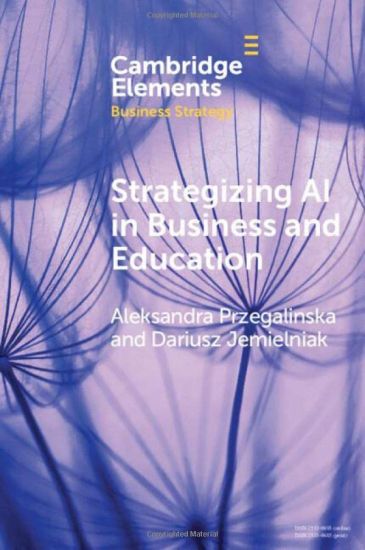
Strategizing AI in Business and Education

Strategizing AI in Business and Education

Aleksandra Przegalinska; Dariusz Jemielniak

Cambridge University Press
2023
pokkari
This Element proposes a clear and up-to-date description of the state of artificial intelligence today, not only in terms of business processes and strategies, but also its societal reception. It presents our view of the technology landscape, avoiding both the forward-looking, rose-colored utopia and the hyper-apocalyptic gloom. It does so in a concise form, addressing a complex issue in 9 concise and easy-to-read chapters. It aims to discuss the current state of machine learning and AI in strategic management, and to describe the emerging technologies. It conceptualizes their adoption, and then consider the effects of AI technologies' maturity in business organizations.
Thick Big Data

Thick Big Data

Dariusz Jemielniak

Oxford University Press
2020
nidottu
The social sciences are becoming datafied. The questions once considered the domain of sociologists are now answered by data scientists operating on large datasets and breaking with methodological tradition, for better or worse. The traditional social sciences, such as sociology or anthropology, are under the double threat of becoming marginalized or even irrelevant, both from new methods of research which require more computational skills and from increasing competition from the corporate world which gains an additional advantage based on data access. However, unlike data scientists, sociologists and anthropologists have a long history of doing qualitative research. The more quantified datasets we have, the more difficult it is to interpret them without adding layers of qualitative interpretation. Big Data therefore needs Thick Data. This book presents the available arsenal of new methods and tools for studying society both quantitatively and qualitatively, opening ground for the social sciences to take the lead in analysing digital behaviour. It shows that Big Data can and should be supplemented and interpreted through thick data as well as cultural analysis. Thick Big Data is critically important for students and researchers in the social sciences to understand the possibilities of digital analysis, both in the quantitative and qualitative area, and to successfully build mixed-methods approaches.
Thick Big Data

Thick Big Data

Dariusz Jemielniak

Oxford University Press
2020
sidottu
The social sciences are becoming datafied. The questions once considered the domain of sociologists are now answered by data scientists operating on large datasets and breaking with methodological tradition, for better or worse. The traditional social sciences, such as sociology or anthropology, are under the double threat of becoming marginalized or even irrelevant, both from new methods of research which require more computational skills and from increasing competition from the corporate world which gains an additional advantage based on data access. However, unlike data scientists, sociologists and anthropologists have a long history of doing qualitative research. The more quantified datasets we have, the more difficult it is to interpret them without adding layers of qualitative interpretation. Big Data therefore needs Thick Data. This book presents the available arsenal of new methods and tools for studying society both quantitatively and qualitatively, opening ground for the social sciences to take the lead in analysing digital behaviour. It shows that Big Data can and should be supplemented and interpreted through thick data as well as cultural analysis. Thick Big Data is critically important for students and researchers in the social sciences to understand the possibilities of digital analysis, both in the quantitative and qualitative area, and to successfully build mixed-methods approaches.
Collaborative Society

Collaborative Society

Dariusz Jemielniak; Aleksandra Przegalinska

MIT Press
2020
pokkari
How networked technology enables the emergence of a new collaborative society.Humans are hard-wired for collaboration, and new technologies of communication act as a super-amplifier of our natural collaborative mindset. This volume in the MIT Press Essential Knowledge series examines the emergence of a new kind of social collaboration enabled by networked technologies. This new collaborative society might be characterized as a series of services and startups that enable peer-to-peer exchanges and interactions though technology. Some believe that the economic aspects of the new collaboration have the potential to make society more equitable; others see collaborative communities based on sharing as a cover for social injustice and user exploitation.The book covers the "sharing economy," and the hijacking of the term by corporations; different models of peer production, and motivations to participate; collaborative media production and consumption, the definitions of "amateur" and "professional," and the power of memes; hactivism and social movements, including Anonymous and anti-ACTA protest; collaborative knowledge creation, including citizen science; collaborative self-tracking; and internet-mediated social relations, as seen in the use of Instagram, Snapchat, and Tinder. Finally, the book considers the future of these collaborative tendencies and the disruptions caused by fake news, bots, and other challenges.
Common Knowledge?

Common Knowledge?

Dariusz Jemielniak

Stanford University Press
2015
pokkari
With an emphasis on peer–produced content and collaboration, Wikipedia exemplifies a departure from traditional management and organizational models. This iconic "project" has been variously characterized as a hive mind and an information revolution, attracting millions of new users even as it has been denigrated as anarchic and plagued by misinformation. Have Wikipedia's structure and inner workings promoted its astonishing growth and enduring public relevance? In Common Knowledge?, Dariusz Jemielniak draws on his academic expertise and years of active participation within the Wikipedia community to take readers inside the site, illuminating how it functions and deconstructing its distinctive organization. Against a backdrop of misconceptions about its governance, authenticity, and accessibility, Jemielniak delivers the first ethnography of Wikipedia, revealing that it is not entirely at the mercy of the public: instead, it balances open access and power with a unique bureaucracy that takes a page from traditional organizational forms. Along the way, Jemielniak incorporates fascinating cases that highlight the tug of war among the participants as they forge ahead in this pioneering environment.
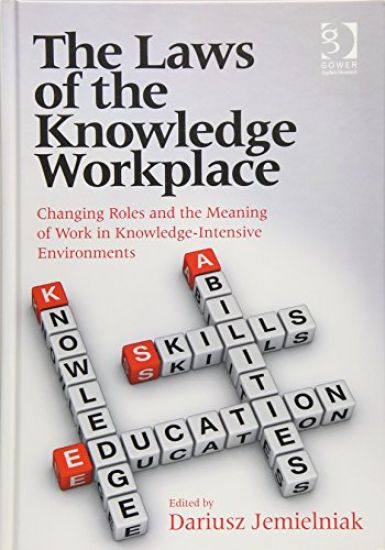
The Laws of the Knowledge Workplace

The Laws of the Knowledge Workplace

Dariusz Jemielniak

Routledge
2014
sidottu
In The Laws of the Knowledge Workplace, Dr Jemielniak has collected research-based chapters providing deep, interdisciplinary insight into knowledge professions, addressing issues of professional identity, emotion, power and authority, trust and indoctrination, and management behaviour. This leads to an examination of issues related to time and work scheduling and its bearing on play, family, symbolic sacrifices, and employee burn-out. In particular, it delves into the identity shifts between knowledge workers and managers, nepotism and turnover intentions among knowledge workers, the implementation of engineering projects, coordination problems in offshore production systems, leadership in virtual teams, decision support systems; taking into account the moral aspects of consequences, netnography as a tool for studying knowledge work, and innovative networks in the aviation industry. The accounts and studies in this book come from management, organization studies, sociology, and anthropology of work perspectives and are fully international in scope. They highlight the scale of the serious changes in occupational roles and to the meaning of work that is taking place in knowledge-intensive environments and give a pointer to what might constitute good and bad management practice in knowledge-intensive companies.
Common Knowledge?

Common Knowledge?

Dariusz Jemielniak

Stanford University Press
2014
sidottu
With an emphasis on peer–produced content and collaboration, Wikipedia exemplifies a departure from traditional management and organizational models. This iconic "project" has been variously characterized as a hive mind and an information revolution, attracting millions of new users even as it has been denigrated as anarchic and plagued by misinformation. Have Wikipedia's structure and inner workings promoted its astonishing growth and enduring public relevance? In Common Knowledge?, Dariusz Jemielniak draws on his academic expertise and years of active participation within the Wikipedia community to take readers inside the site, illuminating how it functions and deconstructing its distinctive organization. Against a backdrop of misconceptions about its governance, authenticity, and accessibility, Jemielniak delivers the first ethnography of Wikipedia, revealing that it is not entirely at the mercy of the public: instead, it balances open access and power with a unique bureaucracy that takes a page from traditional organizational forms. Along the way, Jemielniak incorporates fascinating cases that highlight the tug of war among the participants as they forge ahead in this pioneering environment.
The New Principles of Management

The New Principles of Management

Andrzej Kozminski; Dariusz Jemielniak

Peter Lang AG
2013
nidottu
The New Principles of Management is a textbook meant for European students of principles of management. Developed basing mainly on international cases as well as drawing from international examples of managerial practices, it attempts to address the needs of globalized companies better than other, typically US-centric textbooks. The New Principles of Management challenges many of the fossilized and outdated management notions and covers the topics most relevant for modern 21st century organizations, rather than their historic developments.
The New Knowledge Workers

The New Knowledge Workers

Dariusz Jemielniak

Edward Elgar Publishing Ltd
2012
sidottu
This critical ethnographic study of knowledge workers and knowledge-intensive organization workplaces focuses on the issues of timing and schedules, the perception of formality and trust and distrust in software development as well as motivation and occupational identity among software engineers. The book is a cross-cultural, comparative study of American and European high-tech workplaces that addresses the issues currently of interest to both Academia and to practice and provides a rare international comparison of organizations from both sides of the Atlantic. Its conclusions shed new light on the problems typical for software projects. The book specifically focuses on, and gives voice to, the perspectives of knowledge workers rather than managers and will thus be useful to not only scholars and human resource managers from software companies, but also to high-tech professionals. Scholars and professionals in organization studies, management, HRM, innovation and knowledge management will find this book engaging and enlightening.