Kirjojen hintavertailu. Mukana 12 595 353 kirjaa ja 12 kauppaa.
Kirjailija
Darren Sinclair
Kirjat ja teokset yhdessä paikassa: 3 kirjaa, julkaisuja vuosilta 2002-2025, suosituimpien joukossa Leaders and Laggards. Vertaile teosten hintoja ja tarkista saatavuus suomalaisista kirjakaupoista.
Aiming to identify the most effective tools and water governance innovations, and the circumstances that foster their successful implementation in different contexts, this book examines some of the world’s leading living laboratories of non-urban water law and governance, evaluating the success of different governance forms, legal designs and institutional prescriptions. Drawing on a rigorous empirical study of Australian water governance, it provides insights from Australia’s world leading water law and governance system which it complements with comparative studies from regulatory bodies and governance innovations in the United States, Europe and New Zealand to provide timely insights which test theories, speak to key debates and make recommendations on an array of water, law and governance issues.
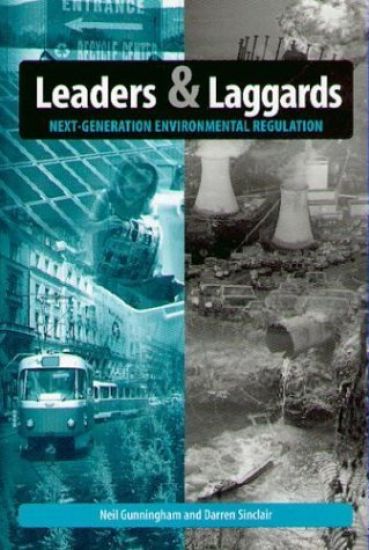
Consensus is growing internationally that traditional command-and-control approaches to environmental regulation have borne much of their low-hanging fruit. Yet it is far from clear what should complement or replace them. Regulatory agencies and policy-makers are struggling with a lack of information about regulatory reform, about what works and what doesn't, and about how best to harness the resources of both government and non-government stakeholders. Progress is being impeded unnecessarily by a lack of shared knowledge of how similar agencies elsewhere are meeting similar challenges and by a lack of data on the success or otherwise of existing initiatives. Despite recent and valuable attempts to deal with such problems in the European Union and North America, these remain islands of wisdom in a sea of ignorance. For example, when it comes to dealing with small and medium-sized enterprises, very little is known, and what is known is not effectively distilled and disseminated. Much the same could be said about the roles of third parties, commercial and non-commercial, as surrogate regulators, and more broadly of many current initiatives to reconfigure the regulatory state. Based on the authors' work for the OECD, Victorian Environmental Protection Authority and the Western Australian Department of Environment Protection, Leaders and Laggards addresses these problems by identifying innovative regulatory best practice internationally in a number of specific contexts, evaluating empirically the effectiveness of regulatory reform and providing policy prescriptions that would better enable agencies to fulfil their regulatory missions. Focusing primarily on the differing requirements for both corporations and small and medium-sized enterprises in North America and Europe, the book aims to complement existing initiatives and to expand knowledge of regulatory reform by showing: how existing experience can best be put to practical use "on the ground"; by drawing lessons from experiments in innovative regulation internationally; by reporting and extrapolating on original case studies; and by advancing understanding on which instruments and strategies are likely to be of most value and why. The authors argue that the development of theory has outstripped its application. In essence, Leaders and Laggards aims to ground a myriad of theory on the reinvention of environmental regulation into practice. The book will be essential reading for environmental policy-makers, regulatory and other government officials responsible for policy design and implementation, academics and postgraduate students in environmental management, environmental law and environmental policy, and a more general readership within environmental policy and management studies. It will also be of interest to those in industry, such as environmental managers and corporate strategists, who are considering the use of more innovative environmental and regulatory strategies, and to environmental NGOs.
Consensus is growing internationally that traditional command-and-control approaches to environmental regulation have borne much of their low-hanging fruit. Yet it is far from clear what should complement or replace them. Regulatory agencies and policy-makers are struggling with a lack of information about regulatory reform, about what works and what doesn't, and about how best to harness the resources of both government and non-government stakeholders. Progress is being impeded unnecessarily by a lack of shared knowledge of how similar agencies elsewhere are meeting similar challenges and by a lack of data on the success or otherwise of existing initiatives. Despite recent and valuable attempts to deal with such problems in the European Union and North America, these remain islands of wisdom in a sea of ignorance. For example, when it comes to dealing with small and medium-sized enterprises, very little is known, and what is known is not effectively distilled and disseminated. Much the same could be said about the roles of third parties, commercial and non-commercial, as surrogate regulators, and more broadly of many current initiatives to reconfigure the regulatory state. Based on the authors' work for the OECD, Victorian Environmental Protection Authority and the Western Australian Department of Environment Protection, Leaders and Laggards addresses these problems by identifying innovative regulatory best practice internationally in a number of specific contexts, evaluating empirically the effectiveness of regulatory reform and providing policy prescriptions that would better enable agencies to fulfil their regulatory missions. Focusing primarily on the differing requirements for both corporations and small and medium-sized enterprises in North America and Europe, the book aims to complement existing initiatives and to expand knowledge of regulatory reform by showing: how existing experience can best be put to practical use "on the ground"; by drawing lessons from experiments in innovative regulation internationally; by reporting and extrapolating on original case studies; and by advancing understanding on which instruments and strategies are likely to be of most value and why. The authors argue that the development of theory has outstripped its application. In essence, Leaders and Laggards aims to ground a myriad of theory on the reinvention of environmental regulation into practice. The book will be essential reading for environmental policy-makers, regulatory and other government officials responsible for policy design and implementation, academics and postgraduate students in environmental management, environmental law and environmental policy, and a more general readership within environmental policy and management studies. It will also be of interest to those in industry, such as environmental managers and corporate strategists, who are considering the use of more innovative environmental and regulatory strategies, and to environmental NGOs.