Kirjojen hintavertailu. Mukana 12 595 353 kirjaa ja 12 kauppaa.

Kirjailija

Dave Baker

Kirjat ja teokset yhdessä paikassa: 17 kirjaa, julkaisuja vuosilta 2005-2026, suosituimpien joukossa Forest Hills Bootleg Society. Vertaile teosten hintoja ja tarkista saatavuus suomalaisista kirjakaupoista.

17 kirjaa

Kirjojen julkaisuhaarukka 2005-2026.

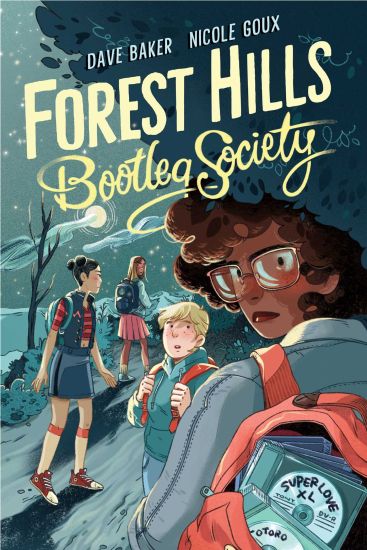
Forest Hills Bootleg Society

Forest Hills Bootleg Society

Dave Baker; Nicole Goux

SIMON SCHUSTER
2024
pokkari
Set in 2005, this gorgeously illustrated, funny, and honest graphic novel follows four teens who stumble into an illicit anime DVD-burning business that shakes up their conservative small town…and their friendship.When Brooke, Kelly, Maggie, and Melissa buy a bootleg anime DVD at a gas station, they get much more than they bargained for with Super Love XL, a risqué move featuring—among other things—a giant mecha who shoots lasers out of her chest. The four girls are horrified (and maybe a little fascinated). It’s so unlike anything they’ve seen, would probably shock everyone else in their town, and definitely would take over their extremely conservative Christian school. That’s when they have the idea to sell copies to local boys…for twenty dollars a pop. At first, everything goes perfectly, with the friends raking in cash—pretty soon they’ll even have enough money to buy the matching jackets they’ve always dreamed of! But as the market for mildly titillating anime DVDs grows, the girls realize they’ll need new material. On top of figuring out how to replicate their first success, there’s growing tension within the group. Brooke and Kelly’s romance is on its last legs, and hurt feelings are guaranteed when Melissa starts falling for one of them. Will the four girls’ shared history be strong enough to see them through this upheaval? Or will they learn that some things can only end in heartbreak?
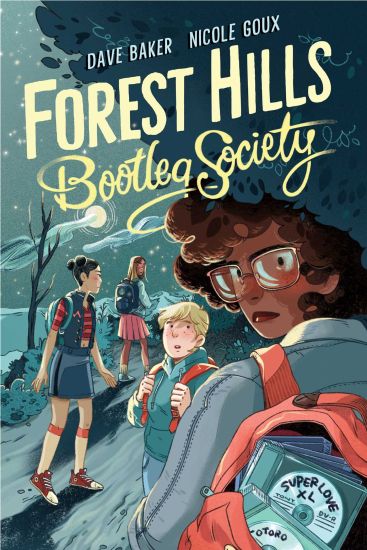
Forest Hills Bootleg Society

Forest Hills Bootleg Society

Dave Baker; Nicole Goux

Atheneum Books for Young Readers
2022
sidottu
Set in 2005, this gorgeously illustrated, funny, and honest graphic novel follows four teens who stumble into an illicit anime DVD-burning business that shakes up their conservative small town...and their friendship. When Brooke, Kelly, Maggie, and Melissa buy a bootleg anime DVD at a gas station, they get much more than they bargained for with Super Love XL, a risqu move featuring--among other things--a giant mecha who shoots lasers out of her chest. The four girls are horrified (and maybe a little fascinated). It's so unlike anything they've seen, would probably shock everyone else in their town, and definitely would take over their extremely conservative Christian school. That's when they have the idea to sell copies to local boys...for twenty dollars a pop. At first, everything goes perfectly, with the friends raking in cash--pretty soon they'll even have enough money to buy the matching jackets they've always dreamed of But as the market for mildly titillating anime DVDs grows, the girls realize they'll need new material. On top of figuring out how to replicate their first success, there's growing tension within the group. Brooke and Kelly's romance is on its last legs, and hurt feelings are guaranteed when Melissa starts falling for one of them. Will the four girls' shared history be strong enough to see them through this upheaval? Or will they learn that some things can only end in heartbreak?
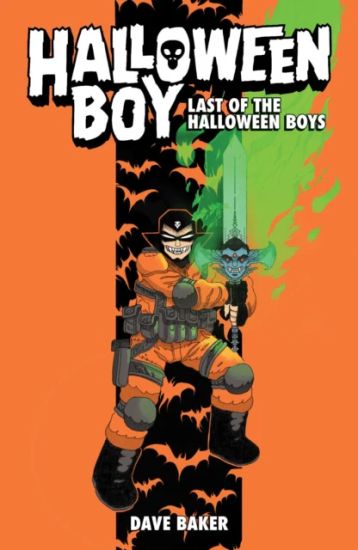
Halloween Boy

Halloween Boy

Dave Baker

ONI PRESS,US
2026
sidottu
From Eisner Award–nominated writer and illustrator Dave Baker (Mary Tyler MooreHawk, Forest Hills Bootleg Society) comes the collected voyages of the man known only as Halloween Boy—an adventurer without a past and a combatant of the impossible. Working as an archaeologist-for-hire, magical ghost hunter, and super-scientist explorer, Halloween Boy has a simple mission: help those who cannot help themselves. From routine artifact rescues gone wrong to helping the surviving members of an ancient religion enact a cosmic funeral dirge, Halloween Boy finds himself operating as the patron saint of the impossible. And yet, just how long can he win in this never-ending battle before things spiral out of control? When will the dark secrets of the Demon Who Lives finally rear their ugly heads? Find out in the pages of this thrilling compendium! Halloween Boy: Last of the Halloween Boys collects issues #1–5 of Baker’s self-published Halloween Boy series for the first time in a premium collected edition!
A Generation Apart

A Generation Apart

Dave Baker

I-Go-Books
2021
nidottu
Whereas most people barely bat an eyelid when a middle-aged man becomes romantically involved with a girl more than thirty years his junior, a mid¬dle-aged woman who takes on a youth that much younger than her is accused of having a ‘toy boy’. Wendy Forsyth finds herself in that exact pre¬dicament when she finds herself seriously attracted to a neighbour’s son while giving him extra maths lessons. The story describes her fears, worries and emotions in detail as she battles with her unusual conundrum. You’ll likely experience a mixture of reactions as you follow what transpires – at times sympathy with her plight but, at others, criticism of her ac¬tions. But, whatever your response, you’ll find it a fascinating read.
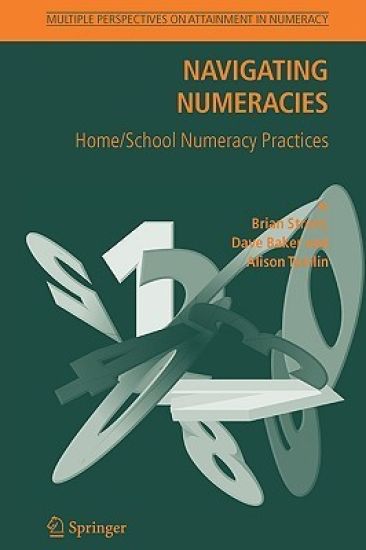
Navigating Numeracies

Navigating Numeracies

Brian V. Street; Dave Baker; Alison Tomlin

Springer-Verlag New York Inc.
2008
nidottu
Abstract. This introduction sets the scene for the remainder of the book by considering first the international context of widespread concern about the improvement of numeracy skills. This is related to reform movements in the UK, the US and other countries aimed at modernising primary (elementary) school mathematics curricula. A detailed account is given of the National Numeracy Strategy in England, a systemic government-imposed response to concern about standards implemented in 1999/2000. This includes a discussion of the alternative meanings of numeracy. An earlier initiative sponsored by a UK charitable trust reacting to concern about primary numeracy was the Leverhulme Numeracy Research Programme. This large-scale longitudinal study and linked set of case-study projects, focusing on reasons for low attainment, took place during 1997-2002. This book, and each other in the same series, is based on results of that research. The timescale fortuitously enabled the research team to also report on some effects of the systemic reform in the National Numeracy Strategy. 1. THE INTERNATIONAL CONTEXT In many countries, there are recurring periods of national concern about the low standards of calculation skills shown by children in primary (elementary) schools. Recently these concerns have become more urgent and more political with the publication of international comparisons of mathematical achievement, first at secondary and more recently at primary level (e. g. Lapointe, Mead et al. 1992; Mullis et al. , 1997).
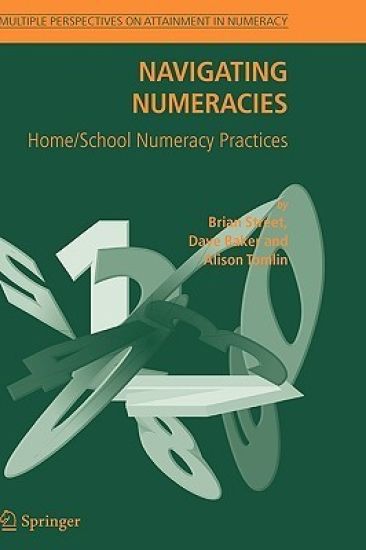
Navigating Numeracies

Navigating Numeracies

Brian V. Street; Dave Baker; Alison Tomlin

Springer-Verlag New York Inc.
2005
sidottu
Abstract. This introduction sets the scene for the remainder of the book by considering first the international context of widespread concern about the improvement of numeracy skills. This is related to reform movements in the UK, the US and other countries aimed at modernising primary (elementary) school mathematics curricula. A detailed account is given of the National Numeracy Strategy in England, a systemic government-imposed response to concern about standards implemented in 1999/2000. This includes a discussion of the alternative meanings of numeracy. An earlier initiative sponsored by a UK charitable trust reacting to concern about primary numeracy was the Leverhulme Numeracy Research Programme. This large-scale longitudinal study and linked set of case-study projects, focusing on reasons for low attainment, took place during 1997-2002. This book, and each other in the same series, is based on results of that research. The timescale fortuitously enabled the research team to also report on some effects of the systemic reform in the National Numeracy Strategy. 1. THE INTERNATIONAL CONTEXT In many countries, there are recurring periods of national concern about the low standards of calculation skills shown by children in primary (elementary) schools. Recently these concerns have become more urgent and more political with the publication of international comparisons of mathematical achievement, first at secondary and more recently at primary level (e. g. Lapointe, Mead et al. 1992; Mullis et al. , 1997).