Kirjojen hintavertailu. Mukana 12 553 691 kirjaa ja 12 kauppaa.

Kirjailija

David A. Dickey

Kirjat ja teokset yhdessä paikassa: 5 kirjaa, julkaisuja vuosilta 1998-2018, suosituimpien joukossa SAS for Forecasting Time Series, Third Edition. Vertaile teosten hintoja ja tarkista saatavuus suomalaisista kirjakaupoista.

Mukana myös kirjoitusasut: David A Dickey

5 kirjaa

Kirjojen julkaisuhaarukka 1998-2018.

SAS for Forecasting Time Series, Third Edition

SAS for Forecasting Time Series, Third Edition

John C Brocklebank; David A Dickey; Bong Choi

SAS Institute
2018
sidottu
To use statistical methods and SAS applications to forecast the future values of data taken over time, you need only follow this thoroughly updated classic on the subject. With this third edition of SAS for Forecasting Time Series, intermediate-to-advanced SAS users-such as statisticians, economists, and data scientists-can now match the most sophisticated forecasting methods to the most current SAS applications. Starting with fundamentals, this new edition presents methods for modeling both univariate and multivariate data taken over time. From the well-known ARIMA models to unobserved components, methods that span the range from simple to complex are discussed and illustrated. Many of the newer methods are variations on the basic ARIMA structures. Completely updated, this new edition includes fresh, interesting business situations and data sets, and new sections on these up-to-date statistical methods: ARIMA models Vector autoregressive models Exponential smoothing models Unobserved component and state-space models Seasonal adjustment Spectral analysis Focusing on application, this guide teaches a wide range of forecasting techniques by example. The examples provide the statistical underpinnings necessary to put the methods into practice. The following up-to-date SAS applications are covered in this edition: The ARIMA procedure The AUTOREG procedure The VARMAX procedure The ESM procedure The UCM and SSM procedures The X13 procedure The SPECTRA procedure SAS Forecast Studio Each SAS application is presented with explanation of its strengths, weaknesses, and best uses. Even users of automated forecasting systems will benefit from this knowledge of what is done and why. Moreover, the accompanying examples can serve as templates that you easily adjust to fit your specific forecasting needs. This book is part of the SAS Press program.
SAS for Forecasting Time Series, Third Edition

SAS for Forecasting Time Series, Third Edition

John C Brocklebank; David A Dickey; Bong Choi

SAS Institute
2018
pokkari
To use statistical methods and SAS applications to forecast the future values of data taken over time, you need only follow this thoroughly updated classic on the subject. With this third edition of SAS for Forecasting Time Series, intermediate-to-advanced SAS users-such as statisticians, economists, and data scientists-can now match the most sophisticated forecasting methods to the most current SAS applications. Starting with fundamentals, this new edition presents methods for modeling both univariate and multivariate data taken over time. From the well-known ARIMA models to unobserved components, methods that span the range from simple to complex are discussed and illustrated. Many of the newer methods are variations on the basic ARIMA structures. Completely updated, this new edition includes fresh, interesting business situations and data sets, and new sections on these up-to-date statistical methods: ARIMA models Vector autoregressive models Exponential smoothing models Unobserved component and state-space models Seasonal adjustment Spectral analysis Focusing on application, this guide teaches a wide range of forecasting techniques by example. The examples provide the statistical underpinnings necessary to put the methods into practice. The following up-to-date SAS applications are covered in this edition: The ARIMA procedure The AUTOREG procedure The VARMAX procedure The ESM procedure The UCM and SSM procedures The X13 procedure The SPECTRA procedure SAS Forecast Studio Each SAS application is presented with explanation of its strengths, weaknesses, and best uses. Even users of automated forecasting systems will benefit from this knowledge of what is done and why. Moreover, the accompanying examples can serve as templates that you easily adjust to fit your specific forecasting needs. This book is part of the SAS Press program.
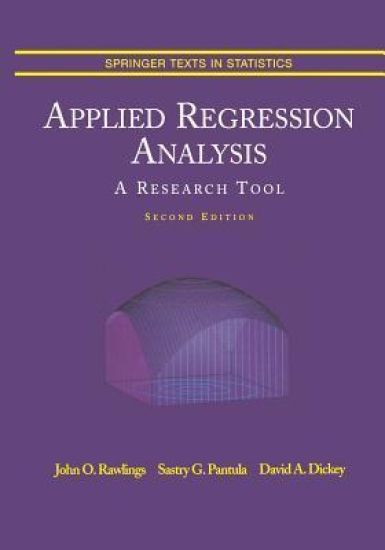
Applied Regression Analysis

Applied Regression Analysis

John O. Rawlings; Sastry G. Pantula; David A. Dickey

Springer-Verlag New York Inc.
2013
nidottu
Least squares estimation, when used appropriately, is a powerful research tool. A deeper understanding of the regression concepts is essential for achieving optimal benefits from a least squares analysis. This book builds on the fundamentals of statistical methods and provides appropriate concepts that will allow a scientist to use least squares as an effective research tool.Applied Regression Analysis is aimed at the scientist who wishes to gain a working knowledge of regression analysis. The basic purpose of this book is to develop an understanding of least squares and related statistical methods without becoming excessively mathematical. It is the outgrowth of more than 30 years of consulting experience with scientists and many years of teaching an applied regression course to graduate students. Applied Regression Analysis serves as an excellent text for a service course on regression for non-statisticians and as a reference for researchers. It also provides a bridge between a two-semester introduction to statistical methods and a thoeretical linear models course.Applied Regression Analysis emphasizes the concepts and the analysis of data sets. It provides a review of the key concepts in simple linear regression, matrix operations, and multiple regression. Methods and criteria for selecting regression variables and geometric interpretations are discussed. Polynomial, trigonometric, analysis of variance, nonlinear, time series, logistic, random effects, and mixed effects models are also discussed. Detailed case studies and exercises based on real data sets are used to reinforce the concepts. The data sets used in the book are available on the Internet.
SAS for Forecasting Time Series

SAS for Forecasting Time Series

John C. Brocklebank; David A. Dickey

John Wiley Sons Inc
2006
nidottu
Easy-to-read and comprehensive, this book shows how the SAS System performs multivariate time series analysis and features the advanced SAS procedures STATSPACE, ARIMA, and SPECTRA. The interrelationship of SAS/ETS procedures is demonstrated with an accompanying discussion of how the choice of a procedure depends on the data to be analysed and the reults desired. Other topics covered include detecting sinusoidal components in time series models and performing bivariate corr-spectral analysis and comparing the results with the standard transfer function methodology. The authors? unique approach to integrating students in a variety of disciplines and industries. Emphasis is on correct interpretation of output to draw meaningful conclusions. The volume, co-pubished by SAS and JWS, features both theory and practicality, and accompanies a soon-to-be extensive library of SAS hands-on manuals in a multitude of statistical areas. The book can be used with a number of hardware-specific computing machines including CMS, Mac, MVS, Opem VMS Alpha, Opmen VMS VAX, OS/390, OS/2, UNIX, and Windows.
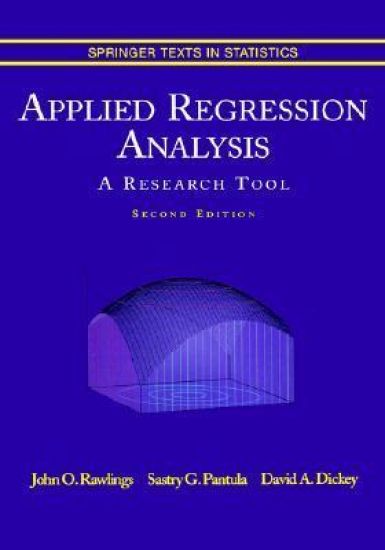
Applied Regression Analysis

Applied Regression Analysis

John O. Rawlings; Sastry G. Pantula; David A. Dickey

Springer-Verlag New York Inc.
1998
sidottu
Least squares estimation, when used appropriately, is a powerful research tool. A deeper understanding of the regression concepts is essential for achieving optimal benefits from a least squares analysis. This book builds on the fundamentals of statistical methods and provides appropriate concepts that will allow a scientist to use least squares as an effective research tool.Applied Regression Analysis is aimed at the scientist who wishes to gain a working knowledge of regression analysis. The basic purpose of this book is to develop an understanding of least squares and related statistical methods without becoming excessively mathematical. It is the outgrowth of more than 30 years of consulting experience with scientists and many years of teaching an applied regression course to graduate students. Applied Regression Analysis serves as an excellent text for a service course on regression for non-statisticians and as a reference for researchers. It also provides a bridge between a two-semester introduction to statistical methods and a thoeretical linear models course.Applied Regression Analysis emphasizes the concepts and the analysis of data sets. It provides a review of the key concepts in simple linear regression, matrix operations, and multiple regression. Methods and criteria for selecting regression variables and geometric interpretations are discussed. Polynomial, trigonometric, analysis of variance, nonlinear, time series, logistic, random effects, and mixed effects models are also discussed. Detailed case studies and exercises based on real data sets are used to reinforce the concepts. The data sets used in the book are available on the Internet.