Kirjojen hintavertailu. Mukana 12 390 323 kirjaa ja 12 kauppaa.

Kirjailija

David A. J. Richards

Kirjat ja teokset yhdessä paikassa: 31 kirjaa, julkaisuja vuosilta 1989-2026, suosituimpien joukossa Conscience and the Constitution. Vertaile teosten hintoja ja tarkista saatavuus suomalaisista kirjakaupoista.

Mukana myös kirjoitusasut: David A.J. Richards, David A J Richards

31 kirjaa

Kirjojen julkaisuhaarukka 1989-2026.

Patriarchal Religion, Sexuality, and Gender

Patriarchal Religion, Sexuality, and Gender

Nicholas Bamforth; David A. J. Richards

Cambridge University Press
2007
sidottu
Legal theorists are familiar with John Finnis's book Natural Law and Natural Rights, but usually overlook his interventions in US constitutional debates and his membership of a group of conservative Catholic thinkers, the 'new natural lawyers', led by theologian Germain Grisez. In fact, Finnis has repeatedly advocated conservative positions concerning lesbian and gay rights, contraception and abortion, and his substantive moral theory (as he himself acknowledges) derives from Grisez. Bamforth and Richards provide a detailed explanation of the work of the new natural lawyers within and outside the Catholic Church - the first truly comprehensive explanation available to legal theorists - and criticize Grisez's and Finnis's arguments concerning sexuality and gender. New natural law is, they argue, a theology rather than a secular theory, and one which is unappealing in a modern constitutional democracy. This book will be of interest to legal and political theorists, ethicists, theologians and scholars of religious history.
The Case for Gay Rights

The Case for Gay Rights

David A. J. Richards

University Press of Kansas
2005
sidottu
As Americans wrestle with red-versus-blue debates over traditional values, defense of marriage, and gay rights, reason often seems to take a back seat to emotion. In response, David Richards, a widely respected legal scholar and long-time champion of gay rights, reflects upon the constitutional and democratic principles - relating to privacy, intimate life, free speech, tolerance, and conscience - that underpin these often heated debates. The distillation of Richards's thirty-year advocacy for the rights of gays and lesbians, his book provides a reflective treatise on basic human rights that touch all of our lives. Drawing upon his own experiences as a gay man, Richards interweaves personal observations with philosophical, political, judicial, and psychological insights to make a compelling case that gays should be entitled to the same rights and protections that every American enjoys. Indeed, the call for gay rights can trace its lineage back to the powerful protest movements of the 1960s and 1970s, which demanded racial and sexual equality and ultimately overthrew the bigoted status quo. Richards focuses particularly on two key Supreme Court cases: the 1986 decision in Bowers v. Hardwick upholding Georgia's anti-sodomy laws and the 2003 decision in Lawrence v. Texas striking down Texas anti-sodomy laws and overturning Bowers. He shows how Bowers arose in a period of constitutional crisis over the right to privacy and examines the opinions in light of the Court's division in Roe v. Wade. He then shows that Lawrence must be understood in the context of later cases, notably Casey and Romer, which required that Bowers be reconsidered and overruled. Along the way, he examines current debates over gays in the military and same-sex marriage, assesses the Massachusetts Supreme Court's decision to permit gay marriage, and critiques the 1996 Defense of Marriage Act. Eloquent and impassioned, Richards's work crystallizes the essence of the argument for a much more expansive and tolerant view of gay rights in America. It also offers a touching account of one gay man's very personal struggle to find the voice he needed to speak truth to the powerful forces of discrimination.
Disarming Manhood

Disarming Manhood

David A. J. Richards

Swallow Press
2005
pokkari
Masculine codes of honor and dominance often are expressed in acts of violence, including war and terrorism. In Disarming Manhood: Roots of Ethical Resistance, David A. J. Richards examines the lives of five famous men—great leaders and crusaders—who actively resisted violence and presented more humane alternatives to further their causes. Richards argues that William Lloyd Garrison, Leo Tolstoy, Mohandas Gandhi, Winston Churchill, and Martin Luther King Jr. shared a psychology whose nonviolent roots were deeply influenced by a loving, maternalistic ethos. Drawing upon psychology, history, political theory, and literature, Richards traces a connection between these leaders and the maternal figures who profoundly shaped their responses to conflict, often on the basis of an original interpretation of the teachings of Jesus of Nazareth. The voice of nonviolent masculinity has empowered ethical transformations, including civil disobedience in South Africa, India, and the United States. Disarming Manhood demonstrates that as Garrison, Tolstoy, Gandhi, Churchill, and King carried out their various missions, they were galvanized by teachings whose ethical foundations rejected unjust violence. Accessibly written and free of jargon, Disarming Manhood will interest a wide audience as it furthers the understanding of human nature itself and contributes to the fields of developmental psychology and feminist scholarship.
Disarming Manhood

Disarming Manhood

David A. J. Richards

Swallow Press
2005
sidottu
Masculine codes of honor and dominance often are expressed in acts of violence, including war and terrorism. In Disarming Manhood: Roots of Ethical Resistance, David A. J. Richards examines the lives of five famous men—great leaders and crusaders—who actively resisted violence and presented more humane alternatives to further their causes. Richards argues that William Lloyd Garrison, Leo Tolstoy, Mohandas Gandhi, Winston Churchill, and Martin Luther King Jr. shared a psychology whose nonviolent roots were deeply influenced by a loving, maternalistic ethos. Drawing upon psychology, history, political theory, and literature, Richards traces a connection between these leaders and the maternal figures who profoundly shaped their responses to conflict, often on the basis of an original interpretation of the teachings of Jesus of Nazareth. The voice of nonviolent masculinity has empowered ethical transformations, including civil disobedience in South Africa, India, and the United States. Disarming Manhood demonstrates that as Garrison, Tolstoy, Gandhi, Churchill, and King carried out their various missions, they were galvanized by teachings whose ethical foundations rejected unjust violence. Accessibly written and free of jargon, Disarming Manhood will interest a wide audience as it furthers the understanding of human nature itself and contributes to the fields of developmental psychology and feminist scholarship.
Tragic Manhood and Democracy

Tragic Manhood and Democracy

David A J Richards

Sussex Academic Press
2004
nidottu
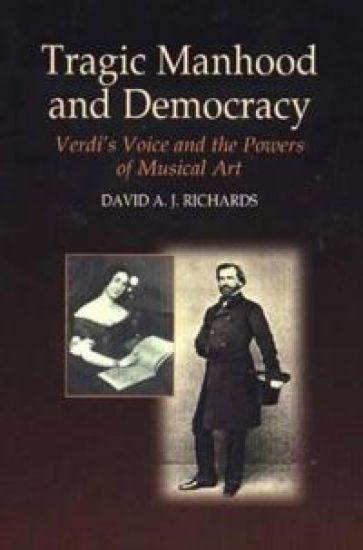
What is tragedy? This work argues that it is, at once, art and science -- an absorbing art and precisely observed empirical inquiry into human psychology, whose subject matter is the dilemma of manhood under democracy. The author expands discussion of the idea of the tragic to include music drama in general and the operas of Verdi in particular, and explores the indispensable contribution of tragedy to an understanding of personal and political psychology through discussion of: the political theory of structural injustice resting on the suppression of voice (underlying evils like racism, sexism, and homophobia), a developmental psychology of gender (drawing on the work of Carol Gilligan [the Harvard Project on Women's Psychology, Boy's Development and the Culture of Manhood]), and an interpretation of tragic art (including the expressive role of music in it). Exploration of the tragic impact of patriarchy on democratic voice is at the heart of the power and appeal of Verdi's innovations in musical voice. At its core is a complex psychic geography of patriarchal practices imposed on personal and political relationships (parents to children, siblings to one another, and adult men and women). Such practices -- fundamental to the family, politics, and religion -- enforce demands by forms of physical and psychological violence directed by men and women at anyone who deviates from its demands. Verdi's tragic musical drama speaks of an emotional loss that literally cannot under patriarchy be spoken, namely, what the author calls the tragedy of patriarchy -- a divided psychology that lives in the tension between patriarchal practices and democratic principles, and between the psychological demands of patriarchy and democratic manhood.
Tragic Manhood and Democracy

Tragic Manhood and Democracy

David A J Richards

Sussex Academic Press
2004
sidottu
What is tragedy? This work argues that it is, at once, art and science -- an absorbing art and precisely observed empirical inquiry into human psychology, whose subject matter is the dilemma of manhood under democracy. The author expands discussion of the idea of the tragic to include music drama in general and the operas of Verdi in particular, and explores the indispensable contribution of tragedy to an understanding of personal and political psychology through discussion of: the political theory of structural injustice resting on the suppression of voice (underlying evils like racism, sexism, and homophobia), a developmental psychology of gender (drawing on the work of Carol Gilligan [the Harvard Project on Women's Psychology, Boy's Development and the Culture of Manhood]), and an interpretation of tragic art (including the expressive role of music in it). Exploration of the tragic impact of patriarchy on democratic voice is at the heart of the power and appeal of Verdi's innovations in musical voice. At its core is a complex psychic geography of patriarchal practices imposed on personal and political relationships (parents to children, siblings to one another, and adult men and women). Such practices -- fundamental to the family, politics, and religion -- enforce demands by forms of physical and psychological violence directed by men and women at anyone who deviates from its demands. Verdi's tragic musical drama speaks of an emotional loss that literally cannot under patriarchy be spoken, namely, what the author calls the tragedy of patriarchy -- a divided psychology that lives in the tension between patriarchal practices and democratic principles, and between the psychological demands of patriarchy and democratic manhood.
Identity and the Case for Gay Rights

Identity and the Case for Gay Rights

David A. J. Richards

University of Chicago Press
2000
nidottu
How should one chart a course toward legal recognition of gay rights as basic human rights? In this study, legal scholar David Richards explores the connections between gay rights and three successful civil rights movements - black civil rights, feminism and religious toleration - to determine how these might serve as analogies for the gay rights movement. Richards argues that racial and gender struggles are informative but partial models. As in these movements, achieving gay rights requires eliminating unjust stereotypes and allowing one's identity to develop free from intolerant views. Richards stresses, however, that gay identity is an ethical choice based on gender equality. Thus the right to religious freedom offers the most compelling analogy for a gay rights movement because gay identity should be protected legally as an ethical decision of conscience. David Richards argues that discrimination is like religious intolerance - denial of full humanity to individuals because of their identity and moral commitments to gender equality.
Italian American

Italian American

David A.J. Richards

New York University Press
1999
sidottu
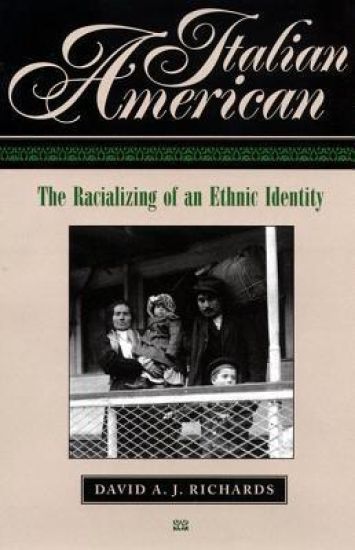
When southern Italians began emigrating to the U.S. in large numbers in the 1870s-part of the "new immigration" from southern and eastern rather than northern Europe-they were seen as racially inferior, what David A. J. Richards terms "nonvisibly" black. The first study of its kind, Italian American explores the acculturation process of Italian immigrants in terms of then-current patterns of European and American racism. Delving into the political and legal context of flawed liberal nationalism both in Italy (the Risorgimento) and the United States (Reconstruction Amendments), Richards examines why Italian Americans were so reluctant to influence depictions of themselves and their own collective identity. He argues that American racism could not have had the durability or political power it has had either in the popular understanding or in the corruption of constitutional ideals unless many new immigrants, themselves often regarded as racially inferior, had been drawn into accepting and supporting many of the terms of American racism. With its unprecedented focus on Italian American identity and an interdisciplinary approach to comparative culture and law, this timely study sheds important light on the history and contemporary importance of identity and multicultural politics in American political and constitutional debate.
Women, Gays, and the Constitution

Women, Gays, and the Constitution

David A. J. Richards

University of Chicago Press
1998
nidottu
This study combines an interpretive history of culture and law, political philosophy and constitutional analysis to explain the background, development and growing impact of two challenging human rights movements: feminism and gay rights. The text argues that both movements are extensions of rights-based dissent, rooted in antebellum abolitionist feminism which condemns both American racism and sexism. It examines the role of dissident African Americans, Jews, women and homosexuals in forging alternative visions of rights-based democracy. The book draws attention to Walt Whitman's visionary poetry, exploring Whitman's impact on pro-gay advocates such as Havelock Ellis, Oscar Wilde and Andre Gide. It also discusses writers and reformers such as Margaret Sanger, Franz Boas, Elizabeth Stanton and Adrienne Rich. The study addresses recent controversies such as the exclusion of homosexuals from the military and from the right of marriage, and concludes with a defence of the struggle for such constitutional rights.
Foundations of American Constitutionalism

Foundations of American Constitutionalism

David A. J. Richards

Oxford University Press Inc
1990
sidottu
David Richards here argues the position that understanding the intent of the Founders is essential to the legal interpretation of the United States Constitution. To this extent he makes common cause with conservative constitutional theorists, but he arrives at conclusions that differ radically from theirs. Indeed, his stated project here is to `reclaim' the Founders intent on behalf of the liberal humanist tradition they embodied. Richards examines the role of the Founders' understanding of history, philosophy, political theory, and political science in the evolution of their constitutional design. In his reconstruction, the Constitution emerges as a brilliant expression of European humanist and critical thought, shaped by such influences as the political ideas of Machiavelli, Harrington, Montesquieu, and Hume, the Lockean theory of legitimate government, and the common law model of interpretive practice. Armed with this new understanding of the Founders' intent, Richards is able to fully develop the methodology of constitutional interpretation sketched in his earlier book, TOLERATION AND THE CONSTITUTION (OUP 1986), and uses it effectively to defend a liberal reading of constitutional guarantees of individual rights.
Toleration and the Constitution

Toleration and the Constitution

David A. J. Richards

Oxford University Press Inc
1989
nidottu
The author argues the relevance of philosophical and political theory for the interpretation of law, and especially for constitutional interpretation. He surveys all of the major contemporary theories of constitutional interpretation, and concludes that 'interpretivism', the view that interpretation should concern itself only with the text of the American Constitution and the intentions of its framers, is invalid. He presents both historical and theoretical arguments in support of a contractarian theory of interpretation - a theory that affirms the moral sovereignty of the people, and maintains that toleration, or respect for conscience and individual freedom, is the central constitutional ideal. The book goes on to examine some of the implications of this theory through important issues in constitutional law: freedom of religion, speech, and privacy.