Kirjojen hintavertailu. Mukana 12 595 353 kirjaa ja 12 kauppaa.

Kirjailija

David A. Ochmanek

Kirjat ja teokset yhdessä paikassa: 9 kirjaa, julkaisuja vuosilta 1998-2024, suosituimpien joukossa Insights from the Plan Blue 21 Game. Vertaile teosten hintoja ja tarkista saatavuus suomalaisista kirjakaupoista.

Mukana myös kirjoitusasut: David A Ochmanek

9 kirjaa

Kirjojen julkaisuhaarukka 1998-2024.

Insights from the Plan Blue 21 Game

Insights from the Plan Blue 21 Game

Elizabeth M Bartels; David A Ochmanek; Nathaniel Edenfield; Brien Alkire; Katherine Anania; Michael Bohnert; Julia Brackup; Hannah Jane Byrne; Rachel Costello; Alyssa Demus; John J Drennan; Emily Ellinger; David R Frelinger; Michelle Grisé; Russell Hanson; Mace Moesner; Stephanie Pezard; Stephanie Anne Pillion; Clint Reach; Melissa Shostak; Gabrielle Tarini; Abbie Tingstad

RAND Corporation
2024
pokkari
This report describes the 2021 U.S. Air Force-sponsored Plan Blue game, which examined competition against Russia in the Arctic with a focus on the role of sensing in competition and featured robust participation from regional partners and allies. The purpose of the game was to increase understanding of the capabilities, postures, and alliance command, control, and communication relationships that may be called for in future Arctic operations.
A New Division of Labor

A New Division of Labor

Andrew R. Hoehn; Adam Grissom; David A. Ochmanek; David A. Shlapak; Alan J. Vick

RAND
2007
pokkari
An emerging U.S. grand strategy--the promotion of democracy and freedom abroad--will certainly involve the U.S. armed forces. Although they must change to meet changes in emphasis and demand, they cannot risk their historic strengths. Some areas of interest are the organization and employment of forces, planning for future conflicts, developing information resources, and fostering partnerships among the services and with allies.
The Challenge of Nuclear-armed Regional Adversaries

The Challenge of Nuclear-armed Regional Adversaries

David A. Ochmanek; Lowell H. Schwartz

RAND
2008
pokkari
Deterrence of nuclear use through the threat of retaliation could be highly problematic in many plausible conflict scenarios with nuclear-armed regional adversaries. This could compel U.S. leaders to temper their military and political objectives if they come into conflict with these states. This book examines the reasons behind this important shift in the international security environment and its strategic and force planning implications.Deterring nuclear use by regional adversaries such as North Korea could be problematic in some situations. This book examines the strategic and force planning implications of this shift in the international security environment.
Protecting Commercial Aviation Against the Shoulder-fired Missile Threat

Protecting Commercial Aviation Against the Shoulder-fired Missile Threat

James Chow; James Chiesa; Paul Dreyer; Mel Eisman; Theodore W. Karasik; Joel Kvitky; Sherrill Lingel; David A. Ochmanek; Chad Shirley

RAND
2005
pokkari
Examines the capabilities and costs of onboard technologies to divert missiles attacking commercial airliners. Given the significant uncertainties in the cost and effectiveness of countermeasures, a decision to install them should be postponed, and concurrent development efforts to reduce these uncertainties should proceed as rapidly as possible.
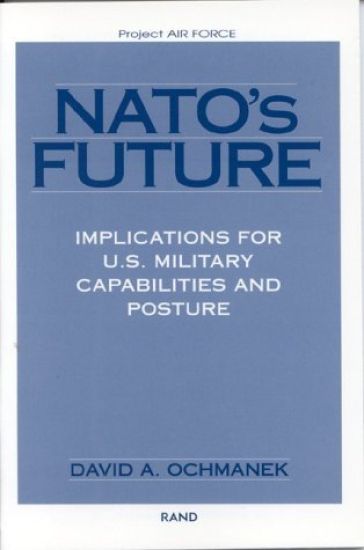
NATO's Future

NATO's Future

David A. Ochmanek

RAND
2000
pokkari
Events after the collapse of the Soviet Union and the end of the Cold War have shown the need for a transformed NATO capable of a wide range of missions, including projecting stability around the periphery of the NATO treaty area, intervening in civil conflicts, coordinating power-projection operations, and countering weapons of mass destruction. The author's analysis finds that the military forces of NATO's member states should be ready for expeditionary operations, which will require expanding and modernizing forces; NATO must be able to deter and defeat chemical, biological, and nuclear weapons; and U.S. forces in Europe are invaluable assets for shaping behaviors and expectations in the region and for responding to challenges in and around Europe. The future will demand effective and coordinated action by nations with common interests, and for the United States and its allies, NATO is by far the best vehicle available. A key factor will be the Europeans' willingness to accept greater responsibility for the defense of common interests outside of the treaty area, perhaps beyond Europe itself. Investment in military capabilities as needed is called for.
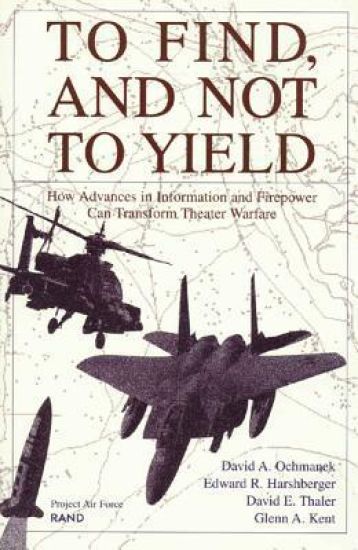
To Find, and Not to Yield

To Find, and Not to Yield

David A. Ochmanek

RAND
1998
pokkari
Absent significant changes in U.S. defense investment priorities, American forces could soon find themselves unable to cope with some emerging challenges in large-scale power projection operations. Specifically, U.S. forces will need better capabilities to secure a foothold in distant theaters, to defeat weapons of mass destruction and their delivery vehicles, to gain control of operations in the air, and to locate and destroy invading ground forces. New surveillance sensors, information processing capabilities, communication systems, and guided munitions are enabling operational concepts that can allow U.S. forces to meet emerging challenges and, indeed, to adopt new approaches to warfare. The authors assess quantitatively the capabilities of U.S. forces in the context of a generic scenario depicting a large-scale war in the next decade. From this, they identify priorities for modernizing U.S. forces. They argue that modernization dollars should be focused on forces and enabling capabilities that allow for decisive operations early in a conflict. If necessary, funds for such enhancements can come from modest reductions in forces that are slower to deploy.
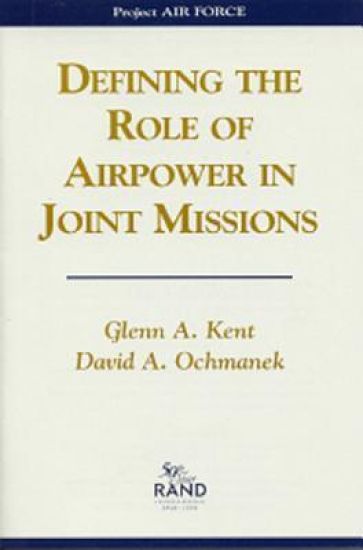
Defining the Role of Airpower in Joint Missions

Defining the Role of Airpower in Joint Missions

Glenn A. Kent; David A. Ochmanek

RAND
1998
pokkari
The stage is set for the emergence of a "new American way of war," in which U.S. forces are able to bring military power to bear against an enemy state quickly, comprehensively, decisively, and with minimal risk of heavy casualties. But some obstacles remain. These obstacles seem more budgetary and political than technical or operational. Some key programs are being abandoned or delayed because of the press of limited resources and competing demands. In this environment, it is imperative that the Air Force articulate in clear and compelling terms the potential contributions of airpower to joint operations. This is distinct from claiming "Air Force roles and missions." The approach offered here begins with a consideration of the basic characteristics of air forces and space forces, identifies the operational capabilities of these forces, and lists the missions and operational objectives to which these forces can contribute. By insisting that these missions and objectives be defined from the perspective of joint operations, this approach to doctrine positions the Air Force favorably to advance the role of its forces in the competition for roles within missions.