Kirjojen hintavertailu. Mukana 12 595 353 kirjaa ja 12 kauppaa.

Kirjailija

David A. Smith

Kirjat ja teokset yhdessä paikassa: 13 kirjaa, julkaisuja vuosilta 1995-2026, suosituimpien joukossa Mahan. Vertaile teosten hintoja ja tarkista saatavuus suomalaisista kirjakaupoista.

Mukana myös kirjoitusasut: David A Smith

13 kirjaa

Kirjojen julkaisuhaarukka 1995-2026.

Mahan

Mahan

David A. Smith

Naval Institute Press
2026
sidottu
The first full biography of Alfred Thayer Mahan in nearly fifty years explores how his groundbreaking ideas on sea power reshaped naval strategy and global politics—and why they still matter today. Drawing on rich archival material, David A. Smith brings to life the man whose intellect helped chart the course of modern maritime history. Alfred Thayer Mahan’s theories of sea power transformed the strategic thinking of his time and continue to influence global affairs today. This is the definitive biography of the man whose writings reshaped naval doctrine and engendered a new understanding of international power. Author David A. Smith examines in full Mahan’s intellectual development, professional path, and the broad consequences of his work for both the United States and the wider world. Chapters focus on the major stages of Mahan’s life and thought (1840-1914): his early years as the son of a West Point professor, his formative experience at the U.S. Naval Academy, and his service during the Civil War, where he began to reflect on the operational and strategic dimensions of naval conflict. His time at the Naval War College marks a turning point where, distanced from command and engaged in study, he produced The Influence of Sea Power upon History, 1660–1783—a work that would revolutionize how nations conceived of maritime power and its role in national strength. Smith places Mahan’s theories in the context of the industrial and imperial expansions of the late nineteenth century and tracks the reception of his ideas in Europe, Japan, and beyond. Mahan emerges here not simply as a theorist, but as a participant in the great debates of his age—about commerce, strategy, and the nature of national power. Drawing on personal correspondence, official records, and Mahan’s own prolific writings, this biography also addresses the paradoxes of his character. He was an introvert in a profession that prized command, a strategist more at ease with books than with crews. His career unfolded in peacetime posts and classroom lectures rather than combat, yet his influence reached admirals, kings, and presidents. Above all, Mahan was a thinker whose work shaped modern navalism and whose legacy continues to inform discussions of military force and international order. This biography is a portrait of a mind that saw the ocean not as backdrop, but as the main arena in which nations rise and fall.

A New Force at Sea

A New Force at Sea

David A. Smith

Naval Institute Press
2023
sidottu
A New Force at Sea tells the story of one of the most important officers in the U.S. Navy between the Civil War and World War II. Born in Montpelier, Vermont, George Dewey attended the still relatively new U.S. Naval Academy, graduating in 1858. He served with distinction in the Civil War in the Union Navy, saw a significant amount of action in the Mississippi River and along the Atlantic coast, and was singled out for his leadership and bravery by his superior officers. In the wake of the war, Dewey remained in the Navy as an officer, but the American people were generally uninterested in any role their nation could play in the broader world and the Navy languished. Dewey however, refined his perception of what American global naval strategy could be. By the time the Spanish-American War broke out in 1898, Dewey commanded a squadron of ships on the far side of the Pacific. His victory in the Battle of Manila Bay instantly made him the most famous American military figure after Ulysses S. Grant. The degree to which Dewey bore responsibility for embroiling the United States in what came to be known as the Philippine Insurrection was overlooked by an American public that eagerly named children for him, composed songs in his honor, and competed to stage the most extravagant civic celebrations of the quiet naval officer from Vermont. It was a public role for which he was ill-suited. Such was Dewey’s celebrity that he when he returned to the United States he was instantly spoken of as a serious candidate for the Presidency in 1900. After an abortive and half-hearted candidacy that damaged his public reputation, Congress raised his rank to the newly created “Admiral of the Navy,” the rank he would hold for the rest of his life. He became the embodiment of Theodore Roosevelt’s “big stick” attitude and the national symbol for American naval power. He served as the chairman of the new General Board of the United States Navy, created in 1900 as the first body to address questions of strategy and operational readiness. Dewey had a profound understanding that his career bridged two seminal periods in American naval history, and clearly understood the repercussions of his victory at Manila. He died in Washington in January 1917, shortly before the United States entered World War I fighting against Germany as he had foretold years earlier. He was buried at Arlington National Cemetery but shortly after reinterred at the Washington National Cathedral, the only U.S. military officer to have such an honor.
Cowboy Presidents

Cowboy Presidents

David A. Smith

UNIVERSITY OF OKLAHOMA PRESS
2022
nidottu
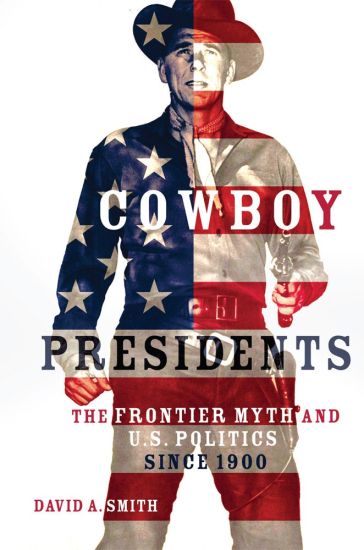
For an element so firmly fixed in American culture, the frontier myth is surprisingly flexible. How else to explain its having taken two such different guises in the twentieth century—the progressive, forward-looking politics of Rough Rider president Teddy Roosevelt and the conservative, old-fashioned character and Cold War politics of Ronald Reagan? This is the conundrum at the heart of Cowboy Presidents, which explores the deployment and consequent transformation of the frontier myth by four U.S. presidents: Theodore Roosevelt, Lyndon B. Johnson, Ronald Reagan, and George W. Bush. Behind the shape-shifting of this myth, historian David A. Smith finds major events in American and world history that have made various aspects of the “Old West” frontier more relevant, and more useful, for promoting radically different political ideologies and agendas. And these divergent adaptations of frontier symbolism have altered the frontier myth. Theodore Roosevelt, with his vigorous pursuit of an activist federal government, helped establish a version of the frontier myth that today would be considered liberal. But then, Smith shows, a series of events from the Lyndon Johnson through Jimmy Carter presidencies—including Vietnam, race riots, and stagflation—seemed to give the lie to the progressive frontier myth. In the wake of these crises, Smith’s analysis reveals, the entire structure and popular representation of frontier symbols and images in American politics shifted dramatically from left to right, and from liberal to conservative, with profound implications for the history of American thought and presidential politics. The now popular idea that “frontier American” leaders and politicians are naturally Republicans with conservative ideals flows directly from the Reagan era.Cowboy Presidents gives us a new, clarifying perspective on how Americans shape and understand their national identity and sense of purpose; at the same time, reflecting on the essential mutability of a quintessentially national myth, the book suggests that the next iteration of the frontier myth may well be on the horizon.
Hidden Agendas

Hidden Agendas

David A. Smith

CHRISTIAN FOCUS PUBLICATIONS LTD
2022
pokkari
This book lifts the lid on the human heart, seeking to uncover the hidden agendas that stop us from loving God and others as we should. Our hearts have a selfish list of priorities that we believe are important and need to be given attention. But often these heart agendas are in tension with God’s agenda. David Smith uses four biblical pictures to help us consider these agendas that are often hidden so deep within our hearts that we are unaware of them. Using examples from the Bible, he uncovers the desire to be significant; the desire to have certainty; the desire to have peace, safety, and security; and the desire for our own fulfilment. Each of these four chapters begins with a story from the Bible, an explanation of the heart agenda exposed in the story, the underlying heart fear, the heart demand, and the heart problem. It then goes on to show God’s heart agenda in that situation and concludes with a summary and questions for reflection. The final two chapters show the servant heartedness that is central to the Kingdom of God, and the way we can honestly assess our own hearts. David helpfully finishes the book with guidance on how we can journey towards the heart agendas God wants us to have.
It's About Time!

It's About Time!

David A Smith

Lioncrest Publishing
2021
pokkari
"Imagine trying to inspire people who need help but who are actively resisting change. That is the essence of Heroic Selling."In It's About Time , David Smith chronicles his thirty-plus-year journey in senior living. He reveals how to turn deep-seated resistance into successful conversions. His field-tested technique, Prospect-Centered Selling(R), is based on a theoretical model adapted from the psychology of change. It's a strategy supported by data-driven metrics and a purpose-built CRM platform.David's methodology is disrupting the universally accepted speed-to-lead paradigm. This book provides case studies and is a step-by-step guide that will show you how to double your close rates, drive higher occupancies, and achieve faster fills. It will not only boost your performance, but it will also help hundreds of thousands more people get ready for a new and vibrant chapter in their lives.Be heroic. It's time. Come join us.
It's About Time!

It's About Time!

David A Smith

Lioncrest Publishing
2021
sidottu
"Imagine trying to inspire people who need help but who are actively resisting change. That is the essence of Heroic Selling."In It's About Time , David Smith chronicles his thirty-plus-year journey in senior living. He reveals how to turn deep-seated resistance into successful conversions. His field-tested technique, Prospect-Centered Selling(R), is based on a theoretical model adapted from the psychology of change. It's a strategy supported by data-driven metrics and a purpose-built CRM platform.David's methodology is disrupting the universally accepted speed-to-lead paradigm. This book provides case studies and is a step-by-step guide that will show you how to double your close rates, drive higher occupancies, and achieve faster fills. It will not only boost your performance, but it will also help hundreds of thousands more people get ready for a new and vibrant chapter in their lives.Be heroic. It's time. Come join us.
Designers' Guide to EN 1992-2. Eurocode 2 : Design of concrete structures. Part 2: Concrete bridges

Designers' Guide to EN 1992-2. Eurocode 2 : Design of concrete structures. Part 2: Concrete bridges

Chris R Hendy; David A. Smith; Haig Gulvanessian

Thomas Telford Ltd
2007
sidottu
This guide describes the principles and requirements for safety, serviceability and durability of concrete bridges. It provides the user with guidance on the interpretation and use of EN 1992-2 and the relevant provisions of the general rules ofEN 1992-1-1. Worked examples are provided to illustrate the use of the rules. It also explains the relationship with the other Eurocode parts to which if refers (ENs 1990, 1991). The provision of background information and references also enables the users of Eurocode 2: Part 2 to understand the origin and objectives of its provisions.
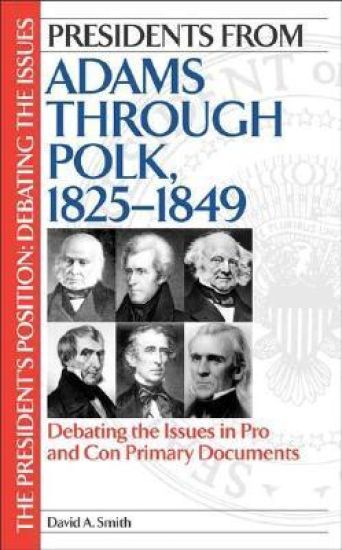
Presidents from Adams through Polk, 1825-1849
It was the Era of Good Feelings, but all was not well with the young Republic. From 1825 to 1849, presidents John Quincy Adams, Andrew Jackson, Martin Van Buren, William Henry Harrison, John Tyler, and James K. Polk grappled with the legacy of the Monroe Doctrine, Indian removal, territorial expansion, the National Bank, tariffs, economic depressions, War with Mexico, near war with Great Britain, and the place of slavery in the growing nation. As one would expect from confident citizens of the burgeoning young country, conflicting arguments swirled around the hot-button issues of the day. This rich resource of primary documents enables students to read these arguments first hand, and feel the passions and study the logic driving their often forceful positions.All of the primary documents are annotated and placed into historical context. A thorough index concludes the work.
Brief Mental Health Interventions for the Family Physician

Brief Mental Health Interventions for the Family Physician

Michael V. Bloom; M.A. Baird; David A. Smith

Springer-Verlag New York Inc.
2001
nidottu
Family Physicians need to be expert and active providers of mental health care. Their rapport with patients and accessibility enable them to control minor mental health conditions before these problems become critical. Brief Mental Health Interventions for the Family Physician is an ideal resource for Family Physicians. It provides a "refresher course" of sensible paths toward resolution of common mental health problems. It features an easy to read style, and well-focused references. The book summarizes the basic components of brief therapy and reviews how to conduct a brief therapy interview. It also includes chapters on specific clinical conditions and situations that routinely confront the family physician. Each chapter includes an outline, a case example or vignette, and a concise discussion of brief therapy strategies for the disorder. Primary care physicians will find this convenient text an ideal handy reference and review.
A New World Order?

A New World Order?

Jozsef Borocz; David A. Smith

Praeger Publishers Inc
1995
nidottu
The closing years of the 20th century will be remembered as a time of tumultuous change. The various essays are attempts to understand the changes and ground them in the context of the logic of the contemporary world-system. The essays are divided into two main themes: structural transformations and regional ramifications of global transformations. East Asia, the Pacific Rim, European periphery, and the Middle East are all examined to determine if fundamental changes are occuring. Scholars and upper level and graduate students of economic history, developmental economics, regional economics, international economics, and political economy will find provocative contrasts and insights in this collection of essays, presented at the 18th annual Political Economy of the World-System Conference.
A New World Order?

A New World Order?

Jozsef Borocz; David A. Smith

Praeger Publishers Inc
1995
sidottu
The closing years of the 20th century will be remembered as a time of tumultuous change. The various essays are attempts to understand the changes and ground them in the context of the logic of the contemporary world-system. The essays are divided into two main themes: structural transformations and regional ramifications of global transformations. East Asia, the Pacific Rim, European periphery, and the Middle East are all examined to determine if fundamental changes are occuring. Scholars and upper level and graduate students of economic history, developmental economics, regional economics, international economics, and political economy will find provocative contrasts and insights in this collection of essays, presented at the 18th annual Political Economy of the World-System Conference.