Kirjojen hintavertailu. Mukana 12 444 631 kirjaa ja 12 kauppaa.

Kirjailija

David A. Swanson

Kirjat ja teokset yhdessä paikassa: 17 kirjaa, julkaisuja vuosilta 2001-2019, suosituimpien joukossa Cohort Change Ratios and their Applications. Vertaile teosten hintoja ja tarkista saatavuus suomalaisista kirjakaupoista.

17 kirjaa

Kirjojen julkaisuhaarukka 2001-2019.

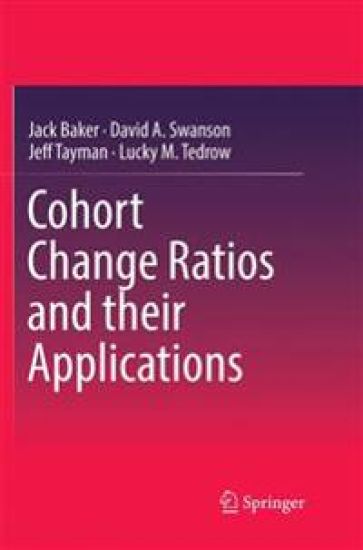
Cohort Change Ratios and their Applications

Cohort Change Ratios and their Applications

Jack Baker; David A. Swanson; Jeff Tayman; Lucky M. Tedrow

Springer International Publishing AG
2018
nidottu
This textbook focuses on the cohort change ratio (CCR) method. It presents powerful, yet relatively simple ways to generate accurate demographic estimates and forecasts that are cost efficient and require fewer resources than other techniques. The concepts, analytical frameworks, and methodological tools presented do not require extensive knowledge of demographics, mathematics, or statistics. The demographic focus is on the characteristics of populations, especially age and sex composition, but these methods are applicable estimating and forecasting other characteristics and total population. The book contains more traditional applications such as the Hamilton-Perry method, but also includes new applications of the CCR method such as stable population theory. Real world empirical examples are provided for every application; along with excel files containing data and program code, which are accessible online. Topics covered include basic demographic measures, sources of demographic information, forecasting and estimating (both current and historical) populations, modifications to current methods, forecasting school enrollment and other characteristics, estimating life expectancy, stable population theory, decomposition of the CCR into its migration and mortality components, and the utility of the CCR. This textbook is designed to provide material for an advanced undergraduate or graduate course on demographic methods. It can also be used as a supplement for other courses including applied demography, business and economic forecasting and market research.
Cohort Change Ratios and their Applications

Cohort Change Ratios and their Applications

Jack Baker; David A. Swanson; Jeff Tayman; Lucky M. Tedrow

Springer International Publishing AG
2017
sidottu
This textbook focuses on the cohort change ratio (CCR) method. It presents powerful, yet relatively simple ways to generate accurate demographic estimates and forecasts that are cost efficient and require fewer resources than other techniques. The concepts, analytical frameworks, and methodological tools presented do not require extensive knowledge of demographics, mathematics, or statistics. The demographic focus is on the characteristics of populations, especially age and sex composition, but these methods are applicable estimating and forecasting other characteristics and total population. The book contains more traditional applications such as the Hamilton-Perry method, but also includes new applications of the CCR method such as stable population theory. Real world empirical examples are provided for every application; along with excel files containing data and program code, which are accessible online. Topics covered include basic demographic measures, sources of demographic information, forecasting and estimating (both current and historical) populations, modifications to current methods, forecasting school enrollment and other characteristics, estimating life expectancy, stable population theory, decomposition of the CCR into its migration and mortality components, and the utility of the CCR. This textbook is designed to provide material for an advanced undergraduate or graduate course on demographic methods. It can also be used as a supplement for other courses including applied demography, business and economic forecasting and market research.
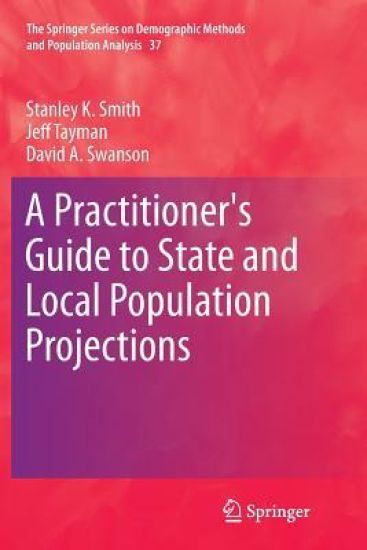
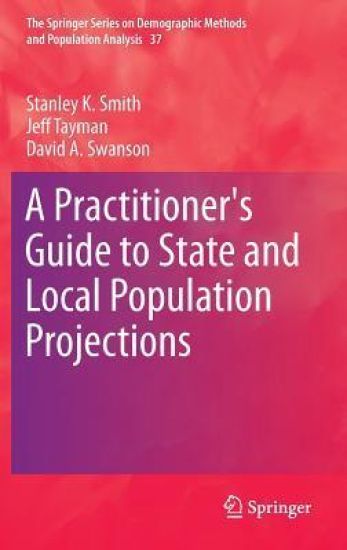
A Practitioner's Guide to State and Local Population Projections

A Practitioner's Guide to State and Local Population Projections

Stanley K. Smith; Jeff Tayman; David A. Swanson

Springer
2016
nidottu
This book focuses on the methodology and analysis of state and local population projections. It describes the most commonly used data sources and application techniques for four types of projection methods: cohort-component, trend extrapolation, structural models, and microsimulation. It covers the components of population growth, sources of data, the formation of assumptions, the development of evaluation criteria, and the determinants of forecast accuracy. It considers the strengths and weaknesses of various projection methods and pays special attention to the unique problems that characterize small-area projections. The authors provide practical guidance to demographers, planners, market analysts, and others called on to construct state and local population projections. They use many examples and illustrations and present suggestions for dealing with special populations, unique circumstances, and inadequate or unreliable data. They describe techniques for controlling one set of projections to another, for interpolating between time points, for sub-dividing age groups, and for constructing projections of population-related variables (e.g., school enrollment, households). They discuss the role of judgment and the importance of the political context in which projections are made. They emphasize the “utility” of projections, or their usefulness for decision making in a world of competing demands and limited resources. This comprehensive book will provide readers with an understanding not only of the mechanics of the most commonly used population projection methods, but also of the many complex issues affecting their construction, interpretation, evaluation, and use.?
A Practitioner's Guide to State and Local Population Projections

A Practitioner's Guide to State and Local Population Projections

Stanley K. Smith; Jeff Tayman; David A. Swanson

Springer
2014
sidottu
This book focuses on the methodology and analysis of state and local population projections. It describes the most commonly used data sources and application techniques for four types of projection methods: cohort-component, trend extrapolation, structural models, and microsimulation. It covers the components of population growth, sources of data, the formation of assumptions, the development of evaluation criteria, and the determinants of forecast accuracy. It considers the strengths and weaknesses of various projection methods and pays special attention to the unique problems that characterize small-area projections. The authors provide practical guidance to demographers, planners, market analysts, and others called on to construct state and local population projections. They use many examples and illustrations and present suggestions for dealing with special populations, unique circumstances, and inadequate or unreliable data. They describe techniques for controlling one set of projections to another, for interpolating between time points, for sub-dividing age groups, and for constructing projections of population-related variables (e.g., school enrollment, households). They discuss the role of judgment and the importance of the political context in which projections are made. They emphasize the “utility” of projections, or their usefulness for decision making in a world of competing demands and limited resources. This comprehensive book will provide readers with an understanding not only of the mechanics of the most commonly used population projection methods, but also of the many complex issues affecting their construction, interpretation, evaluation, and use.?
Global Population in Transition

Global Population in Transition

Jo. M. Martins; Fei Guo; David A. Swanson

Springer Nature Switzerland AG
2019
nidottu
This book deals with macro and micro aspects of population change and their inter-face with socio-economic factors and impact. It examines theoretical notions and pursues their empirical manifestations and uses multidisciplinary approaches to population change and diversity. It investigates the organic nature of the relationships between socio-economic factors and population change and the feedback loops that affect socio-economic organisation and behaviour. The book brings together material often scattered in a number of sources and disciplines that helps to understand population change and their socio-economic aspects. In addition to dealing with the more conventional factors in population dynamics in the form of fertility, mortality and migration, the book examines socio-economic forces that influence them. It discusses population evolving attributes that affect population characteristics and social and behaviour and impact on the environment. Further, it deals with social organisation and pathways that lead to different social and economic development and standards of living of diverse populations.
Global Population in Transition

Global Population in Transition

Jo. M. Martins; Fei Guo; David A. Swanson

Springer International Publishing AG
2018
sidottu
This book deals with macro and micro aspects of population change and their inter-face with socio-economic factors and impact. It examines theoretical notions and pursues their empirical manifestations and uses multidisciplinary approaches to population change and diversity. It investigates the organic nature of the relationships between socio-economic factors and population change and the feedback loops that affect socio-economic organisation and behaviour. The book brings together material often scattered in a number of sources and disciplines that helps to understand population change and their socio-economic aspects. In addition to dealing with the more conventional factors in population dynamics in the form of fertility, mortality and migration, the book examines socio-economic forces that influence them. It discusses population evolving attributes that affect population characteristics and social and behaviour and impact on the environment. Further, it deals with social organisation and pathways that lead to different social and economic development and standards of living of diverse populations.
Methods of Demographic Analysis

Methods of Demographic Analysis

Farhat Yusuf; Jo. M. Martins; David A. Swanson

Springer
2016
nidottu
This book provides an up-to-date overview of demographic analysis and methods, including recent developments in demography. Concepts and methods, from the nature of demographic information through data collection and the basics of statistical measures and on to demographic analysis itself are succinctly explained. Measures and analyses of fertility, mortality, life tables, migration and demographic events such as marriage, education and labour force are described while later chapters cover multiple decrement tables, population projections, the importance of testing and smoothing demographic data, the stable population model and demographic software. An emphasis on practical aspects and the use of real-life examples based on data from around the globe make this book accessible, whilst comprehensive references and links to data and other resources on the internet help readers to explore further. The text is concise and well written, making it ideally suitedto a wider audience from students to academics and teachers. Students of demography, geography, sociology, economics, as well as professionals, academics and students of marketing, human resource management, and public health who have an interest in population issues will all find this book useful.
The Washington State Census Board and Its Demographic Legacy

The Washington State Census Board and Its Demographic Legacy

David A. Swanson

Springer International Publishing AG
2015
nidottu
This book tells the story of how a group of far-sighted, academic researchers came to the aid of an overwhelmed local government. It details the history of the Washington State Census Board, which began in 1943 as part of an emergency measure during a massive wartime in-migration. The narrative also shows the demographic legacy of the Board and, ultimately, provides an unforgettable look into the creation and evolution of applied demography.Inside, readers will discover how Washington State struggled to keep up with the unexpected needs for housing, transportation, schools, and public utilities for the hundreds of thousands of migrants who came to work in industries that practically developed overnight with the mobilization for World War II. The author recounts how Professor Calvin F. Schmid, who led the Washington State Census Board, and his team developed methods of population estimation that are still in use today.In the process, the narrative reveals how populationfigures were gathered, compared, and projected at a time when the hand calculator was considered cutting-edge technology. The book also details how methods were refined and improved over time as well as how those involved developed new ways to obtain and, more importantly, utilize the information. With the aid of archived materials, personal interviews, and rich personal accounts, this book will inform and inspire practicing and academic demographers as well as planners, policy-makers, historians, and interested readers.
Subnational Population Estimates

Subnational Population Estimates

David A. Swanson; Jeff Tayman

Springer
2014
nidottu
Providing a unified and comprehensive treatment of the theory and techniques of sub-national population estimation, this much-needed publication does more than collate disparate source material. It examines hitherto unexplored methodological links between differing types of estimation from both the demographic and sample-survey traditions and is a self-contained primer that combines academic rigor with a wealth of real-world examples that are useful models for demographers. Between censuses, which are expensive, administratively complex, and thus infrequent, demographers and government officials must estimate population using either demographic modeling techniques or statistical surveys that sample a fraction of residents. These estimates play a central role in vital decisions that range from funding allocations and rate-setting to education, health and housing provision. They also provide important data to companies undertaking market research. However, mastering small-area and sub-national population estimation is complicated by scattered, incomplete and outdated academic sources—an issue this volume tackles head-on. Rapidly increasing population mobility is making inter-census estimation ever more important to strategic planners. This book will make the theory and techniques involved more accessible to anyone with an interest in developing or using population estimates.
Consumer Demographics and Behaviour

Consumer Demographics and Behaviour

Jo M. Martins; Farhat Yusuf; David A. Swanson

Springer
2014
nidottu
This is the book that market strategists have been waiting for to position themselves in global markets and take advantage of the opportunities that demographic bonuses and deficits offer to them and their products. It is also a book for teachers and students of consumer behaviour to grasp the importance of the life cycle as a framework that shapes the demand for goods and services determined by changes in social, economic and physical functioning. It gives insights into gendered consumer behaviour and cohort effects. It presents a range of views on consumer behaviour and how demographic perspectives enhance these perspectives. The book offers conceptual and analytical tools that can be used in the assessment of population characteristics as determinants of market size, composition and potential for a variety of products. It offers organising frameworks as well as empirical evidence of consumer behaviour in clusters of markets, with different rates of population growth and age distribution that affect consumers’ priorities and demand for basic and progressive commodities. The book shows commonalities as well as differences in consumer behaviour arising from different cultures and social customs. It uses analytical tools that are explained and accessible to readers with a range of competences. It is a book that can give a better understanding of consumer behaviour and market opportunities to the practitioner. It can also be used for the instruction of students in demography, consumer behaviour and marketing.
Methods of Demographic Analysis

Methods of Demographic Analysis

Farhat Yusuf; Jo. M. Martins; David A. Swanson

Springer
2013
sidottu
This book provides an up-to-date overview of demographic analysis and methods, including recent developments in demography. Concepts and methods, from the nature of demographic information through data collection and the basics of statistical measures and on to demographic analysis itself are succinctly explained. Measures and analyses of fertility, mortality, life tables, migration and demographic events such as marriage, education and labour force are described while later chapters cover multiple decrement tables, population projections, the importance of testing and smoothing demographic data, the stable population model and demographic software. An emphasis on practical aspects and the use of real-life examples based on data from around the globe make this book accessible, whilst comprehensive references and links to data and other resources on the internet help readers to explore further. The text is concise and well written, making it ideally suitedto a wider audience from students to academics and teachers. Students of demography, geography, sociology, economics, as well as professionals, academics and students of marketing, human resource management, and public health who have an interest in population issues will all find this book useful.
Subnational Population Estimates

Subnational Population Estimates

David A. Swanson; Jeff Tayman

Springer
2012
sidottu
Providing a unified and comprehensive treatment of the theory and techniques of sub-national population estimation, this much-needed publication does more than collate disparate source material. It examines hitherto unexplored methodological links between differing types of estimation from both the demographic and sample-survey traditions and is a self-contained primer that combines academic rigor with a wealth of real-world examples that are useful models for demographers. Between censuses, which are expensive, administratively complex, and thus infrequent, demographers and government officials must estimate population using either demographic modeling techniques or statistical surveys that sample a fraction of residents. These estimates play a central role in vital decisions that range from funding allocations and rate-setting to education, health and housing provision. They also provide important data to companies undertaking market research. However, mastering small-area and sub-national population estimation is complicated by scattered, incomplete and outdated academic sources—an issue this volume tackles head-on. Rapidly increasing population mobility is making inter-census estimation ever more important to strategic planners. This book will make the theory and techniques involved more accessible to anyone with an interest in developing or using population estimates.
Consumer Demographics and Behaviour

Consumer Demographics and Behaviour

Jo M. Martins; Farhat Yusuf; David A. Swanson

Springer
2011
sidottu
This is the book that market strategists have been waiting for to position themselves in global markets and take advantage of the opportunities that demographic bonuses and deficits offer to them and their products. It is also a book for teachers and students of consumer behaviour to grasp the importance of the life cycle as a framework that shapes the demand for goods and services determined by changes in social, economic and physical functioning. It gives insights into gendered consumer behaviour and cohort effects. It presents a range of views on consumer behaviour and how demographic perspectives enhance these perspectives. The book offers conceptual and analytical tools that can be used in the assessment of population characteristics as determinants of market size, composition and potential for a variety of products. It offers organising frameworks as well as empirical evidence of consumer behaviour in clusters of markets, with different rates of population growth and age distribution that affect consumers’ priorities and demand for basic and progressive commodities. The book shows commonalities as well as differences in consumer behaviour arising from different cultures and social customs. It uses analytical tools that are explained and accessible to readers with a range of competences. It is a book that can give a better understanding of consumer behaviour and market opportunities to the practitioner. It can also be used for the instruction of students in demography, consumer behaviour and marketing.
Estimating Characteristics of the Foreign-Born by Legal Status
This brief represents a comprehensive review of methods for estimating characteristics of the foreign-born population in the United States, specifically oriented toward characteristics by legal status. A variety of methods have been proffered over the past many decades, in a large variety of venues; this work brings them together, attempts to impart some order on the definition of “legal status,” and describes strengths and deficiencies both in methods and in data. The authors have a combined 50 years of experience in both demographic and statistical methodology.
CEMAF as a Census Method

CEMAF as a Census Method

David A. Swanson; Paula J. Walashek

Springer
2011
nidottu
In provocative terms that push the envelope of technical, administrative, and legal capabilities, Swanson and Walashek propose a re-vamped US census based neither on the current system, self-enumeration, nor its predecessor, door-to-door canvassing. Instead, they propose that it be built on a combination of four elements: (1) administrative records; (2) the continuously updated Master Address File; (3) survey data; and (4) modeling and imputation techniques. They use “Census-Enhanced Master Address File (CEMAF) as a descriptive term for their proposal, which is based on four principles and includes a proposal for an independent Census Bureau. They argue that evidence suggests that the methods used to conduct traditional census counts may be at the end of their useful working lives, as evidenced by increasing costs and declining response rates. Some of their ideas will seem farfetched. However, Swanson and Walashek believe this is the time to discuss radical proposals as governments re-examine the utility of traditional census counts and consider reductions, as is the case in Canada and England. This SpringerBriefs should be on the reading list of staff in statistical agencies grappling with rising costs and declining response rates, as well as census stakeholders concerned about costs, accuracy, and census utility.
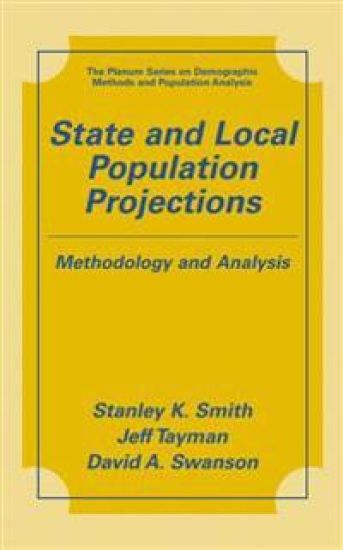
State and Local Population Projections

State and Local Population Projections

Stanley K. Smith; Jeff Tayman; David A. Swanson

Kluwer Academic/Plenum Publishers
2001
sidottu
The initial plans for this book sprang from a late-afternoon conversation in a hotel bar. All three authors were attending the 1996 meeting of the Population As- ciation of America in New Orleans. While nursing drinks and expounding on a variety of topics, we began talking about our current research projects. It so happened that all three of us had been entertaining the notion of writing a book on state and local population projections. Recognizing the enormity of the project for a single author, we quickly decided to collaborate. Had we not decided to work together, it is unlikely that this book ever would have been written. The last comprehensive treatment of state and local population projections was Don Pittenger’s excellent work Projecting State and Local Populations (1976). Many changes affecting the production of population projections have occurred since that time. Technological changes have led to vast increases in computing power, new data sources, the development of GIS, and the creation of the Internet. The procedures for applying a number of projection methods have changed considerably, and several completely new methods have been developed.
State and Local Population Projections

State and Local Population Projections

Stanley K. Smith; Jeff Tayman; David A. Swanson

Kluwer Academic/Plenum Publishers
2001
nidottu
The initial plans for this book sprang from a late-afternoon conversation in a hotel bar. All three authors were attending the 1996 meeting of the Population As- ciation of America in New Orleans. While nursing drinks and expounding on a variety of topics, we began talking about our current research projects. It so happened that all three of us had been entertaining the notion of writing a book on state and local population projections. Recognizing the enormity of the project for a single author, we quickly decided to collaborate. Had we not decided to work together, it is unlikely that this book ever would have been written. The last comprehensive treatment of state and local population projections was Don Pittenger’s excellent work Projecting State and Local Populations (1976). Many changes affecting the production of population projections have occurred since that time. Technological changes have led to vast increases in computing power, new data sources, the development of GIS, and the creation of the Internet. The procedures for applying a number of projection methods have changed considerably, and several completely new methods have been developed.